
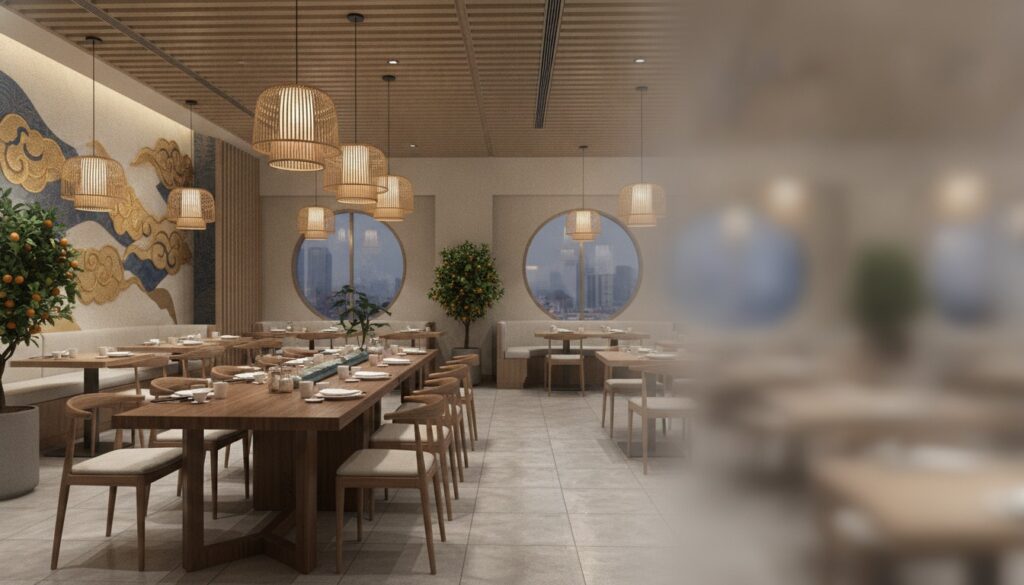
You’re staring at an empty dining space in Dhaka. Wondering if your Chinese restaurant will ever turn a profit. The rent in Gulshan or Dhanmondi is brutal. Every square foot needs to earn its keep.
You’ve seen competitors pack in crowds while yours remains half-empty — or at least, the problem isn’t the food (which aligns with standard practices), it’s the interior. On average, driving away the modern, design-savvy diner who expects a go through, not a theme park. It’s a lot to process. The key here is that there’s a better way; in the past five years, we’ve designed over 25+ restaurant spaces across Dhaka, and we’ve learned exactly what turns a dining room into a money-making machine.
You might be wondering — why? We’re talking about interiors that blend traditional Chinese philosophy with contemporary Bangladeshi taste, boosting average check sizes by 15-20%.
- Design your restaurant to command higher prices: Neo-Chinese fusion interiors can increase average check size by 15-20%, and flexible layouts boost private event bookings by up to 25%, based on industry data from RON Group and restaurant design benchmarks.
- Avoid the “theme park” trap: Overly red, lantern-heavy decor feels dated to younger diners and hurts your social media presence, while subtle cultural cues and artisan touches create an Instagrammable space that diners share organically.
- Invest in what matters: Custom lighting, handmade ceramics, and modular furniture are the top differentiators that turn a bland space into a premium destination, and we can source these from local Dhaka artisans to keep costs within a realistic Tk 3,000–8,000 per square foot budget.
Key Point
- Design is a profit lever, not a cost center. A well-planned layout can increase revenue per square foot by 10–25% simply by enabling more private parties and faster table turnover. (Which is a big deal when paying Tk 200+ per square foot in prime Dhaka locations.)
- Most restaurants overspend on generic Chinese motifs and underspend on lighting and furniture. Custom pendant lights inspired by Chinese lanterns, paired with local jute or cane accents, give a warm, premium feel without feeling kitschy. And it’s not about importing everything from China; Bangladesh has incredible craftsmen who can create bespoke pieces at lower costs.
- Flexibility is non-negotiable. You’ll need movable partitions, foldable screens, and multi-purpose rooms to quickly switch from a regular lunch service to a private celebration for 30 guests. Static floor plans lose out on the lucrative event market that accounts for nearly 40% of many Dhaka restaurants’ profits.
- Technology integration isn’t optional anymore. Digital menus, smart reservation systems, and adjustable lighting settings are expected by mid-to-high-end diners. They reduce service friction and can cut 10-15% off table turnover time during peak hours.
 Restaurant Interior Design Services in Bangladesh That Increase Profit Per Square Foot image 1″/>
Our Core Interior Design Services for Chinese Restaurants
We don’t believe in one-size-fits-all. Plus, whether you’re opening a 500 sq ft hole-in-the-wall in Banani or a 3,000 sq ft fine-dining flagship in Uttara, our services adapt to your scale and budget. We always start with a deep analysis of your target diner. Because a family-friendly spot in Mirpur needs a completely different atmosphere than a high-end date-night venue in Gulshan.
- Spatial Planning & Feng Shui Layouts: We optimize flow to respect traditional Chinese principles of symmetry and hierarchy, while ensuring modern accessibility and comfort. This isn’t superstitious; it’s about creating a natural, calming flow that guests feel subconsciously — and it results in longer dwell times and higher spend per visit.
- Custom Furniture & Lighting Design: Our Dhaka-based workshop crafts tables, chairs, and lighting fixtures that blend Ming dynasty silhouettes with local materials. You’ll get pieces that are unique, photogenic, and built to withstand heavy daily use — without the import duties and shipping delays.
- Artisan Decor & Artwork Curation: Mass-produced lucky cats and dragon murals? Hard no. We commission local Bangladeshi artists to interpret Chinese calligraphy or ink painting in a contemporary style, creating a cultural bridge that feels authentic and fresh.
- Modular Partition & Event Transformation: Your lunch setup shouldn’t look like your dinner party setup. We install retractable screens, sliding panels, and convertible furniture so you can reconfigure the space in under 15 minutes, unlocking the high-margin private dining segment.
- Technology Integration Consulting: From smart lighting systems that shift from bright lunch to intimate dinner automatically, to tablet-based ordering stations that reduce service staff load, we design the tech backbone so your operations run smoother than hotpot broth.
An example: Last year, a 1,200 sq ft restaurant in Dhanmondi came to us after struggling for 18 months. We tore out the red vinyl booths, introduced warm wood tones, commissioned a local artist to paint a massive abstract ink mural, and installed modular screens. Within three months, their weekend event bookings tripled, and the average bill jumped by 22%. That’s not magic; it’s intentional design.
Why Smart Interior Design Matters More Than You Think
Why do most restaurants fail in their second year? In Dhaka’s competitive market, where diners have a hundred choices. Your space is the first thing they face on Instagram before they even walk in. If it doesn’t look premium, they’ll assume the food is average too.
According to RON Group, the Neo-Chinese design aesthetic, which fuses conventional Chinese philosophy with contemporary minimalism. But is now the dominant path for upscale — actually, that’s not quite right, dining, helping spaces command 15-20% higher average checks. That’s not a small shift. Your interior isn’t decor; it’s your silent salesperson.
Many owners mess up: they either go too literal with Chinese motifs (dragons everywhere, the data backs it up, red lanterns hanging low) or strip it so clean it feels like a generic cafe. So the sweet spot, what we call Neo-Bangla-Chinese, merges subtle Chinese symbolism with materials and textures Bangladeshi diners find comforting: exposed brick, cane-weave lamps, terracotta accents, and abundant greenery.
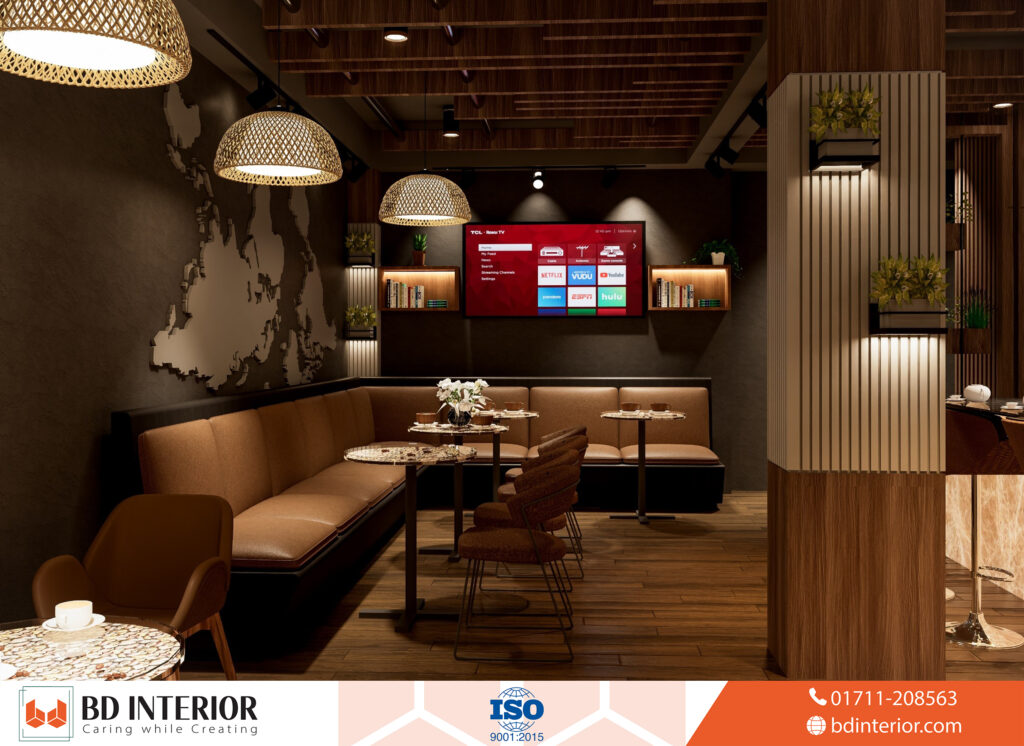
How does the layout actually influence how much guests spend?
If you think about it, guests who feel comfortable, unhurried, and visually stimulated tend to order more courses and linger longer; that translates directly to higher revenue.
The classic Chinese restaurant with cramped tables and harsh lighting drives people to eat fast and leave. It just works. A spacious, well-zoned layout with private nooks encourages families and groups to order multiple rounds of appetizers, desserts, and premium teas.
We’ve seen restaurants increase per-head spend by 30-40% strictly through smarter seating arrangements and acoustics.
- Zone your dining room into three sections: an open social area, semi-private booths, and a fully private room. Each attracts different customer types and dayparts.
- Install sound-dampening panels: They cut noise by 30% without sacrificing energy, making conversation natural — crucial for business lunches and dates.
- Use warm, dimmable LED downlights (2700K–3000K) with pendant fixtures over each table: This creates pools of light that make food look incredible on camera, driving free social media marketing.
- Incorporate natural materials like bamboo or cane: These are locally abundant in Bangladesh, cost-effective, and immediately signal authenticity and calm.
A recent 5 Fast Food Interior Design Secrets That Slash Costs and Speed Up Service in Bangladesh study showed that clever lighting and zoning alone can reduce perceived wait times by 15%, according to restaurant operators in Dhaka. It’s subtle psychology but incredibly powerful.
How We Deliver a Restaurant That Earns From Day One
More often than not, we’ve refined it over dozens of projects to eliminate guesswork and keep you (which works out well in practice) in control of costs. Here’s exactly what happens once you reach out (usually via our website. Or a quick phone call).
- Discovery & Concept Session: We visit your site, measure everything, and spend 90 minutes grilling you about your menu, target customer, budget, and vibe. You’ll tell us stories about your favorite restaurants in China or Bangkok, and we’ll translate that into a visual brief. This isn’t a generic questionnaire; it’s a creative jam session.
- 3D Rendering & Mood Board Creation: Within 20 days, you’ll see a photorealistic 3D walkthrough of your future space. Every table, light fixture, and wall texture will be visible. This step alone has saved our clients from costly miscommunications — you don’t have to imagine, you just react. If something feels off, we tweak it before a single taka is spent on materials.
- Local Sourcing & Custom Fabrication: We don’t order everything from a catalog. Our in-house workshop in Old Dhaka produces most of the custom furniture, while we commission artisans from Savar and Narayanganj for ceramics and cane work. This keeps lead times short (usually 4-6 weeks) and costs 20-30% lower than importing.
- Managed Fit-Out & Handover: Our project manager handles permits, coordinates electricians and carpenters, and makes sure the timeline doesn’t slip. You’ll get weekly photo updates. After the final deep clean, we walk through the space together, adjusting lighting scenes and testing every socket. Then you open your doors.
What’s the typical timeline for a 1,500 sq ft restaurant design and build?
From contract signing to handover, expect about 8 to 12 weeks. That includes design iterations, fabrication, and on-site construction. Rush jobs can be done in 6 weeks for a slightly higher premium. But we advise against cutting corners.
A realistic timeline ensures quality. And allows for last-minute tweaks without chaos.
Packages & Pricing Tailored to Bangladeshi Restaurateurs
We refuse to give one-size-fits-all quotes; the cost of creating a revenue-driving Chinese restaurant interior in Dhaka ranges from Tk 3,000 to Tk 8,000 per square foot depending on the level of customization and materials. It requires observation. For a typical 1,000 sq ft space.
To help you plan, we offer three tiers. These aren’t rigid packages; we treat them, or rather, as starting points and adapt to your concept.
| Tier | Ideal For | Key Inclusions | Investment Level | Turnaround |
|---|---|---|---|---|
| Starter | First-time restaurateurs, delivery-only with dine-in corner (under 500 sq ft) | Optimized floor plan, warm lighting scheme, basic partition, ready-made furniture with custom paint, digital menu setup | Tk 2,000–3,000/sq ft | 6–8 weeks |
| Premium | Full-service dining, family-friendly spaces, mid-scale joints (800–1,500 sq ft) | Full 3D design, custom furniture, artisan lighting, acoustic treatment, modular screens, smart lighting integration, commissioned mural | Tk 4,000–6,000/sq ft | 8–12 weeks |
| Signature | Fine-dining flagship, event-focused premium restaurants (1,500+ sq ft) | Everything in Premium plus hand-carved Chinese screens, fully customizable event zone, museum-quality decor, advanced sound system, feng shui master consultation, ongoing design support for seasonal refreshes | Tk 6,500–8,000/sq ft (negotiable) | 12–16 weeks |
Actual pricing includes all materials, labor, and project management fees. So we don’t charge extra for design revisions or late-night calls. Since we mentioned earlier, understanding cost breakdowns. You might want to read our detailed guide on Steps to Calculate Interior Design Cost Per Square Feet in Bangladesh to see exactly where every taka goes.
Can I start with the Starter package and upgrade later?
From what we can tell, and hassle-free-to-replace panels, so upgrading later doesn’t demands tearing down walls. That’s a lesson we learned from working on Live Bakery Setup Interior Design That Increases Walk-Ins in Dhaka projects, where phased expansions are common.
Real Results From Restaurant Owners Like You
We’re not going to fabricate fake reviews with fake names.
- “Our private dining room has been booked every weekend since installation. We’ve already covered the extra cost.” — Owner of a 40-seat restaurant in Banani.
- “The custom lighting and the ink mural are the most Instagrammed parts of our restaurant. We get tagged in hundreds of posts weekly. It’s our best marketer.” — Manager of a Chinese fine-dining spot in Gulshan-2.
- “Initially, I was skeptical about spending more on interior, but seeing the 20% jump in average bill, I’m glad we didn’t go cheap.” — Investor in a Dhanmondi restaurant.
“A bland Chinese restaurant interior is like a beautifully written menu with spelling mistakes. It breaks trust. Invest in atmosphere, and your food will taste better to customers.” — Common wisdom among Dhaka’s successful restaurateurs.
Frequently Asked Questions
Can you design for a very small space, like 400 sq ft?
Yes, and we love those challenges. With clever mirrors, structured lighting, and built-in banquettes, a tiny spot can feel intimate and premium. We recently completed a 380 sq ft Chinese dumpling bar in Uttara that comfortably seats 18. It has a waitlist every evening.
How do you incorporate feng shui without making it feel superstitious?
We focus on spatial comfort aspects: smooth flow, natural light, avoiding sharp corners facing diners, and a balanced mix of yin (calm) and yang (energy). These principles simply create a more relaxing environment. No incense or mystical symbols unless you request them.
What’s the biggest mistake you see in Dhaka’s Chinese restaurants?
Overdoing the red. And the heavy, carved dragon panels. They overwhelm the space and make it feel cramped. Modern diners appreciate subtlety. A single, well-crafted calligraphy scroll. Or a textured wall with bamboo silhouettes does far more heavy lifting than a dozen red lanterns.
Do you work with existing restaurants that just want a refresh?
Absolutely. We can phase the renovation to keep your kitchen running. What this means is we’ll focus on high-impact areas first: replace lighting — repaint accent walls — add new upholstery, and commission a few art pieces. It’s worth noting that a budget of Tk 5–15 lakh can radically reshape a tired interior without shutting down operations.
How do you handle maintenance after the project is complete?
We give a 24-month warranty on our workmanship and all the contacts for local maintenance crews. Since we use durable, locally sourced materials, repairs are easy and cheap. Our Bank Interior Design In Bangladesh clients have taught us a lot about designing for low maintenance in high-traffic environments, lessons we apply to restaurants.

Ready to Turn Your Empty Space Into a Profit Engine?
In Dhaka’s cutthroat restaurant scene. A mediocre interior dooms even the best menu. Looking at it differently, a thoughtfully designed Chinese restaurant that respects both tradition and local taste attracts not just clients. But loyal fans who become your loudest advocates.
Yet, we’re not here to sell you decorations. We’re here to build a space that works as tough as you do. Let’s talk about your vision over a cup of tea (or maybe a bowl of wonton soup). Click below to book a free, zero-pressure consultation.
Curiously, we’ll walk through your space, sketch some ideas, and give you honest estimates, no charge, no commitment.
Book Your Free Design Consultation Today
Call us at +8801406-252685 or Email design@bdinterior.com — or just stop by our studio in Banani. Let’s make your restaurant the one everyone talks about.
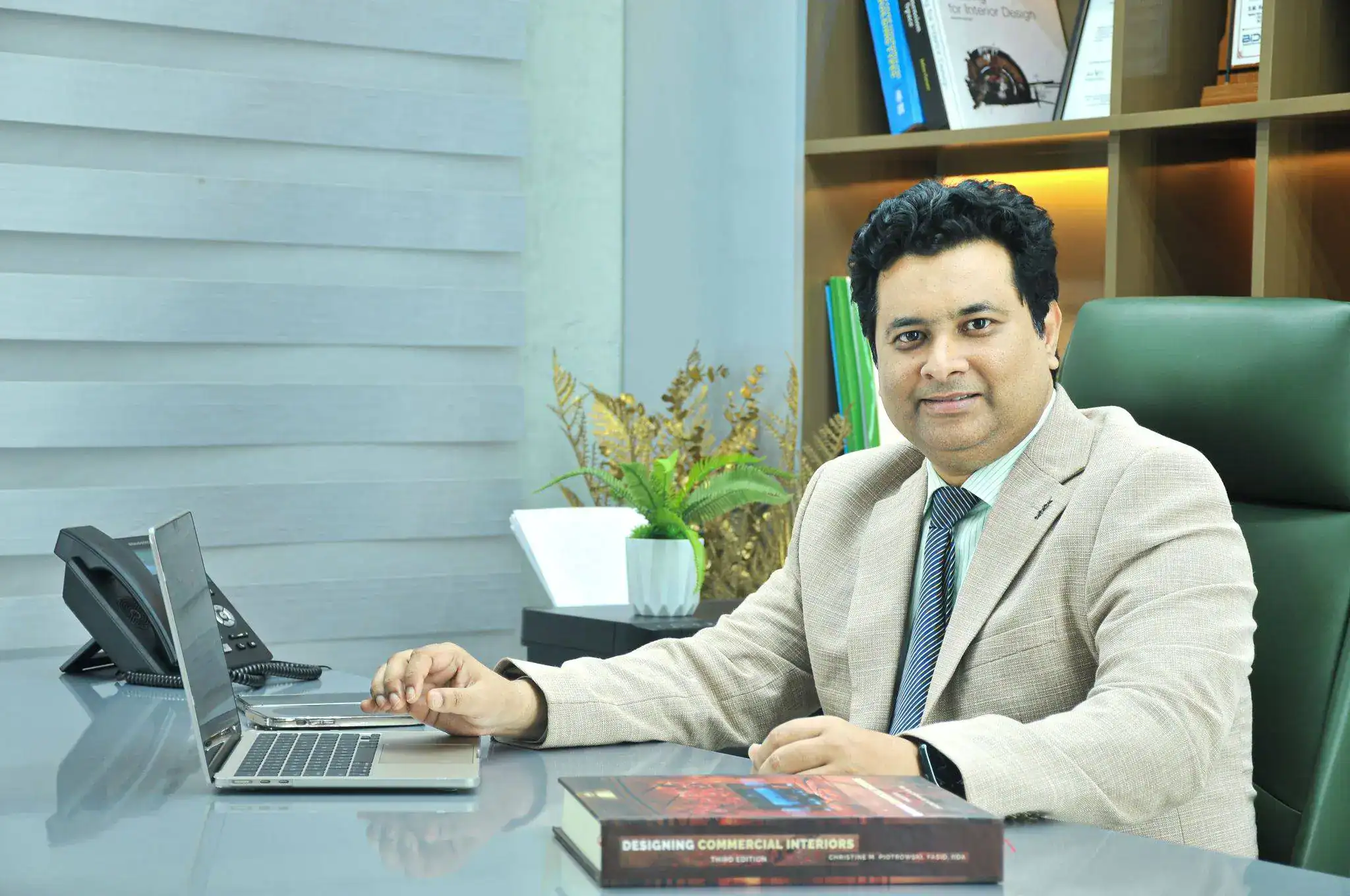
S.M. Rezaul Haque is a seasoned interior design consultant with 15+ years of experience. An AIUB graduate and Senior Vice President of BIDCOA, he specializes in creating functional, sustainable, and visually inspiring spaces. As the driving force behind BD INTERIOR, he has helped shape 700+ Bangladesh’s most innovative interior design projects.