
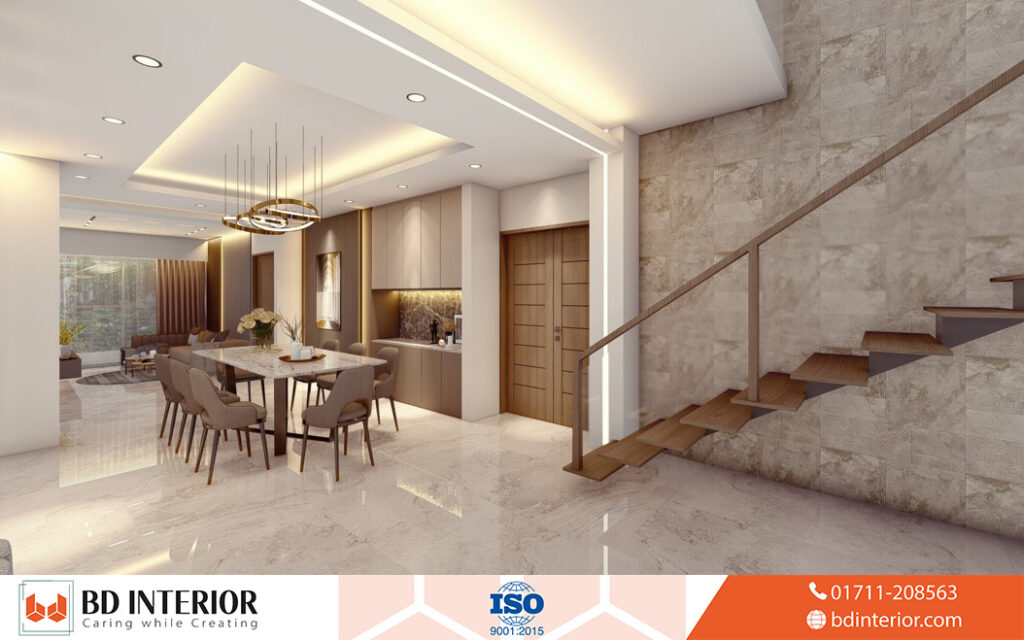
You’ve probably scrolled past dozens of interiors that all seem the same. Neutral palettes, straight lines. That vaguely cold, hotel-lobby feel. Modern contemporary interior design faces intense skepticism.
The real thing isn’t about stripping personality. It’s about editing with a scalpel, not a sledgehammer.
- Modern contemporary interior design blends tactile minimalism, hidden tech, and broken-plan layouts to create airy, clutter-free zones that actually feel livable.
- It thrives on a strict 70% neutrals / 20% wood and stone / 10% bold accent ratio, floor-to-ceiling windows covering 30–45% of walls, and circadian lighting.
- You can pull this off in a Dhaka apartment without a fortune if you know which shortcuts matter and which disasters to dodge.
Key Point
- Space isn’t about square feet; it’s about the illusion of openness. A north-facing Gulshan flat feels twice its size with the right reflective surfaces and glass partitions.
- Dark, matte kitchen counters will reflect every oily fingerprint, and the fishbowl effect of oversized windows will make your neighbors your new interior critics if you don’t plan privacy layers.
- The single most overlooked mistake: prioritizing Instagram-worthy hard angles over soft textiles. A room without rugs, drapes, or nubby throws becomes an echo chamber, not a sanctuary.
- True contemporary design in Bangladesh works best when you adapt to the climate. Use local hardwoods, handloom cotton, and terracotta accents alongside sleek lines to keep the look rooted rather than robotically international.
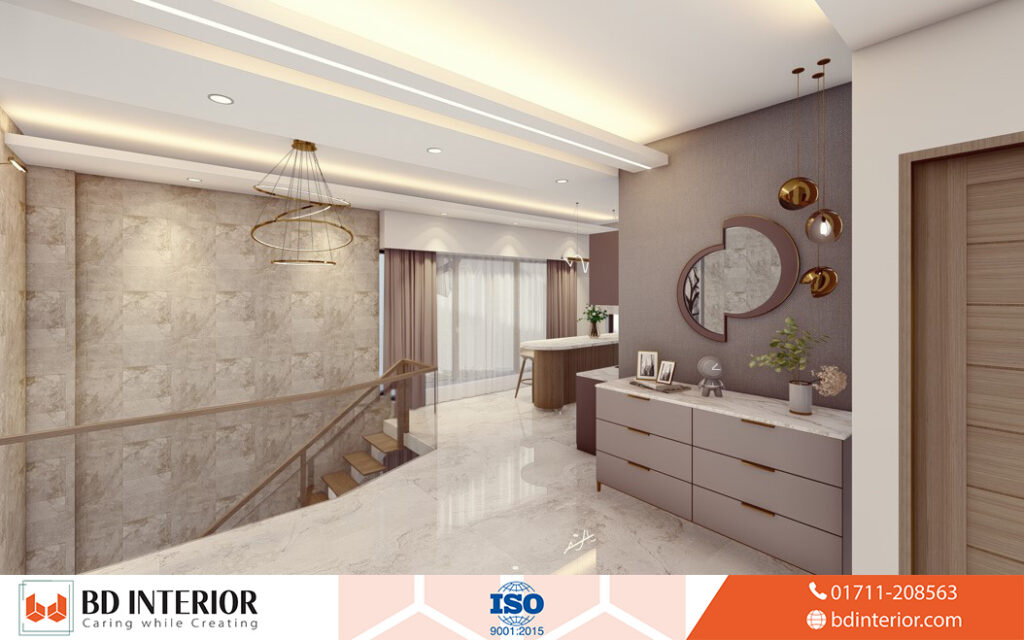
What Exactly Is Modern Contemporary Interior Design?
Circling back for a moment, put simply, modern contemporary interior design is a living, breathing reflection of now. From a practical standpoint, it borrows the clean bones of midcentury modernism but wraps them in textures you want to touch, boucle, raw timber, limewash walls, and tech that mostly stays invisible.
It’s not a fixed-period style like Art Deco. It evolves. Right now, that means broken-plan layouts — furniture made from recycled composites. To some extent.
And lighting systems that shift color temperature with the sun. According to Architectural Digest. The window-to-wall ratio in normal contemporary builds sits between 30% and something like 45%. That’s a lot of glass.
And it’s there to (at least based on current observations) dissolve the line between inside. Outside, even if your outside is a crowded Dhanmondi balcony, because the (at least based on current observations) aesthetic moved on.
Why does contemporary design feel so different from 2010s minimalism?
Switching focus for a On top of that, it’s simple. The old minimalism was reductive to the point of hostility.
Empty rooms, hard edges, no personality. Today’s approach layers in warmth without clutter, and you’ll see a sculptural rattan chair- to be more precise, a chair that’s 3D-printed- or a concrete wall softened by a giant handwoven kantha throw. The wood isn’t without fail pale oak. Sometimes it’s black-stained mahogany that brings drama.
It’s minimalism with a heartbeat.
“Modernity today is about the intersection of high-tech efficiency and high-touch materials.”
— Architectural lead quoted in industry discussions
How Do You Actually Pull Off This Look in a Dhaka Apartment?
Alright, you’re staring at a 1,200-square-foot flat with a load-bearing column right in the middle. Start with the 70/20/10 color rule: 70% off-whites and soft greys for walls and large furniture, 20% natural wood. Hard to ignore those numbers and stone (maybe a teak credenza or a terrazzo coffee table), and 10% a bold accent like a mustard yellow armchair or a deep indigo rug. This ratio instantly anchors the space.
Then tackle lightly. Bangladeshi homes often have small windows to block heat, and let me tell you, invest in sheer, reflective roller blinds that cut glare but keep the room bright. Hang a large mirror opposite the main window, anecdotally. Clients report that their rooms feel about 30% larger.
That’s a significant gap. Though practical limits do exist.
What about the furniture? Go multifunctional. I once sourced a slim console that unfolded into a six-seater dining table for (at least in quite a few practical scenarios) a Mirpur apartment. That kind of stealth flexibility is key.
Won’t all those hard surfaces make my home echo like a hall?
You bet they will, if you skip the soft stuff, and concrete floors and bare walls bounce sound like crazy. The fix is low-tech: thick area rugs. Cork wall panels behind your sofa, and heavy cotton curtains. Not only do they kill the echo, but they also add the tactile- wait, let me rephrase- layer that makes the whole design feel intentional, not just shiny.
“The focus has shifted from a specific ‘look’ to a feeling of wellness and quiet luxury.”
— Interior design consensus, as reported in industry outlets
Now, let’s get real about the money and the maintenance. Because nobody tells you how dusty those matte black faucets get.
Is the Investment Worth It for Bangladeshi Homeowners?
I’ve seen the regret. A family in Bashundhara dropped serious taka on a glossy Italian kitchen island only to discover that Dhaka’s humidity left water marks. The cost of high-end finishes in this style can range from 2500 to 6000 BDT per square foot (global average). And in Dhaka, premium custom cabinetry drives up budgets.
Resale value gets a boost. Clean lines and neutral backdrops appeal to almost every buyer, so it’s a smart long game if you don’t shoot yourself in the foot with impractical choices.
Sustainability isn’t a buzzword here; it’s survival. Many homeowners now demand low-VOC paints and furniture made from recycled composites. I’ve guided clients toward local artisans who build sleek daybeds (at least based on current observations) from reclaimed jackfruit wood.
This keeps the carbon footprint low and the look authentic. For a deeper, specifically eco-friendly choices. Our guide on sustainable interior design breaks down the materials.
What’s the biggest mistake people make with this style?
The number one error: forgetting that a home must support a life. Not just look awesome for a 60-second reel. What this means is that sculptural chair may feel like a medieval torture device after 20 minutes, test (as one might expect) furniture for comfort before buying. Also, avoid the “all-neutral everything” trap.
Without those 10% bold accents, the room flatlines.
Here’s something nobody talks about in the glossy magazines: privacy. You could say, curiously, or simply sheer curtains that let light through but blur prying eyes. Getting the space element right includes sightlines and privacy zones.
- Declutter ruthlessly first — remove 50% of your current decor to see the bones of the room.
- Paint walls a warm off-white — such as Benjamin Moore’s Simply White or a local equivalent.
- Add three texture sources — a wool rug, linen curtains, and a boucle armchair work instantly.
- Install layered lighting — combine overhead, task, and an ambient floor lamp on a dimmer.
- Test one bold accent piece — an emerald green ottoman or a large abstract canvas with deep blue tones.
People Also Ask
How is modern design different from contemporary design?
Modern design refers to a specific historical movement (mid-20th century) with known rules. Arguably, right now, that means softer edges, more curves, and tech integration.
What colors work best for a modern contemporary home?
About 70% neutral base (whites, greiges, warm taupes), 20% natural wood and stone hues, and 10% striking accent. The data speak for themselves. Think sage green, burnt sienna. Or deep teal for that pop.
Can I mix vintage furniture with contemporary pieces?
Absolutely. A 1960s teak sideboard against a smooth limewash wall adds soul. The contrast between old. And new is exactly what keeps the room (as one might expect) from feeling like a catalog.
Does this style work in very small apartments?
Yes, maybe even better. The emphasis on multipurpose furniture and visual lightness makes a 600-square-foot studio feel expansive. Just avoid dark floors and heavy drapes.
How do I maintain the look without it feeling cold?
Add layers: a chunky knit throw, a gallery wall of personal photos in sleek black frames, and a few live plants. The greenery breaks the visual monotony and oxygenates the room.
Final Word
Modern contemporary interior design isn’t about chasing trends that die in six months. It’s about curating a backdrop so quiet that your life becomes the main event. In a busy city like Dhaka, that sanctuary matters more than ever. Start with one room.
Swap out the clutter for a single beautiful texture. See how it breathes. You might just truly find a whole new way of living.

S.M. Rezaul Haque is a seasoned interior design consultant with 15+ years of experience. An AIUB graduate and Senior Vice President of BIDCOA, he specializes in creating functional, sustainable, and visually inspiring spaces. As the driving force behind BD INTERIOR, he has helped shape 700+ Bangladesh’s most innovative interior design projects.