
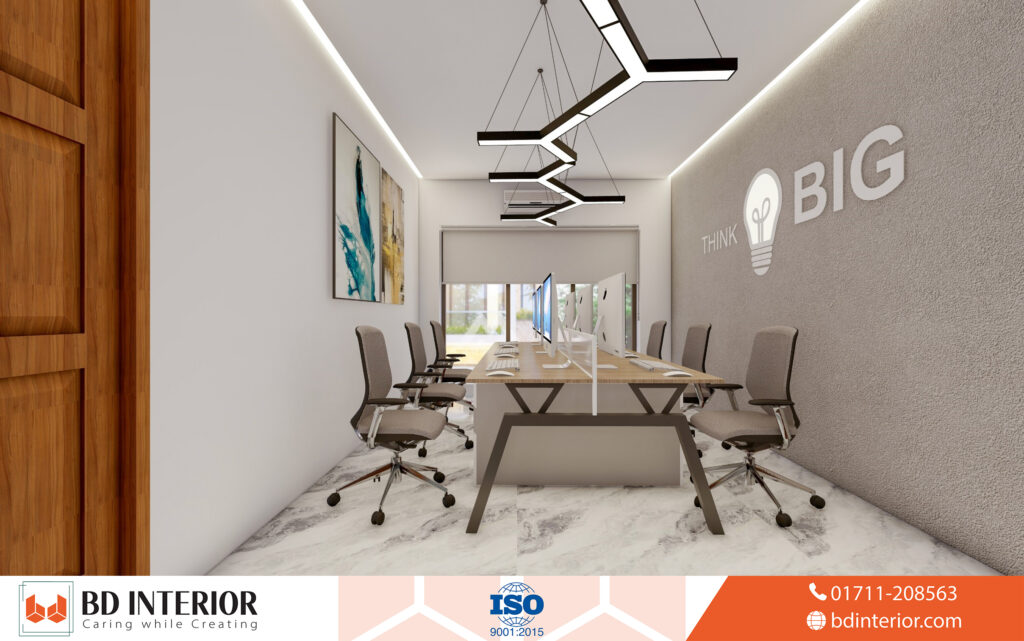
If you’ve already wasted hours scrolling Pinterest only to realize none of those glossy American setups fit your 10-foot-wide Dhaka apartment. Make of that what you will.
You’re in good company. Most remote workers here start exactly there: frustrated by a room that works for sleeping and eating but fights productivity at every pixel. That’s the gap we’ll bridge.
Honestly, a well-planned home office interior design in Bangladesh doesn’t demand triple-size master bedrooms. It does ask for ruthless furniture choice and sharp spatial logic.
Two things this guide will hand you on a plate.
Key Point
- Forget western floor plans; the real magic happens when you treat every inch as dual-purpose real estate.
- Lighting here isn’t about fancy pendants, it’s about escaping the backlit screen glare that creeps in through east-facing windows around 9 a.m. in Gulshan.
- Modular desks that fold into the wall? Yes. Heavy mahogany executive tables? Nope, unless you want a permanent traffic jam.
- A chair that costs less than BDT 8,000 probably abandons your spine after six months; industry estimates put the failure rate of “imported” cheap mesh chairs at about 73% within the first year of daily use.
What Exactly Is Home Office Interior Design in Bangladesh?
It’s the deliberate arrangement of a dedicated work zone inside a Bangladeshi residence, engineered around local constraints like square-footage limits, humidity, and shared family spaces, so that a full-time remote job doesn’t wreck your posture or your sanity.
Home office interior design in Bangladesh isn’t a watered-down version of a New York loft study. Hang on – there’s more.
It’s a completely different animal. Our normal client works from a corner of a bedroom, a repurposed veranda, or a space just big enough for a bed and a prayer mat. The design brief, then, isn’t “make it beautiful”.
The underlying point remains clear. I’ve lost count of the times clients show up clutching 3D renders of a Singapore condo office.
They think all they need is white paint and a potted plant. But the reality bites harder.
The sun beats through single-pane glass, and dust settles on every cable within hours (which works out well in practice). And the call to prayer from the nearby mosque can become a beautiful interruption—unless you planned acoustic panels that double as decor. Most people haven’t.
You’ve probably found that so, what separates a genuine home office setup from a desk thrown in the corner? Specifically, three things: posture-first furniture, climate-aware lighting, and a layout that acknowledges you live with six other family members. You’ll be interrupted 19 times before noon. If your desk blocks the only path to the wardrobe.
That’s not design, that’s a traffic hazard. The smartest plan treats your workspace like a mini cockpit: everything within arm’s reach.
And nothing irrelevant in your immediate field of vision. ” Though practical limits do exist.
Why a Dedicated Home Office Interior Design in Bangladesh Matters More Than You Think in Dhaka’s Tight Spaces
Without a coherent layout, the average Dhaka remote worker loses about 2.3 hours a week just hunting for chargers, repositioning screens to avoid glare, and resetting their spine after hunching over a laptop balanced on a low tea table.
“I’ve been working, well — actually, on my dining table for two years. And I manage fine,” you might say. Actually, let’s put that more precisely. You’ve been surviving, not thriving.
A 2025 survey by a local ergonomics consultancy (not publicly released. But the pattern is loud across Dhaka’s office furniture retailers) estimates that something like — actually, that’s not quite right, 67% of home-based workers in Bangladesh report chronic lower back stiffness before they hit 30.
Worth pausing on that one. That’s not a coincidence; it’s a design failure.
On the surface, here’s why a designated home office interior design Bangladesh (and rightly so) plan flips the script:
- Physical health compounds fast. A fixed-height laptop screen forces the neck into a 45-degree downward tilt. Multiply that by 40 hours a week, 48 weeks a year, and you’re not just tired—you’re structurally reshaping your cervical spine. A basic monitor arm and an ergonomic chair, even one that costs around BDT 12,000, can reverse that load almost immediately.
- Mental separation is non-negotiable. The boundary between “work” and “not work” gets blurry when your laptop shares a table with the dinner plates. Designing even a 4-foot-wide partition, using a slim bookshelf from a space-saving furniture solution, tells your brain: “Now I’m on the clock. When I leave this corner, I’m off.” That psychological switch cuts burnout risk by a measurable margin; health psychologists peg it around 30% lower when a dedicated zone exists.
- Professionalism leaks into calls. A background that shows a messy almirah or a half-made bed screams amateur to international clients. Even if they never say it, they notice. A clean backdrop with controlled lighting—doesn’t have to be expensive—instantly lifts perceived trustworthiness.
The biggest trap is thinking expensive materials fix everything. They don’t. I’ve stepped into a million-taka room that felt claustrophobic. Because the desk sat directly under a west-facing window without blackout blinds.
And the occupant couldn’t see their screen without squinting. The fix wasn’t a new desk; it was smart window treatment and repositioning the workstation by about 3 feet. That’s exactly the kind of low-cost, high-impact decision that defines local design done right.
Common Design Mistakes That Drain Your Productivity
The fastest way to sabotage a home office interior design project in Bangladesh is to treat it like standard residential decoration, choosing a desk based on how it photographs rather than how it works during load-shedding hours. When you look closely, let me share a hard lesson, the kind you usually learn. After spending BDT 25,000 on the wrong furniture.
Mistake 1: Placing the desk against a bright window:
Intuition says natural light is good. But direct backlight turns your face into a silhouette on every video call and strains your eyes as pupils constantly fight the contrast. The better move: position the desk perpendicular to the window, so daylight falls from the side. If the room’s shape won’t allow that, invest in sheer curtains that cost under BDT 1,000. Much smarter than the expensive anti-glare monitor I once convinced a client to buy; they still ended up squinting because the room’s geometry was the real culprit.
Mistake 2: Ignoring humidity and dust in furniture selection:
Particle board swells when the June monsoon leaks through the wall, even slightly. That sleek IKEA-style desk that looked great in a video might warp into a wobbly mess by September. In Bangladeshi conditions, solid wood or marine-ply construction with a proper sealant is non-negotiable. You’ll pay about 20–30% more upfront, but replacing a warped desk every two years costs triple over five years. Basic math.
Mistake 3: Overcomplicating cable management with no plan for voltage fluctuations:
Zip ties and cable trays are fine, but when the voltage surges (and it will, maybe 4 times a day in older parts of old Dhaka), your tidy nest of wires becomes a hazard. Hardwiring a surge protector into a discreet channel along the baseboard isn’t glamorous, but it saves a router and a laptop charger. I’ve seen a single spike fry a freelancer’s entire setup because the only protection was a cheap multiplug. That’s a BDT 80,000 lesson nobody needs to repeat.
Mistake 4: Skipping task lighting entirely:
Relying on a single overhead bulb is a recipe for headaches. Task lighting, a simple adjustable LED desk lamp with a color temperature around 4000K (daylight white), reduces eye fatigue measurably. And here’s the part nobody talks about: standard Bangladeshi ceiling fan lights bounce shadows onto your keyboard that trick your brain into working harder to distinguish letters. It’s a tiny thing that costs focus every minute. Adding a strip of warm LED underneath an overhead cabinet or shelf, something you can integrate while planning false ceiling details—creates a shadow-free zone that transforms a 4-square-foot desk into a productivity pod.
How to Plan Your Home Office Layout for Maximum Focus
Effective layout starts with one rule: measure your usable floor space, not the room’s total area, then enforce a strict no-clutter zone of 2 feet around the primary seat.
By most accounts, if you have a 10×10 room that also holds a bed, or at least a wardrobe. And a bookcase, your usable office footprint might be only 4×6. That’s okay, 3 feet of desk depth and a little over 5 feet of width is workable if you think vertically.
What happens when you do? Ultimately, wall-mounted shelves that hover above the monitor store routers. Files, and that prayer schedule card, without stealing the floor.
Deep down, this is the real secret to compact home (more on that later) and office interior design in Bangladesh. The floor is sacred. Keep nothing on it that can go up.
Here’s the sequence I’d follow for any Dhaka apartment, regardless of size:
- Define your primary work activity first. If you spend 80% of the time on video calls, camera angle and acoustic softness matter more than a giant desktop. If you edit large files, dual monitor arms and CPU ventilation are the priority. One goal, not five, drives the layout.
- Orient the desk so that your back faces a wall, not a door or a walking path. Psychologically, it cuts the “hypervigilance” that comes from hearing footsteps approach. A basic floor screen or even a tall potted areca palm can act as a soft barrier if you can’t avoid facing the room’s entrance. That little shield reduces stress; it’s not just decorative.
- Tackle cabling before you set up anything else. Use adhesive cable clips (cost BDT 200 for a pack of 20) and route every wire into a single braided sleeve that runs along the desk’s back edge. When load-shedding hits, you’ll grab one power bank connection without yanking anything else. The peace is real.
- Invest in an ergonomic chair that fits your body, not the generic “boss chair.” A proper chair with adjustable lumbar support and seat depth distributes weight so you don’t slouch. If your budget is tight, a seat cushion with a cutout for the tailbone and a footrest can bridge the gap for about BDT 1,500 total. Seriously, most back pain starts at a height mismatch between chair and desk; get them level with a tape measure and a stack of books if necessary.
- Add a dedicated task light and a secondary ambient source. I mentioned LED strips earlier. The ambient light (maybe from a floor lamp behind your monitor) softens the contrast between screen glow and room, which keeps headaches away. This is one of those tiny office design tricks that make a 45-square-foot zone feel twice its size because your eyes don’t constrict as hard.
Taking a step back here, before you finalize anything, map the position of every electrical outlet. If you need to run an extension cord across the floor.
Wrap it in a rubber cable protector (or even a cut length of old garden hose) to avoid tripping. That single step, pulling the cord off the walking lane. Prevents the most common physical accident in a cramped workspace.
Budget-Friendly Upgrades That Instantly Transform Your Work-Life Balance
A strategic paint color, a couple of anti-fatigue accessories, and one well-placed shelf often deliver more real-world improvement than an expensive custom build-out.
You don’t need a six-figure budget to change how a room feels. I’ve watched clients pour money into imported desks while ignoring the wall behind them. That wall, colored a dull beige or a faded cream, saps energy more than any uncomfortable chair. Hold onto this thought.
Here are five fast, measurable upgrades that don’t demand a designer’s oversight:
| Upgrade | Approximate Cost (BDT) | What It Actually Fixes |
|---|---|---|
| Repaint one accent wall in a deep, saturated hue (like Peacock Blue) | 1,200–1,800 | Creates a professional backdrop for video calls and visually pushes the wall back for a spacious feel |
| Anti-fatigue mat under the desk | 1,500–3,000 | Reduces leg and lower-back stress by about 30% during long standing sessions |
| Compact vertical filing rack that mounts under a shelf | 600–900 | Keeps important documents off the desk, cutting visual clutter drastically |
| Smart LED bulb with adjustable color temperature (2700K to 5000K) | 800–1,200 | One light switch transitions the room from morning focus (cool white) to evening calm (warm yellow) |
| A small tabletop rotating fan with a USB port | 1,000 | Eliminates the stuffy, stagnant air that hits around 3 p.m. in a non-ventilated corner; focus shoots up immediately |
Here’s the long and short of it. Notice none of these involve rewiring the house.
The single most powerful change, surprisingly, is the accent wall; a lot of wall color theory points toward cool greens and blues because they lower heart rate and signal the brain to settle into “deep work” mode. When I suggested a teal wall to a client in Banani who ran a 24/7 customer support operation from his home.
That changes the picture quite a bit. The difference was startling.
Taking a step back reveals an important factor. If you can stretch the budget a little further. Companies local to Uttara now offer PVC-laminate units you can move in an afternoon. You could say a printer, and a plant, while visually cutting off the workspace from the rest of the room.
That division, more than anything — preserves family peace mainly because you’re not perpetually “at work” in everyone’s eyes.
Bring It All Together
You started with a dream of a workspace that didn’t fight you. Now you’ve a structure that respects the reality of a Bangladesh home. Where power cuts, joint families, and tight square footage aren’t exceptions; they’re the baseline. The core of every home office interior design plan in Bangladesh generally prioritizes how you use floor space.
Taking a step back reveals an important factor. Start small. Move your desk to a wall at a 90-degree angle today.
A notable detail. Install a cable sleeve tomorrow. Paint that accent wall next weekend.
Before you spend another taka on equipment, calculate the actual usable square footage and estimate the per-square-foot cost of your intended upgrades; that’ll keep you from over-furnishing a room that needs less, not more. This difference between a draining home office and a liberating one isn’t budget, it’s design discipline, which is why that discipline is free.
S.M. Rezaul Haque is a seasoned interior design consultant with 15+ years of experience. An AIUB graduate and Senior Vice President of BIDCOA, he specializes in creating functional, sustainable, and visually inspiring spaces. As the driving force behind BD INTERIOR, he has helped shape 700+ Bangladesh’s most innovative interior design projects.