
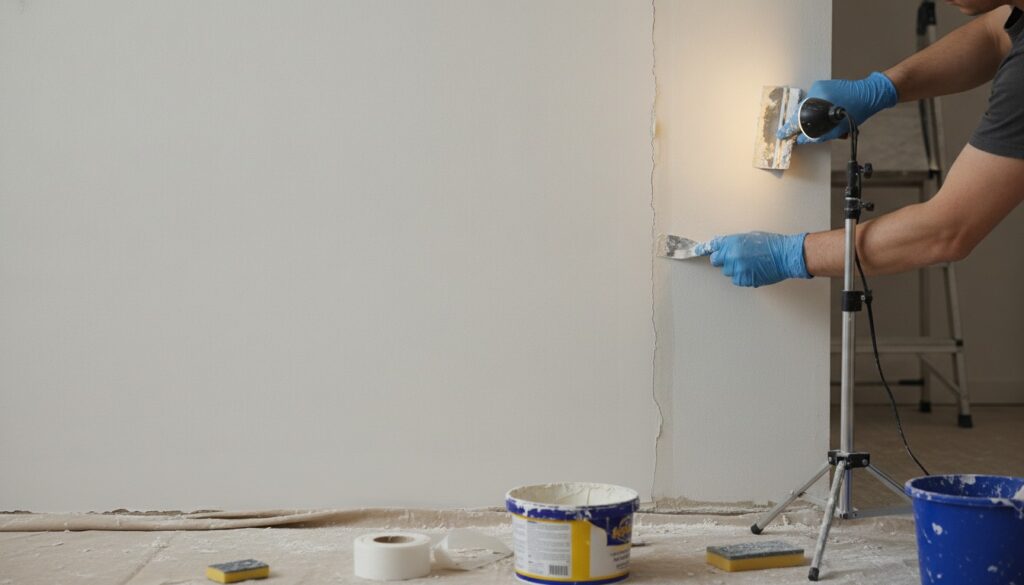
Every time you sit on the couch. Generally speaking, it appeared right after the last monsoon rains; now you’re probably assuming that bringing in a professional mistri to patch it up will set you back at least BDT 3,000. You can easily tackle this repair over a single weekend without spending a fortune.
- For minor hairline fractures measuring under 5mm, applying a flexible compound like Berger Crack Fill paired with 180-grit sandpaper delivers a seamless finish that resists reopening.
- Deep gaps require structural backing; you should slice a piece of scrap cardboard slightly larger than the opening, thread a support string through its center, and pull it taut against the inner wall before packing the hole.
- Skipping the surface prep or the primer coat accounts for roughly 90% of adhesion failures; always clean the area first with sugar soap or rubbing alcohol.
Key Point
- High humidity levels in Dhaka apartments rapidly degrade interior plaster; any gap wider than 5mm usually points to water entry that you must seal before patching the wall surface.
- Doing this work yourself keeps BDT 3,000 to BDT 5,000 in your wallet; additionally, you pick up a practical home maintenance skill for future paint touch-ups.
What You’ll Need
Probably take a rapid inventory of what you already have at home. You can find almost everything else on this list at any neighborhood hardware shop in Mirpur or New Market.
- Tools: A pair of putty knives (a narrow 2-inch and a wider 4-inch work best), a utility knife, a sanding block, some 180-grit sandpaper, a small paint roller, and a standard paintbrush.
- Materials: Flexible spackle for thin cracks, specialized patching plaster for deep cavities, a small piece of stiff cardboard, sugar soap, a tin of wall primer, and matching interior emulsion paint.
- Time: Budget about 3 to 4 hours of actual labor spread across Saturday and Sunday; you will spend most of this time waiting for the filler to dry.
Step 1: Assess and Prepare the Surface
Assessing the damage first dictates your entire approach. Thin hairline cracks under 5mm take nothing more than a quick skim coat of flexible filler. What happens when you do? Plus, then again, if you’re staring at a deep hole wider than your fist, you must build a solid backing patch.
Putting that aside for now, still, don’t even think about patching the wall until you find. And fix the source of the dampness. In reality, if you ignore that leaky overhead pipe or outer wall seepage. The plaster will start bubbling again within six months.
- Clear your workspace by pushing your furniture at least two feet away from the wall; cover the floor with a plastic drop cloth. In a cramped Dhaka apartment, this usually means piling everything against the opposite wall.
- Clean the cracked area thoroughly using sugar soap dissolved in warm water. Scrub it with a stiff sponge and wipe it down with a clean, damp cloth; this step cuts through the greasy film and dust that otherwise prevents the filler from bonding.
- Use your utility knife to widen the crack slightly, cutting away loose, flaky plaster to create clean, beveled edges. This technique gives the fresh compound a clean structural groove to lock into.
Step 2: Fill Cracks and Patch Holes
For small cracks, the process is incredibly clear. Larger holes, then again, require a solid backing to support the weight of the new plaster. Without a backer, your wet plaster will simply fall behind the wall cavity.
Using a breeze homemade cardboard anchor supplies immediate structural stability; it’s a reliable trick that saves you from replacing a whole section of plaster.
Should I use spackle or joint compound for hairline cracks?
For thin cracks, a premium flexible spackle is almost always the superior choice. The thing is, while professionals use joint compound for taping large drywall seams, it shrinks too much when used as a standalone filler.
- For thin cracks: press the flexible filler deep into the gap using your 2-inch putty knife. Hold the blade at a 45-degree angle and scrape away the excess compound so the patch sits flush with the plaster.
- For deep holes: cut a piece of stiff cardboard so it is roughly 2 cm wider than the hole itself. Thread a piece of string through a small hole in the middle, tie a thick knot on one side, and slide the cardboard flat through the wall opening. Pull the string tight to hold the cardboard firmly against the backside of the plaster.
- Apply your patching plaster in two thin, separate coats. Spread the first layer over your cardboard backing; let it sit for about 30 minutes before scratching light cross-hatch lines into the surface with your putty knife. These grooves give your final coat a strong physical grip.
- Apply the second coat of plaster, spreading it slightly beyond the edges of the hole to blend it with the wall. Let the patch dry completely.
- Let the filler cure according to the instructions on the packaging; this usually takes 1 to 2 hours on warm days, though high humidity will double that time.
Step 3: Sand, Prime, and Finish
Sanding levels the dry patch so it blends with the rest of the wall. Priming seals the raw, thirsty filler — or, better put, so it doesn’t drink up your paint. If you paint directly over unprimed filler, you’ll end up with dull. Blotchy spots that remain visible even after the paint dries.
Why is priming so critical before painting?
It all goes back to that earlier idea: raw filler absorbs liquid much faster than old, sealed paint. Primer blocks this absorption; it prevents patchy, flat spots and noticeable color differences. If you skip this step, you will easily waste three coats of expensive paint trying to hide the repair. Of course, actual metrics may shift.
- Once your patched area is completely dry, wrap some 180-grit sandpaper around a sanding block. Work in gentle, circular motions until the entire repair feels level with the wall surface. Run your bare palm over the spot; if you cannot feel the seam, the surface is ready.
- Wipe away all the fine drywall dust using a damp microfiber cloth and wait for the surface to dry.
- Brush a thin coat of primer directly over the patched areas. Let this dry for about 30 minutes before opening your paint can.
- Apply two thin coats of high-quality interior emulsion over the repaired area; local options like Berger Easy Clean or Asian Paints Royale work beautifully. Use a small roller for the main wall area and a paintbrush to cut in near the edges.
This reminds me of a rental apartment I repaired near Dhanmondi. Following some heavy monsoon water seepage, I rushed the prep work and applied only one thick layer of plaster. Sure enough, the behind-the-scenes crack tore right back through the fresh paint within two months.
Troubleshooting Common Mistakes
In practice, the dynamic changes slightly. Even with careful planning, things do not always go perfectly on the first try. Here is how you can handle the most common wall repair blunders.
- The filler shrinks and cracks after you paint. This happens because the compound was still wet inside, or you applied it too thickly. Sand the area flat, apply a paper-thin skim coat, let it dry for a full 24 hours, then prime and paint again.
- You can still see the outline of the patch. You failed to feather the edges of the plaster or skipped the priming step. Sand the borders of the patch to create a gradual slope, apply a fresh coat of primer, and repaint.
- A brand new crack forms right next to your repair. The structural foundation of the house is still settling. Scrape out the hard plaster and use a flexible product like Berger Crack Fill to absorb the wall movement.
- The paint starts bubbling right over the patch. Moisture is trapped inside the wall. Scrape off the peeling paint, let the damp plaster dry out completely, and seal the area with a specialized sealer before repainting.
What to Do Next
Now that your interior walls look smooth and clean, you might, you know what, want to pick a color scheme that opens up the room. Our guide on wall color design secrets reveals exactly.
Which tones work best with the natural light we pick up in Dhaka? If you recently fixed a damp spot. Take a look at your exterior balcony walls for cracks.
In practice, the moving changes slightly. A single tube of exterior silicone sealer costs only about BDT 150. Applying it now will save you from, you know what, major plaster damage during the next heavy monsoon.
- Inspect the wall thoroughly — note crack widths, moisture stains, and loose plaster so you buy the right materials.
- Wash with sugar soap — removes grease and dust; skipping it is the #1 cause of filler failure.
- Apply filler in thin layers — build up gradually, scraping flush each time to avoid sanding nightmares.
- Sand with 180-grit — work circularly, then run your hand over the area and a light across to catch uneven spots.
- Prime before painting — seals the patch and guarantees uniform colour; one coat of primer beats three coats of paint.
People Also Ask
How long does wall repair take?
Consider this practical perspective. Budget roughly 6 to 8 hours of total time spread across a weekend. High humidity levels in Bangladesh will slow down drying times. Deep plaster patches often require a full 24 hours of curing time before you can safely start sanding.
What is the cheapest way to fix large wall holes?
Making a simple backing patch out of scrap cardboard is the most budget-friendly solution. This classic method offers a much stronger base than thin mesh tape for holes wider than 5 cm, and on top of that, it saves you from buying expensive drywall sheets.
Can I use cement to fill cracks in plaster walls?
Standard cement is a poor choice. Because it shrinks as it cures and fails to bond with established plaster. Instead, you should use a gypsum-based patching plaster. Now, it expands marginally as it dries, locking itself into the clean edges of the crack.
Do I need to sand between coats of filler?
In most scenarios, yes, running your sanding block lightly over the first coat removes small ridges. And helps the next layer stick. Make sure to wipe away any fine powder with a damp cloth. Before applying your final skim coat.
How do I prevent hairline cracks from coming back?
Keep in mind what we talked about earlier; the underlying point remains direct. You can stop these recurring cracks by using an elastomeric flexible filler. And fixing any underlying moisture leaks.
Because many local buildings are constructed on soft alluvial soil. Minor settling is inevitable; flexible compounds bend with it rather than snap. At least, that outlines the core theory.
Is it worth repairing the wall myself or hiring a contractor?
Handling minor plaster repairs yourself will easily save you some money. However, if you spot a diagonal crack wider than your finger. It is in general. You should consult a structural engineer rather than a hassle-free painter.

S.M. Rezaul Haque is a seasoned interior design consultant with 15+ years of experience. An AIUB graduate and Senior Vice President of BIDCOA, he specializes in creating functional, sustainable, and visually inspiring spaces. As the driving force behind BD INTERIOR, he has helped shape 700+ Bangladesh’s most innovative interior design projects.