
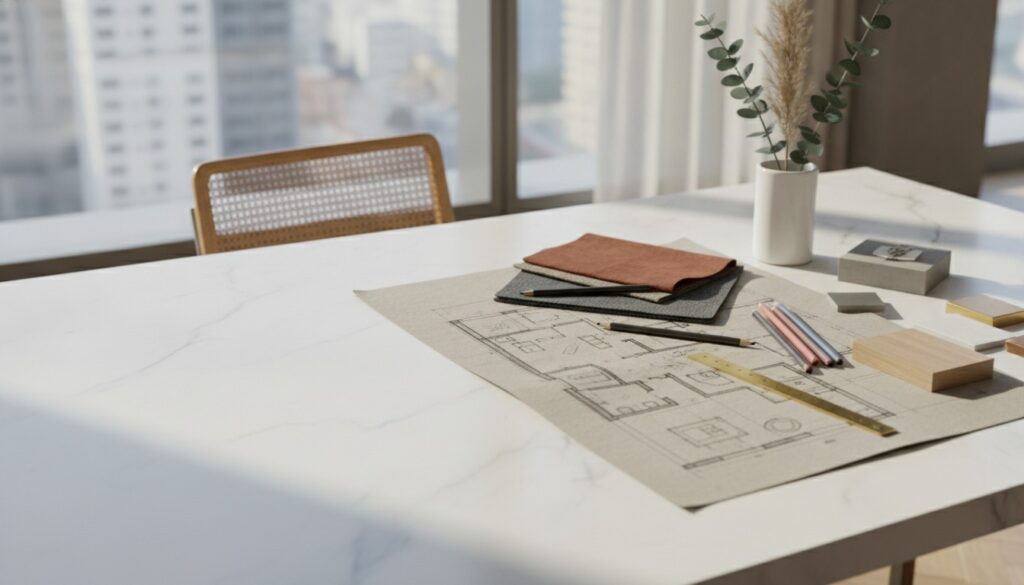
Among all elements of interior design, space is the one you can’t ignore — it dictates how you move, (at least based on current observations) breathe, and live. In Bangladesh’s compact city flats, where every square foot counts. Understanding spatial layout separates a cramped box from a functional home. This checklist breaks down exactly what to do.
Step by step, so you master it like a seasoned designer.
- Balance positive (occupied) and negative (empty) space at a 60-40 ratio, and keep 24–30 inches of clearance around primary furniture for real-world flow.
- Use the 60-30-10 color rule to ground the space, and layer ambient, task, and accent lighting so the room works from morning to night.
- Repeat dominant shapes and textures throughout the room, and don’t skip vertical lines — tall elements make a space feel stable rather than chaotic.
What is Space in Interior Design?
Space is the three-dimensional area defined by length, width, and height: the total volume available for furniture, movement, and living. From what we can tell, the art is balanced — let me put it differently: the room feels inviting, not cluttered or cold.
Who This Checklist Is For
Probably aspiring designers building their first residential projects, and anyone tired of their room feeling ‘off’ without knowing why. If you’ve ever walked into a living room and felt cramped, or into a bedroom that felt lifeless, this is your fix.
How to Use It
Work through the checklist in order. Each item starts with a concrete action. Followed by a speedy ‘why this matters’ line so you understand the logic. Skip items at your own risk; they build on each other.
Foundational Space Planning
Before arranging a single piece of furniture. You need tricky numbers and a clear map. Start by treating your room as a volume, not a floor plan.
How do I start measuring my room like a pro?
First, ignore the urge to eyeball it. Plus, grab a laser measure (or a good old tape measure) and record the length, width, and ceiling height to the nearest inch. Those three numbers, for everything else.
- Measure the room’s length, width, and ceiling height exactly.
- Why this matters: Height often gets forgotten, yet it’s what makes a room feel airy or oppressive; a 9-foot ceiling in a Dhaka apartment feels vastly different from a 7-foot one.
- Mark all door swings, window placements, and electrical outlets on a rough sketch.
- Why this matters: You’ll avoid the classic blunder of placing a sofa that blocks a door or a mirror that reflects a blank wall.
- Identify the primary positive space zone (the area you’ll occupy most with furniture).
- Why this matters: Without naming this zone, you’ll scatter pieces randomly; focused positive space creates purpose.
- Reserve at least 40% of the floor as negative space.
- Why this matters: Industry data from Furnish & Finish suggests a 60-40 positive-to-negative ratio keeps a room visually comfortable, not empty.
- Test the layout with painter’s tape on the floor before buying furniture.
- Why this matters: In Bangladesh’s tight spaces, a trial run saves you the agony of returning a massive sofa that doesn’t fit.
Now, you might think vertical space is wasted. If you’ve got a normal Dhaka apartment with low ceilings. But actually, tall bookshelves or floor-to-ceiling curtains pull the eye up.
Making the room feel larger. That’s a trick tons of local interiors miss.
Designing for Flow and Movement
Once the zones are set. Your next job is to make sure most of us can walk through easily. Nobody wants to squeeze sideways past a dining table every morning.
Why does the ‘wiggle room’ clearance matter so much?
Without it, your family fights the space daily. Probably 24 inches in front of sofas; that’s the “wiggle room” needed for a comfortable stride, not a shimmy.
- Leave at least 24 inches of walking path in front of sofas and coffee tables.
- Why this matters: City Furniture highlights that 24 inches is the minimum for a natural gait; less and you’ll subconsciously avoid the area.
- Keep 30 inches behind dining chairs (from table edge to wall or next piece).
- Why this matters: When someone pushes back to stand, that clearance stops chairs from hitting walls and prevents the “trapped” feeling.
- Ensure a clear 3-foot-wide primary circulation path from entry to main zones.
- Why this matters: In Bangladesh homes where guests enter directly into the living room, a bottleneck path kills the first impression.
- Align furniture edges with architectural lines (walls, windows) rather than angling randomly.
- Why this matters: Angled pieces look chaotic unless they serve a defined purpose; straight alignment calms the eye.
- Check that no drawer or cabinet door blocks a pathway when opened.
- Why this matters: You’ll be shocked how often a fully extended drawer turns a walkway into an obstacle course.
If you think about it. A Dhaka family that hosts frequent iftar — or rather, gatherings asks for wider paths than a single person. So tweak the numbers; just don’t drop below 18 inches anywhere.
Visual Harmony and Proportion
By most, space feels right when things look like they belong together. Plus, that’s where scale, color distribution, and rhythm come in.
Can I break the 60-30-10 rule if I want a bold look?
In many cases, the rule says close to 60% dominant color (walls), at least 30% secondary (furniture), and 10% accent (accessories). Breaking it increases visual noise; do it intentionally, not out of ignorance.
- Apply the 60-30-10 color distribution across the room.
- Why this matters: Joya Architects notes this ratio grounds a space; otherwise, your eye bounces around with no rest point.
- Repeat one dominant shape (e.g., a curve from a rug) in at least two other smaller objects.
- Why this matters: Flooring America emphasizes that a repeated form creates harmony; without it, the room feels like a flea market.
- Use at least one tall element — a bookshelf, floor lamp, or drapes — to draw the eye upward.
- Why this matters: Vertical lines bring stability and formality; an 8-foot shelf makes a low ceiling feel intentional, not oppressive.
- Check that the largest rug covers at least 60% of the floor area in the seating zone.
- Why this matters: A tiny rug under a big sofa looks like a postage stamp, disrupting proportion; a larger one anchors the room.
- Avoid mixing more than three distinct textures without a unifying theme.
- Why this matters: Too many textures create visual noise; rough wood, smooth glass, and a soft textile feel balanced; add shiny metal and it tips over.
Keep in mind what we talked about earlier: you probably know someone who bought an oversized sofa for a small Dhaka living room; the room now feels like a storage unit, and that’s a scale fail. Actually, that’s more common than you’d think. Because showrooms distort perception. Take measurements and photos before you buy.
Negative 40%
Lighting and Texture to Elevate Space
More often, the element that makes every other design choice visible. Consider this: without layered light, your carefully planned space flattens into a dull box.
How many light sources do I actually need in one room?
At least three distinct sources: ambient (overall glow), task (reading, cooking), and accent (highlighting art or texture). Two is survivable; one is depressing.
- Install ambient lighting that covers the whole room without harsh shadows.
- Why this matters: Ceiling fixtures alone rarely do it; consider cove lighting or wall-mounted sconces for a soft wash.
- Add at least one task light per functional zone (desk, kitchen counter, reading chair).
- Why this matters: Without directed light, you’ll strain your eyes; a clamp-on LED in a cramped workspace changes everything.
- Use accent light to draw attention to texture — backlight a stone wall or a textured fabric panel.
- Why this matters: According to City Furniture, light is the only element that makes texture “shine”; skip it and the rough wood feels flat.
- Blend rough textures (wood, jute, brick) with smooth ones (glass, metal, polished cotton) in a 2:1 ratio.
- Why this matters: Two rough to one smooth keeps the room tactile without feeling like a construction site; jute carpets common in Bangladesh pair beautifully with sleek glass tabletops.
- Test lighting at morning, noon, and evening before finalizing placement.
- Why this matters: Bangladesh daylight is intense; a west-facing window may wash out a TV screen, forcing a rework of task layouts.
Remember what we said earlier about vertical lines? This means that it is backlit by soft LED strips and can double the perceived height, a godsend.
Final Review
If you skip everything else, do these—more accurately, they anchor the whole space. File that away. You’ll see why it matters in a bit.
- Keep the 60-40 positive/negative ratio; it’s your single biggest lever against clutter.
- Maintain 24–30 inches of clearance so the room stays livable, not a museum.
- Apply the 60-30-10 color rule before mixing in wild accents.
- Layer ambient, task, and accent light — one ceiling bulb is a rookie mistake.
- Repeat one shape in at least two places; it’s the cheapest way to look professionally designed.
- Measure your room’s three dimensions — write them in your phone notes immediately.
- Tape the layout — yes, literally use masking tape to mark positive zones and walking paths on the floor.
- Audit your furniture — remove one piece that violates the 24-inch path and breathe.
- Pick your dominant color — match it to the largest wall or floor and stick to 60%.
- Add a task light — any zone where you read, cook, or work must have its own directed light.

S.M. Rezaul Haque is a seasoned interior design consultant with 15+ years of experience. An AIUB graduate and Senior Vice President of BIDCOA, he specializes in creating functional, sustainable, and visually inspiring spaces. As the driving force behind BD INTERIOR, he has helped shape 700+ Bangladesh’s most innovative interior design projects.