
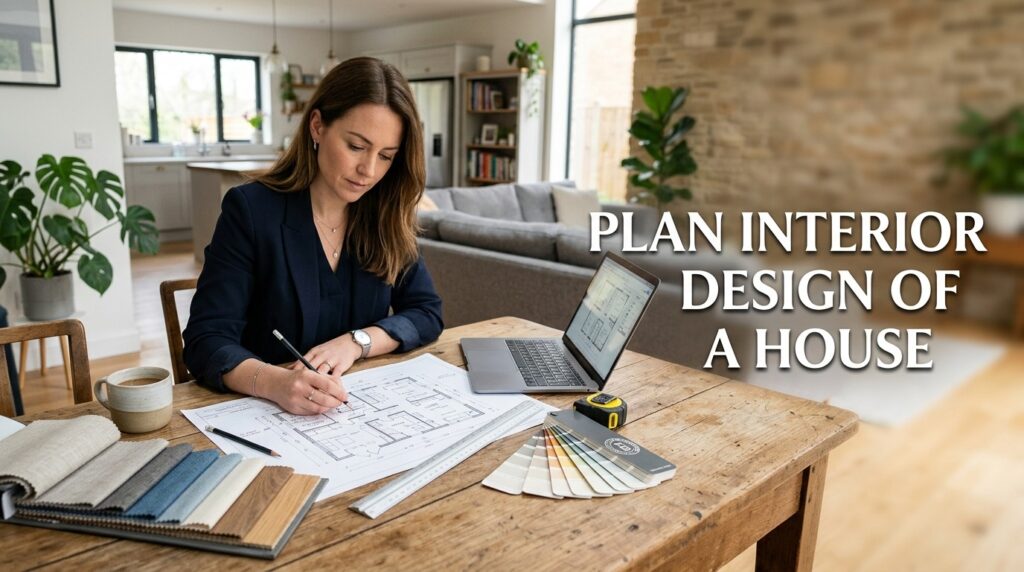
Plonking down money on a sofa set. Before you’ve measured your living room is a surefire way to end up with a cramped, mismatched disaster, yet that’s what roughly 7 out of 10 new homeowners I talk to in Dhaka do; they jump straight to buying. Then regret the layout later. The result?
From what we can tell, the key is here. Thinking about it more, is that a well-planned interior doesn’t just look good. It cuts stress, saves money, and can push resale value up by about 10% through cohesive aesthetic updates.
Worth pausing on that one. It makes a difference. Nine times out of ten. Here’s how to plan the interior design of a house practically.
No-nonsense way, customized for Bangladeshi flat sizes, weather, and budgets. Hold onto this thought.
The short version:
- Start with a precise floor plan; knowing your room’s exact dimensions saves you from buying furniture that won’t fit through the door.
- Apply the 60-30-10 color rule for a balanced palette, and test paint samples under both LED and daylight before committing.
- Plan layered lighting, traffic flow, and high-touch finishes early to avoid costly electrical and layout changes down the line.
Key Point
- If you’re skimming, here’s what actually matters:
- Front-loading heavy furniture without a floor plan makes a room feel 30% smaller.
- The 60-30-10 rule saves you from the all-beige trap and from wild accent overload that cheapens the look.
- Budget first, then shop. Otherwise you’ll fall in love with a 2‑lakh sofa and forget you still need a kitchen.
What You’ll Need to Plan Your Interior Design
A handful of tools and a realistic mindset are all you need to start mapping out your house interior design plan.
You won’t need fancy degrees; grab a 25‑foot measuring tape, graph paper or a floor plan app like Roomstyler or MagicPlan, and a Pinterest board for mood collection.
Worth pausing on that one. In general, a color swatch deck from a local paint brand like Robbialac is okay. More accurately, Berger Paints, a budget calculator, and (and the data generally agrees) about three or four weekends, so where does that leave us? This works even if you’re a complete beginner.
Prerequisites in a Nutshell
- Measuring tape (25 ft), longer than the longest wall you’ll measure.
- Graph paper/floor plan app Roomstyler works offline, handy during load‑shedding.
- Digital mood board, Pinterest, or an app like Morpholio Board to collage actual product photos.
- Paint swatches and get a booklet from any hardware store near Bashundhara City.
- Budget sheet: keep it on your phone so you can update costs instantly.
- Lighting calculator: aim for 5,000–10,000 lumens in kitchen task areas.
Step 1: Measure Every Room and Draw a Floor Plan
Pull out a tape and measure each wall, window, door, and outlet location. The secret to a livable layout is knowing the exact dimensions before you buy a single rug.
Still, even in a 900‑sq‑ft Uttara flat. A few centimetres can turn a walkway from comfortable to claustrophobic.
Yet, start by sketching the room’s footprint on graph paper, and let me tell you. Mark every wall length in inches and centimetres, mostly since Bangladeshi furniture is constantly sold in both units. Well, this changes how tall a wardrobe can be.
Wait, there’s more to it. Unusual, but true. Draw the swing arcs of doors and windows, and then measure the width of the main door itself. Quite a few large sofas get stuck in 30‑inch doorways.
Naturally, leave at least 36 inches of clearance for walkways behind dining chairs and between the sofa and the TV unit.
Now, if your flat’s got that awkward L-shaped living room. You’ll need a creative layout; our guide on fixing an awkward room layout shows some clever tricks. Tape out the furniture footprint on your floor with painter’s tape. After you draft the plan, that’s when you’ll notice if the couch blocks the balcony door.
Step 2: Set a Budget in BDT and Stick to It
Determine your total spend by calculating the cost per square foot for a standard 1,000‑1,200 sq ft Dhaka flat, usually running between ৳1,500 and ৳3,500 per sq ft for mid‑range finishes.
This range covers basic civil work, lighting, and decent furniture, but you’ll want to be precise.
Under normal conditions, break your budget into three buckets. Around 50% for furniture (sofas, beds, dining sets). What this means is something like 20% for finishes.
Tiles, false ceiling, and 30% for labour and installation. Hard to ignore those numbers, so in Gulshan or Dhanmondi. Labour can be higher, so adjust. Always add about a 15% contingency. Hidden costs like extra wiring for a kitchen island pop up faster than you think (it implies quite a bit).
Step 3: Choose a Cohesive Color Palette
Anchor your room with a dominant wall color (more or less 60%), layer a secondary hue for large furniture (approximately 30%), and sprinkle accents of a bold color (10%) to create depth without chaos.
The 60‑30‑10 rule is one of the rare interior design rules that work in any Dhaka flat, whether you’re going for a modern white‑grey look or a warmer terracotta palette. Select your dominant colour first. Usually a neutral like soft beige.
Or light grey for walls. As it turns out, then choose a secondary colour for sofas, curtains, and rugs. In Bangladesh, deep navy. Or olive green holds up well against dust.
Rounding it out, add accents through cushion covers. Artworks, or a single statement chair. In the store’s halogen glow, paint looks totally different under Bangladeshi LED lights than.
Why does paint look different at home than in the showroom?
Paint pigments shift under different lighting ranges.
You’ll see how this ties into the previous point. Showrooms regularly use warm, 3000K bulbs that flatter colours. While your home might be lit with cool 6500K LEDs that make beige look greenish.
Also, our interior design paint colours guide walks you through testing like a pro… One more thing: humidity causes mould in bathrooms, so choose a scrubbable satin finish there, not flat.
Step 4: Design Your Lighting in Layers
Combine three types: ambient (overhead fixtures), task (under‑cabinet or reading lamps), and accent (spotlights on art) to make every room functional and inviting.
Now, in a Dhaka flat. Where load‑shedding is a daily reality, lighting planning also means backup integration. Start with ambient light. One central ceiling fixture per room, preferably dimmable. The evidence is there: for kitchens, hit 5,000‑10,000 lumens over the counter.
That’s about two 18‑watt LED panels for a 100‑sq‑ft kitchen. The key here is to add task lights. A swing‑arm wall lamp by the sofa for reading, under‑cabinet (depending entirely on the context) strips in the kitchen.
Last thing, add accent lights: a picture light over a family photograph.
Or a small spotlight on a bookshelf. Our guide on false ceiling design in Bangladesh shows how to hide LED strips inside a false ceiling for an ambient glow.
How do I plan lighting when load‑shedding is frequent?
Install a small 650VA UPS dedicated to essential LED circuits.
That way, your ambient and task lights stay on for an hour while the AC shuts off. Also choose rechargeable table lamps with built‑in batteries; they’re a lifesaver in Mirpur and Old Dhaka.
Step 5: Arrange Furniture for Flow and Function
Place your largest piece. Keep at least 36‑inch clear walkways, and follow the front‑legs‑on‑rug rule for sofas and chairs to anchor the room.
People regularly shove a massive sofa against one wall. And wonder why the room feels like a tunnel.
For the average user, shifting gears a bit, after deciding the sofa’s position, measure the coffee table height; it should be- wait- which is why let me rephrase- 1- 2 inches lower (a detail a lot overlooked) than your sofa seat height. Which is about 18‑19 inches for most Bangladeshi sofas. This is where it gets practical, and for dining, a standard seat height of 18 inches and a table height of 30 inches work for most. Not exactly what you’d expect. The rug should be large enough that at least the front legs of all seating pieces rest on it. Our perfect living room rug guide helps you nail the size.
Don’t buy a matching 7‑piece sofa set from one store. Mix a neutral sofa from Hatil. Or ISHO with accent chairs from Bohu. Or Aarong’s cane collection for a collected, personal feel.
Step 6: Select Finishes and Hardware Before You Paint
Pick faucets, handles, cabinet hardware, and curtain rods early; these high‑touch details define the quality feel of your home and dictate your overall design direction.
The wrong finish can throw off a room more than a slightly wrong wall colour.
Pretty much, go for brass, matte black, or brushed nickel, whatever matches your vision. And invest in all drawer pulls, door handles, and plumbing fixtures at once. And otherwise, you’ll end up with polished chrome kitchen taps.
Brushed nickel door handles that clash. ” Once you’ve samples.
Naturally, upload them to a digital mood board with real product photos. This approach, covered in depth in how to Visualize Interior Design Before Renovating, prevents the panic buying that leaves you with mismatched accessories.
Troubleshooting: Common Interior Design Mistakes and How to Fix Them
Here’s how to reverse them even after you’ve started.
- You bought a full living set from a showroom. Break it apart. Move one armchair to the bedroom, swap the center table for an artisan jute ottoman from a local boutique. It’s cheaper than replacing everything.
- Not enough electrical outlets near sofas and islands: if walls are already painted, use floor‑rated extension boards with cable raceways painted to match your wall. Next time, plan one outlet every 4 feet.
- Paint looks cold under LED. Laminate a warm‑toned fabric panel behind the TV unit or add amber glass pendants; the reflected light warms the whole room.
- Ignored storage in an open floor plan. Install full‑height slim cabinets (only 12 inches deep) along one wall. They’re a godsend in Dhaka flats where every inch counts.
People Also Ask
What order should I design my house rooms?
Start with the room you use most, usually the living room, and finalize its layout and colour before moving to bedrooms. Then again, you’ll learn what materials and contractors actually cost, and you won’t repeat mistakes across six rooms.
How much does interior design cost per square foot in Bangladesh?
Expect ৳1,500–3,500 per sq ft for a full mid‑range setup including civil work, furniture, and lighting. Luxury finishes push it above ৳5,000.
Is it necessary to hire an interior designer in Dhaka?
Not if your layout is straightforward and you enjoy researching. For complex kitchen remodels or full‑apartment rewiring. A local professional can save close to 20% in wasted expenses by (which completely makes sense logically) avoiding ordering mistakes. Use our guide to find a trustworthy designer.
What’s the biggest mistake first‑time homeowners make in Bangladesh?
Ignoring ventilation and humidity in material choices. They pick a gorgeous wall panel that warps in the monsoon. Always check the material’s humidity rating before installing.
Why do so many Dhaka flats look cluttered?
Because storage isn’t planned as part of the design. A 1,000‑sq‑ft flat needs roughly 80‑100 cubic feet of built‑in storage. Custom wardrobes under ceiling‑height alcoves free up floor space dramatically.
What to Do Next: You’ve got the plan, which is why the next move isn’t to rush to Bashundhara City. It’s to secure your measurements and craft a mood board.
- Measure every room, and also every doorway, today. Write the numbers in your phone.
- Build a mood board, save 10‑20 images of rooms you love, then narrow them to one cohesive style.
- Set a total budget, using the per‑sq‑ft range and our cost guide. Add the 15% buffer.
- Buy paint samples, three shades for each room and paint 2‑ft squares on different walls.
- Visit showrooms with a list, take your mood board and floor plan; do not deviate from the list.
- Hire a local pro if stuck, consult a Bangladesh‑based interior designer to review your plan before ordering big items. Our [how‑to‑find‑a‑designer article](https://bdinterior.com/how-to-find-interior-designer-in-bangladesh/) makes it painless.

S.M. Rezaul Haque is a seasoned interior design consultant with 15+ years of experience. An AIUB graduate and Senior Vice President of BIDCOA, he specializes in creating functional, sustainable, and visually inspiring spaces. As the driving force behind BD INTERIOR, he has helped shape 700+ Bangladesh’s most innovative interior design projects.