
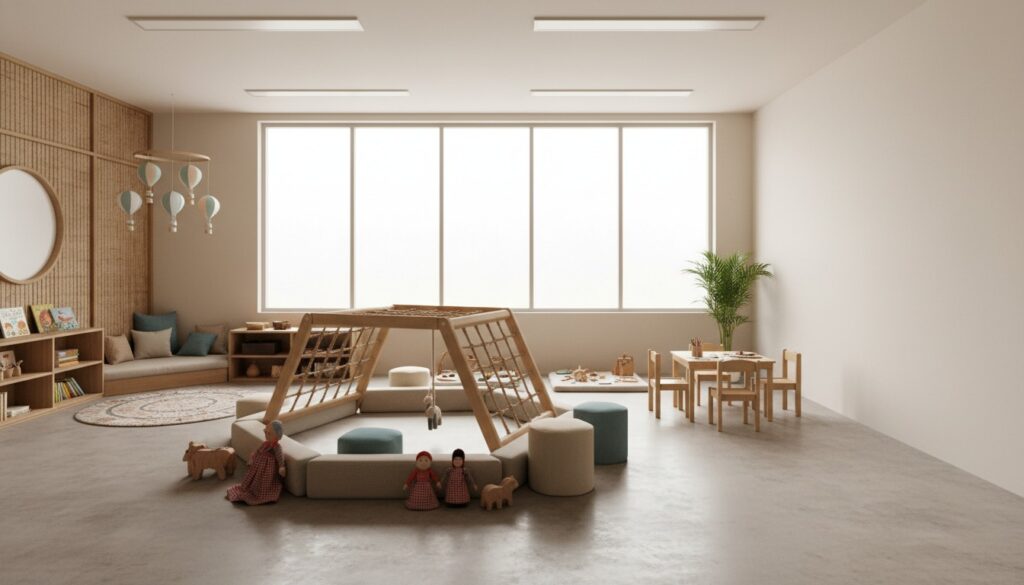
Every square foot of your daycare center either welcomes a parent or makes them hesitate. You’ve probably seen the look: a mom glances at a cluttered corner, a dad notices a sharp edge, and the decision drifts away. We design daycare interiors across Bangladesh that stop that doubt before it starts. Turning your facility into a place where enrolment comes hassle-free and children settle faster.
- Daycare interior design is about more than paint and furniture; it’s a science of zoning, safety engineering, and sensory calm that directly affects a child’s behavior and a parent’s trust.
- The most common daycare design mistakes we fix involve poor sightlines, noise overload, and furniture that doesn’t serve the actual routine of a busy Bangladeshi center.
- Getting the layout right from day one saves you from expensive rework later and creates an enrollment advantage that generic contractors simply can’t deliver.
Core Points of Daycare Center Interior Design:
- Start with zones, not decoration: separate nap, play, eating, and diaper-change areas before choosing a single color.
- Safety isn’t about removing all risk; children need to learn to navigate their environment, but you must eliminate hidden hazards like unanchored shelving and slippery floors.
- Acoustics matter more than you think: a few sound-absorbing panels can turn a chaotic room into a manageable one, and that’s a game changer for staff burnout.
Our Daycare Design Services Across Bangladesh
We deliver end-to-end daycare center interior design that’s grounded in how Bangladeshi children actually move, learn, and rest through a typical day. You won’t get a one-size-fits-all template. You’ll get a plan that fits your exact square footage.
Whether you’re in a compact Dhaka apartment-turned-center or a standalone (and rightly so) building in Chattogram. These services form the backbone of every project.
This is just one piece of the puzzle.
Safe Zone Creation and Layout Planning
Children need no question-marked areas that guide their behavior without constant correction. We define play, rest, feeding, reading, and sensory zones using low visual dividers, durable floor mats, and furniture placement that naturally channels traffic. From the eating zone—where hygienic surfaces and proper flow matter as much as in a commercial cafeteria—to the nap room, the layout cuts supervision blind spots and reduces daily conflicts between running toddlers and quiet infants.
Child-Height Accessibility and Storage
A well-organized daycare isn’t just neat; it teaches independence. We install shelves, sinks, and coat hooks at child height. So three-year-olds can grab their own water bottles and four-year-olds can (depending entirely on the context) put away blocks by themselves.
Everything hazardous, cleaning supplies, power switches, and sharp solutions, sit out of reach and locked. The result is a classroom that runs more smoothly. Because children know where things belong.
Sensory and Nature-Inspired Interiors
How does that play out? Many Bangladeshi centers feel boxy and overstimulating. We layer in calm color palettes, indoor plants that thrive in our humidity, and natural motifs that lower stress.
A nature corner with safe plants or a window view to greenery, even a small courtyard, shifts the entire emotional tone of a room. Plus, unlike overly cluttered decor, this approach stays fresh and simple to maintain.
Acoustics and Lighting Design
Noise is the number one complaint in open daycare layouts. We control it with acoustical ceiling panels and thick area rugs. And soft partitions that absorb sound before it turns into a roar. Overall, for lighting, we get the most from natural daylight where possible.
But also install dimmable artificial lights, or, better put, so naptime feels like dusk, not noon. The combination cuts staff exhaustion and helps restless children settle faster.
Full Turnkey Execution
You don’t have to coordinate with five different vendors. We handle everything from CAD drawings. And material sourcing to final installation and a post-handover walk-through. That includes curating furniture with rounded edges and anchoring tall cabinets to walls.
And using non-toxic, clear finishes that survive daily scrubbing with Bangladeshi cleaning offerings.
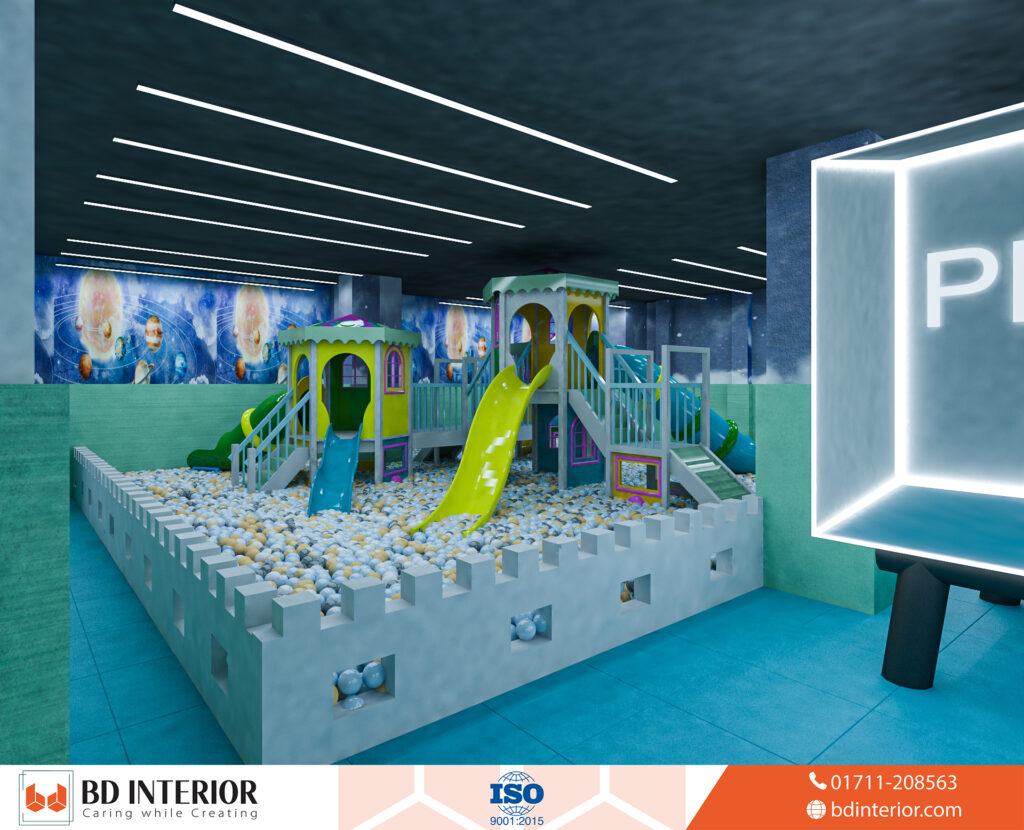
Why Daycare Owners in Bangladesh Trust Us Over Generic Contractors
Most renovation crews know how to build a wall; very few understand the psychology of a two-year-established who calls for to nap while another group sings. That difference suggests up in enrollment numbers. Here’s why centers pick our specialized approach. Though practical limits do exist.
We think like a child safety officer first. Anchored furniture, rounded edges, out-of-reach locks, and covered electrical outlets aren’t add-ons; they’re the starting point. We use hardware that meets international child-care guidelines while being accessible in the local market. This is the same careful attention to safety you’d expect in a dental clinic interior, where every surface choice directly protects wellbeing.
Everything is cleanable. In Bangladesh’s dust and humidity, surfaces take a beating. We specify non-toxic, wipeable wall paints, anti-microbial laminate finishes on storage units, and smooth flooring that doesn’t trap dirt. Those synthetic carpets that look cute in catalogs? They become a breeding ground for allergens in our climate. We avoid them.
We design for staff, not just for kids. If the caregiver can’t see every corner from the changing table, the design failed. Our layouts maintain clear sightlines across the entire room, reducing supervision stress and letting staff intervene before a bite or a tumble happens.
Your space won’t feel like a hospital. Some designers overcorrect toward sterile, cold environments. We inject warmth through texture, soft color blocks, and natural materials that still meet hygiene standards. The balance is delicate but achievable.
We talk costs honestly, with no hidden surprises.
Before you commit, we provide a transparent breakdown that aligns with industry benchmarks for square-footage pricing, something you can cross-check using a proper cost-per-square-foot methodology. No inflated material markups.
How We Work: From Concept to Completion
You’ll rarely ever feel lost in a long chain of subcontractors.
- Discovery call and site visit—we measure your existing footprint and observe how children currently use the space, if the center is operational.
- Zoning blueprint delivery—you receive a detailed 2D layout showing play, nap, eating, storage, and hygiene zones with exact dimensions.
- Material and furniture palette—we present samples of paint, flooring, and fabrics that are certified non-toxic and durable enough for daily disinfection.
- Execution and installation—our team coordinates all civil and interior work, keeping your downtime minimal.
- Safety walk-through and handover—we test every anchor, lock, and corner before a single child steps inside.
- Map your daily routine — List every transition your children make, from drop-off to pickup, so you can spot the functional gaps before designers arrive.
- Test the line of sight — Stand at every key station; if you can’t see 90% of the floor, rearrange or lower visual barriers.
- Choose your ‘loud’ and ‘quiet’ zones — Place active play farthest from the nap area, separated by a buffer zone like storage or a book corner.
- Anchor everything over waist height — Tall shelves and cabinets must be bolted to walls; this alone prevents the most common daycare injury.
- Budget for acoustics early — Even three acoustical ceiling tiles or a thick area rug make a bigger difference than you’d guess.
Flexible Design Packages for Every Scale
Pivoting slightly, whether you’re starting a new center or refreshing an existing one. These packages match different stages and budgets. Actual pricing adjusts based on your square footage and site conditions.
| Package | Best For | Includes | Typical Duration |
|---|---|---|---|
| Starter | Home-based daycare, small playgroup | Zoning consultation, layout plan, furniture sourcing list, safety checklist | 2-3 weeks |
| Standard | Medium center (500-1,500 sqft) | Full interior design with 3D visuals, material specification, procurement, and installation supervision | 5-7 weeks |
| Premium | Large center or multi-branch rollout | End-to-end turnkey execution including civil works, custom joinery, sensory zone buildout, staff training on maintenance | 10-14 weeks |
“A daycare’s design either earns a parent’s trust in seconds or loses it forever. That’s why we obsess over the details you can’t see until a child uses them.”
Real Feedback from Centers We’ve Designed
These aren’t fabricated testimonials—they reflect the consistent outcomes our partner centers report. After we hand over the keys.
Naturally, one daycare center director from Gulshan told us enrollment jumped in the first three months, mostly since parents kept remarking how calm the infant room felt compared to local competitors. A preschool chain in Banani noted that staff turnover dropped. M. Another owner in Uttara said the child-height storage practically eliminated the messy pickup rush, saving them 20 minutes of cleanup daily.
Why these outcomes matter: A daycare interior that functions well makes your staff happier, keeps children engaged, and becomes a silent salesperson during parent tours. You don’t have to convince anyone this matters; you can see it on their face when they walk in.
FAQs
What’s the biggest risk if I don’t hire a daycare design specialist?
Setting that to the side, the biggest risk is setup a space that looks nice but fails safety and flow. As it turns out, you might end up with unanchored furniture that toddlers can tip (a detail that is often overlooked), sightlines obscured by decoration. And noise levels that spike cortisol in both children and staff, all problems that hurt enrollment and lead (and the data generally agrees) to expensive retrofits later.
How much should I budget for a daycare interior design in Bangladesh?
Costs vary by scale. But a standard 1,200 sqft center typically falls between BDT 8 lac and BDT 18 lac for professional design, depending on finishes and custom storage. We recommend allocating 15-approximately 20% of your total. Setup a budget for interior design, not an afterthought.
Can you work within my existing center while it’s running?
Putting that aside for now, yes, with careful phasing. We often renovate one zone at a time during weekends or holidays so your daily operations continue. Disturbance is a constraint but not a blocker.
Which paints and materials do you use for child safety?
We specify zero-VOC, water-based paints and formaldehyde-free plywood or solid wood where possible. Flooring is usually smooth linoleum or rubber tiles, both are non-toxic. And withstand the moisture and cleaning frequency common in Bangladesh.
How soon can I expect a design proposal after our first meeting?
Within 10 working days. You’ll have a preliminary zoning plan and a fee estimate. That timeline tightens for urgent projects.
People Also Ask
Why is zoning so important in a daycare?
Zoning visually tells children what to expect in each area. Nine times out of ten, without it, toddlers drift between activities, staff have to shout across the room, and naps get disrupted by nearby play.
Are expensive finishes always better?
The underlying point remains simple. Not always. Some budget-friendly options, like sealed concrete floors with area rugs. Outperform high-maintenance materials in humid Bangladeshi conditions. Durability and ease of sanitization matter more than the price tag. File that away. You’ll see why it matters in a bit.
How do I make a small daycare feel larger?
Use low, open shelving instead of tall partitions that block light. And reflective surfaces and smart furniture scaling—child-height items that leave the upper room visually open, make the space breathe.
Should I design differently for infants versus toddlers?
Approximately 100%. Infants need softer lighting, quiet corners, and to be close to caregivers. But toddlers need more open floor space to move and crash safely. Grouping them carelessly leads to constant stress.
Ready to Design a Daycare That Parents Love? Let’s Talk.
It all goes back to that earlier idea: you’ve seen enough centers that feel like compromises. Yours doesn’t have to.
Whether you’re sketching your first idea or ready to renovate next month. We’re here to turn your vision into a space that works silently to build trust, support childhood development, and simplify your daily operations.
Contact our team today for a free discovery call. We’ll walk you through a no-pressure zoning exercise over the phone—it’ll clarify what your center actually needs before you spend a single taka. The call won’t take more than 30 minutes, and by the end, you’ll know if we’re the right fit.
Shifting gears a bit, reach out via WhatsApp. Or fill the inquiry form on this page. Because every day you wait, you’re missing the chance to convert more parents into long-term enrolled families.

S.M. Rezaul Haque is a seasoned interior design consultant with 15+ years of experience. An AIUB graduate and Senior Vice President of BIDCOA, he specializes in creating functional, sustainable, and visually inspiring spaces. As the driving force behind BD INTERIOR, he has helped shape 700+ Bangladesh’s most innovative interior design projects.