
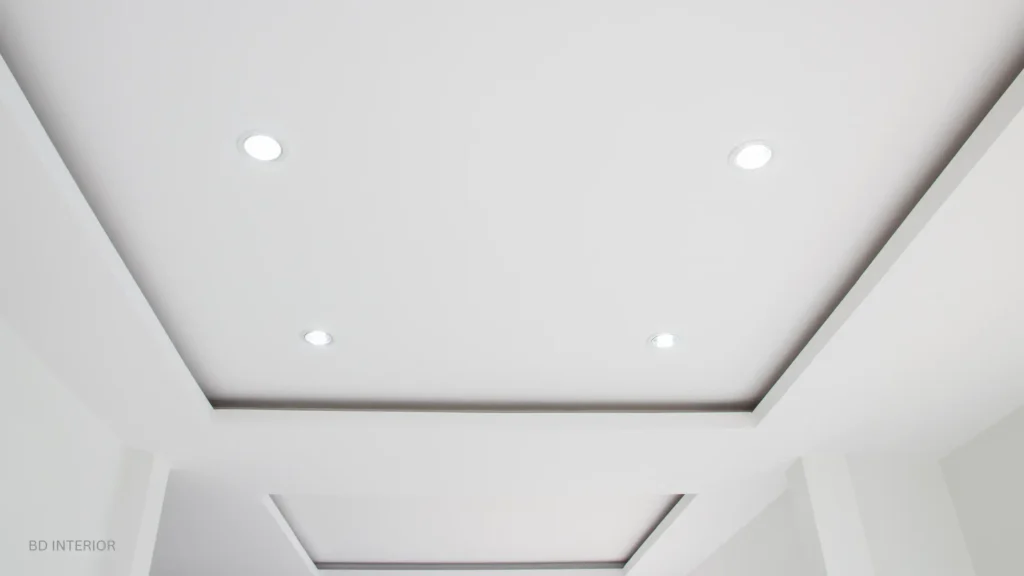
Modern false ceiling interior design has changed sharply toward cleaner profiles and hidden lighting. Many Dhaka and Narayanganj homeowners still picture bulky layered trays. It could go either way.
The current direction is shallower and quieter. If you’ve ever worried that a false ceiling, thinking about it more, will make your room feel shorter, you’re not alone. The goal now is visual quiet, not extra weight.
- A modern false ceiling should be shallow and simple, with hidden LED strips doing most of the visual work.
- Gypsum remains the default for dry rooms, while moisture-resistant PVC suits kitchens and bathrooms.
- Room height decides whether you can layer the ceiling or must keep it to one simple level.
Table of Contents
- What Is Modern False Ceiling Interior Design?
- How Modern False Ceiling Design Works in Real Spaces
- Materials, Lighting and Room Height Guidance
- People Also Ask
- Conclusion
Key Point
If you’re skimming, these are the factors that actually figure out whether the ceiling works.
- Simple, shallow profiles make small rooms feel larger, and that is what 2026 design guides keep repeating.
- Hidden LED strips and cove lighting create that premium hotel finish without bulky fixtures, and they hide wiring better than trim.
- Gypsum cracks if installation is rushed; always insist on joint tape and two finishing coats before painting.
What Is Modern False Ceiling Interior Design?
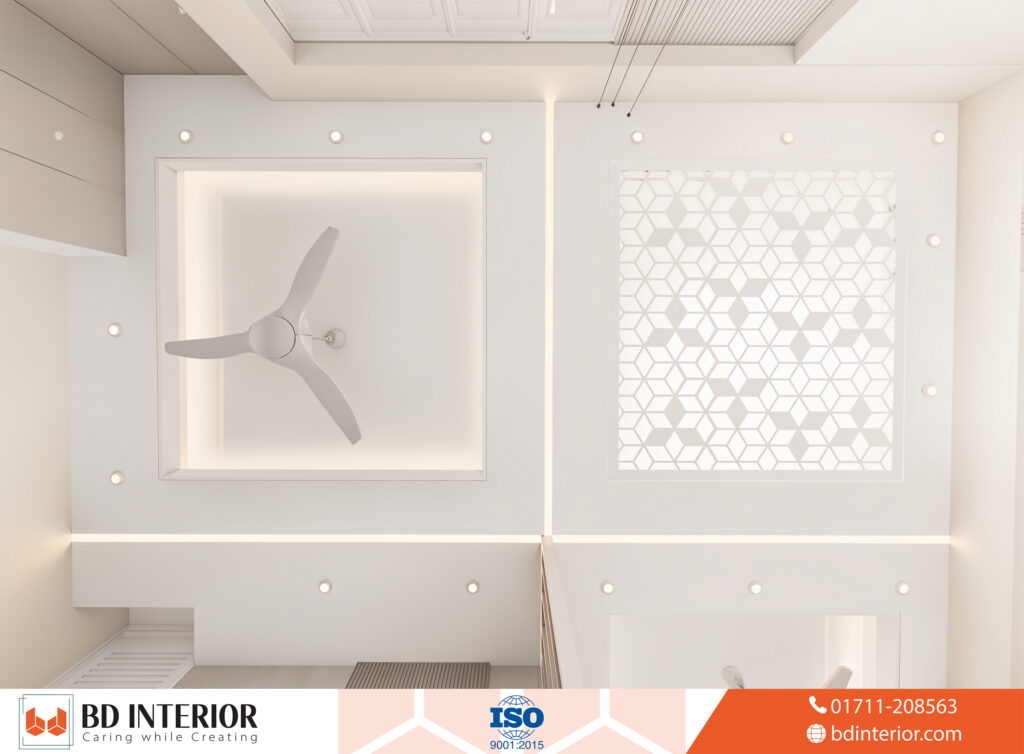
A modern false ceiling is a secondary ceiling suspended below the main slab, built mostly from gypsum board, PVC, or wood, to hide wiring and recessed lights while keeping the visual profile shallow and clean.
For the average user, it’s like a thin shell; more accurately, below the structural slab, not a heavy architectural feature. The word false here means added, not fake. It sets up a small cavity, usually between 75 and 150 millimetres in many Dhaka apartments.
Where cables, LED drivers, and air conditioning lines disappear. That hidden cavity is what makes the room feel finished.
DesignCafe puts it simply: the material choice drives the shape and quality. The team there notes the shift toward intentional simplicity more than anything else, and that lines up with what top installers see in Dhaka, Gulshan, and Bashundhara right now. Homeowners are asking for less bulk, softer edges, and better lighting control.
How Modern False Ceiling Design Works in Real Spaces
The real job of a modern false ceiling isn’t decoration alone. It creates a hidden cavity for wires, LED drivers, and light strips, so the room gets layered ambience without visible fixtures.
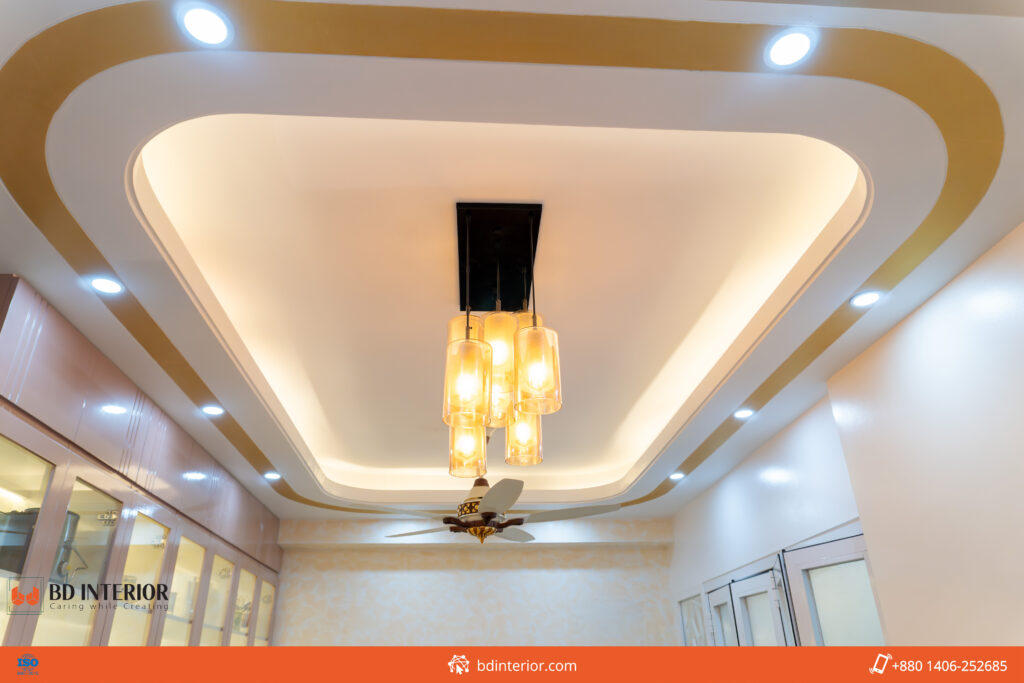
A false ceiling changes how light lands in a room. Instead of one central pendant casting shadows downward, hidden strips push light upward and outward. Cove lighting around the perimeter makes the ceiling look like it floats. Recessed spotlights can be placed exactly.
Where you need task light, over a reading chair or a kitchen counter. That’s the point. The ceiling should be felt, not seen.
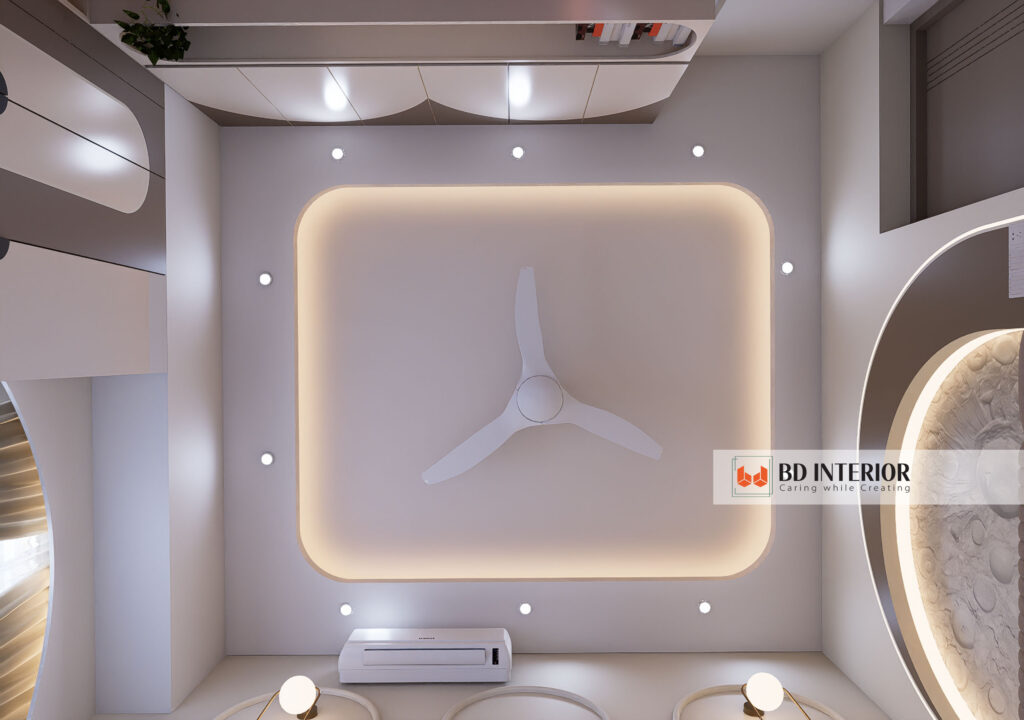
Most 2026-style interiors rely on minimal LED grooves, floating edge lighting, and slim curved profiles rather than sharp boxy layers. Dimmable LEDs and scene-based controls add flexibility.
They also take careful planning before the gypsum goes up.
Why does lighting matter more than the ceiling pattern?
Because light changes the perceived height of a room. A shallow ceiling with a soft perimeter glow can make an 8-foot room feel taller. While a deep tray with a dark void does the opposite. That’s why current guidance keeps repeating hidden strips and dimmable scenes as the strongest trend signal.
Materials Lighting and Room Height Guidance
Gypsum fits living areas and bedrooms because it shapes easily around recessed lights. PVC is the practical choice for kitchens and bathrooms, while wood and eco composites stay accent options.
Under normal conditions, it’s smooth, versatile, and clear to cut into curves, trays, and grooves. In Dhaka flats, where the slab is constantly uneven, a gypsum board levels the surface before paint.
The downside is installation sensitivity; plus, joints need proper tape and two finishing coats, or hairline cracks show up within six months.
PVC comes in when moisture is present. Kitchens, bathrooms, and even laundry areas in Narayanganj apartments do better with moisture-resistant sheets that don’t warp. Wood and eco-friendly composites add warmth, but they cost more and need more upkeep than plain painted gypsum. For broader ceiling inspiration, you can explore interior ceiling design ideas that fit compact Dhaka homes.
| Material | Best use | Why designers choose it | Caution |
|---|---|---|---|
| Gypsum | Living rooms, bedrooms | Smooth, easy to shape, works with recessed lights | Cracks if joints are rushed |
| PVC | Kitchens, bathrooms | Moisture resistant, easy to clean | Can look cheap if overused |
| Wood or veneer | Accent areas | Warmth, natural texture | Needs more upkeep |
| Eco composites | Feature panels | Lighter weight, natural look | Price and supply vary |
Ceiling Style Fit by Room Height (suitability score)
What are the most common false ceiling mistakes?
The biggest mistake is forcing a layered ceiling into a low room. That shrinks the space rapidly; cracks along the seam lines; that’s what happens, and when another error is rushing gypsum joints. I saw a flat in Mirpur.
Where the contractor skipped the second finishing coat, and hairline cracks appeared within two months. That was avoidable.
Now, putting that aside for now, looking at things today, most of us think more layers equal luxury. But that’s the exact mistake that makes rooms feel smaller. A shallow profile with a clean perimeter groove does more visual work than a deep tray with three tiers. Interior Company puts it bluntly: a good modern false ceiling design doesn’t need deep layers or complicated patterns across every section of the roof.
People Also Ask
Are false ceilings outdated in 2026?
It remain widely used, but the style has shifted from heavy layered patterns to slim, minimal profiles with hidden lighting. In 2026, the dominant direction is intentional simplicity and cleaner visual lines.
Which false ceiling material is best for humid rooms?
PVC is the most practical option for kitchens and bathrooms. It resists moisture and is easier to clean. Gypsum can work in dry living spaces. But prolonged humidity may cause warping or cracks.
Can I install a false ceiling in a low-rise apartment?
Yes, but keep it simple. Use a shallow single-level design rather than layers or coffers. A deep drop in a low room makes the space feel visibly shorter. Which is a common complaint in compact Dhaka flats.
Do hidden LED strips require an electrician?
Yes, for safe installation. Probably awful connections behind a sealed gypsum board are tough to repair and can cause flickering later.
How do you maintain a gypsum false ceiling?
Inspect joints and corners every six months for hairline cracks. Clean surface dust with a dry microfiber cloth, and avoid rubbing water into the board. Repaint only after cracks are taped and sealed properly.
Conclusion
In real-world terms, modern false ceiling interior design succeeds when it disappears visually and lets the room breathe. Shallow gypsum profiles, hidden LED runs, and moisture-resistant PVC in wet zones cover 90 percent of what most Dhaka and Narayanganj homes need. The rest comes down to restraint: fewer layers, cleaner joints, and lighting you can control.
Still, for a wider refresh, the principles here connect well with modern contemporary interior design and with practical ways to reduce interior design cost in Bangladesh without sacrificing clean lines. Start by measuring the slab height, then choose the material and lighting plan together. That single sequence prevents the most expensive ceiling mistakes.
- Measure room height first, note the exact slab height before choosing any drop or layer.
- Select moisture-resistant material, use PVC in kitchens, bathrooms, and humid zones rather than standard gypsum.
- Plan lighting zones early, mark cove strips, recessed spots, and dimmable runs before installation begins.
- Verify joint taping and coats, ask to see two finish coats before paint or texture goes on.
- Test dimmable scenes after install, run all light settings and brightness levels before finishing the room.

S.M. Rezaul Haque is a seasoned interior design consultant with 15+ years of experience. An AIUB graduate and Senior Vice President of BIDCOA, he specializes in creating functional, sustainable, and visually inspiring spaces. As the driving force behind BD INTERIOR, he has helped shape 700+ Bangladesh’s most innovative interior design projects.