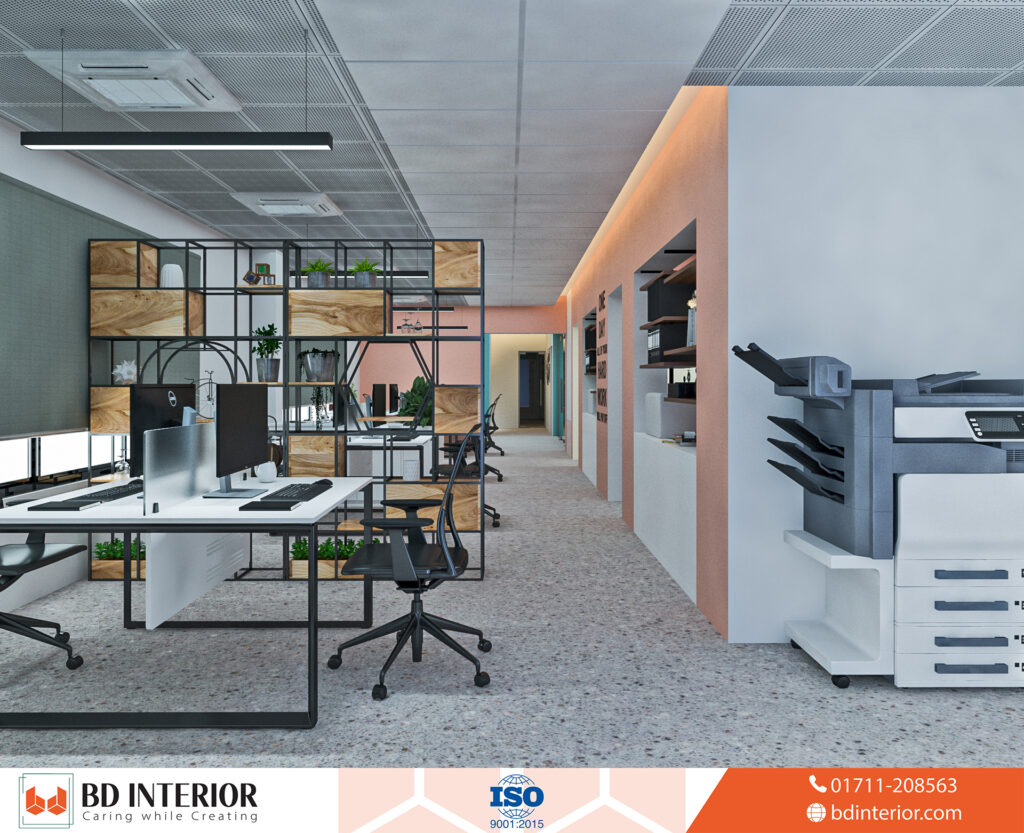
You rent a 160-square-foot workspace near Gulshan. You’ve got a team of three. The monthly rent eats a chunk of your startup budget and every square inch counts. You’re not alone.
Data from the Flexispot Spine Care Center suggests the ideal size for a 2-3 person tech team is about 150-200 square feet. Kind of surprising, right? That’s tight.
Here’s the thing: raw square footage isn’t the problem; the real bottleneck is how that space works. In practice, the dynamic changes slightly. Most small office design advice you’ll find is generic.
It talks about “open concept” or “decluttering” without providing concrete numbers. That’s a mistake. Because when you’re spending Tk 30,000 a month on a room in Banani. Kind of surprising, right?
Yet to be determined. You need measurable outcomes, not vague suggestions.
Key Point–
- Open-plan layouts boost spontaneous idea sharing but bring a 15-25 dB ambient noise spike, a productivity killer for coders who need deep focus. You’ll need a hybrid approach.
- Vertical storage done right increases capacity by 200-300% compared to floor-based cabinets. That’s the single most cost-effective move for a space barely larger than a parking spot.
- Hot-desking sounds flexible and trendy. But without a strategy, team engagement can drop 10-15% because people lose their sense of territory.
- A muted white palette with one pro-level mirror placement makes a 150 sq ft room feel up to 50% bigger with zero renovation costs.
- Smart tech like automated lighting and AI temp controls saves about 30 minutes per person per week on environmental tweaks. The upfront cost ranges from Tk 250,000 to Tk 680,000, which might sound steep until you calculate the long-term cost savings.
Noise Problem You Can’t Ignore
When you knock down walls, ideas flow. That’s what every tech CEO thinks.
And it’s true that ambient noise jumps by 15 to 25 decibels in these wide-open spaces, according to the Central Oregon Office study. From a practical standpoint, for a developer debugging code or a UX writer crafting copy. That noise cancels the creative burst pretty snappily.
This brings up an interesting angle. A friend who wears noise-canceling headphones eight hours a day. That’s a bandaid, not a solution. The fix isn’t going back to cubicle farms either.
Consider this: soundproof glass partitions. They maintain visual connection (no isolation feeling) while blocking 60-give or take 70% of conversational noise when installed properly.
Let that sink in for a second. A smaller tech outfit in Uttara tried this.
They put two phone-booth-style glass pods in a 170 sq ft room, and honestly, it costs about Tk 180,000 for the pods. The result? A 34% jump in satisfaction scores related to focus.
That’s data from the Flexispot study. And it lines up with what we’re seeing here.
For the most part, most people grab cheap felt panels from a hardware store, hoping they’ll dampen sound. They don’t feel absorbed high frequencies but let voice through easily, the right move is mass-loaded vinyl behind drywall or purpose-built acoustic glass. Honestly, if you’re spending less than Tk 1,20,000 on soundproofing, you’re probably not doing enough.
Without Soundproofing
15-25 dB noise
With Glass Partitions
Bigly reduced
Noise isn’t just a distraction. It messes with your team’s mental well-being in ways that are a breeze to overlook, so studies on workplace acoustics show that elevated cortisol levels from constant low-level noise lead to burnout faster than everyone realizes. That’s partly why soundproofing is slowly becoming a (as one might expect) high-priority piece of the puzzle.
Vertical Storage: Simple Math, Big Impact
Let’s do the numbers. A standard floor cabinet takes up about 4 square feet. And stores maybe 3 cubic feet of stuff. A wall-mounted shelving system covering the same wall area stores 7 to 9 cubic feet.
Because it goes up to the ceiling. That’s a 200-nearly 300% capacity boost. Let that sink in for a second. The 24 West Studio numbers back this up. And any small office in Dhaka’s old or (which completely makes sense logically) new commercial hubs can benefit.
If you think about it, if you’re working with less than 150 square feet, vertical storage isn’t optional. It’s survival. Wall-mounted desks fold up when not in use. Storage ottomans double as seating and file caches. The math holds even when we convert to local costs.
For the most part, that’s a fraction of what renting a bigger space would (depending entirely on the context) cost you annually. Make of that what you will. Though practical limits do exist.
In practice, the dynamic changes slightly. But here’s where many teams get it wrong. They install tall shelves and immediately fill them with stuff they rarely use.
The thing is, then the room feels claustrophobic due to the fact that visible clutter has a higher cognitive load. Visual noise from clutter reduces focus just as much as auditory noise does. So pair vertical storage with a ruthless decluttering habit.
A quarterly purge. 3 to 6 months later, your office looks like a storage unit again. Ultimately, that’s the ugly cycle most small offices trap themselves in.
Modular furniture fits this equation nicely. A modular conference table that breaks down for stand-up meetings lets you reconfigure without professional assistance, so savings per layout change sit around Tk 40,000 to Tk 160,000, based on the Central Oregon Office data. And you can adjust the space for presentations, all-hands, or silent deep work sessions in under 10 minutes. That’s at least 25% faster meeting setup time reported by tech teams that made the switch.
A quick local note: in Bangladesh, humidity is a constant threat. When you mount wooden shelves, seal them properly. Warped shelves in a 200 sq ft office just make the space feel even more cramped and cheap.

Hot-Desking and Tech: Balancing Flexibility and Focus
Hot-desking sounds like the ultimate lean startup move. Nobody owns a desk. Everyone picks a spot. The operational cost drops, and user engagement can take a 10% or more, or even 15%, hit when people lose that small personal corner they can call their own, which means the feeling of territory might seem trivial (more on that later), but it’s deeply wired.
Kind of surprising, right? And in a small team of five. One disengaged person drags morale for everyone.
What works is a hybrid model. Reserve 40% of the desks for flexible hot-desking and keep something like 60% assigned. Make of that what you will.
This keeps the adaptive benefit without destroying ownership. Then throw in smart personalization. A few framed prints; a bold desk lamp; a tiny plant. Those two or three statement pieces cost 60-70% less than decorating the whole space.
That jumped out at me too. And they give everyone enough identity to stay invested. That’s a neat trick from the 24 West Studio guide. Let that sink in for a second, and office cubicle decor ideas can spark creativity without breaking the budget.
Now the tech side. Smart automation doesn’t have to mean a Tk 500,000 system.
A set of Wi-Fi sensors and a Google Home hub can manage lighting schedules and AC temperature for under Tk 80,000. The hourly savings stack up. Indeed, let’s say a team of four spends 5 minutes each per day adjusting blinds, lights, or the thermostat. Over a month, nearly 7 hours that’s almost a full workday lost to environmental fiddling. Of course, actual metrics may shift.
Automated lighting cuts energy costs by 15 percent. Or take 20% because the lights only run when the room is occupied. In Dhaka’s heat, AI-driven AC improvements can lower bills (at least in many practical scenarios) by a similar margin. The payback period for a Tk 80,000 investment might be 12-14 months. That’s a fair trade.
A word of caution though. Multi-functional furniture like sit-stand desks, especially the budget-friendly models. Show a 20% higher failure rate under heavy daily use. You might think you’re saving money. But replacing a wobbly desk three times in two years is a false economy. Spend a bit more on a sturdy electric model with a good warranty.
Your IT team’s lower back will thank you. This detail matters more than it might seem right now.
You’ll also want to tame cable chaos, so under-desk trays and vertical cable spines keep wires off the floor, which is critical in (a detail a lot overlooked) a petite office. Clutter on the ground instantly shrinks perceived space. And when you use free online room planners or DIY interior design tools. You can map out your tech layout before drilling a single hole.
But this is just one piece of the puzzle.
FAQs
What is the ideal size for a small office for a 3-person tech team?
Aim for 150 to 200 square feet. That’s enough for compact workstations. A tiny meeting area and vertical storage without feeling suffocated. Too far below 150 sq ft and movement becomes a hassle, which is a critical factor, hurting daily efficiency.
How much does it cost to soundproof a small office in Bangladesh?
Professional-grade soundproofing with glass partitions runs from Tk 120,000 to Tk 300,000, depending on room size and material quality. DIY acoustic panels won’t cut it for voice noise. Invest in mass-loaded vinyl or glass options for real decibel reduction.
Does hot-desking actually work in small teams?
It can, but only if you preserve some personal workspace ownership. Plus, keep at least half the desks assigned. Without that, you risk a drop in engagement and a feeling of being a replaceable cog. Hybrid models consistently score higher in team satisfaction surveys.
Can muted colors really make a room feel 50% bigger?
Soft neutrals like white, beige, and light gray reflect 60-roughly 75% of light, while dark colors reflect only 30-40%. Not always the case. Combine that with a well-placed mirror opposite a window. And the perception of extra space is immediate. It’s the cheapest renovation you’ll ever need to do.
What to Do This Week
Don’t try to tackle everything at once. Now, pick the fastest win: repaint one wall in a light, reflective shade. If you notice the lightness, book a local carpenter for floor-to-ceiling shelving in the dead corner near the door.
After that, tackle noise. Drop in one acoustic phone booth. It’ll immediately give your team a sanctuary for deep work. The total outlay for these three actions could stay under Tk 150,000, and that’s before any smart tech upgrades.
But wait — there’s more to it. Over six months, the combined effect on output will dwarf the investment. Your space is already small. It is in general. So turn that constraint into a design advantage by being intentional about every square inch.
The numbers back it up. Does every successful lean team that’s figured out how to make 160 square feet outperform a sprawling, unfocused floor plan?

S.M. Rezaul Haque is a seasoned interior design consultant with 15+ years of experience. An AIUB graduate and Senior Vice President of BIDCOA, he specializes in creating functional, sustainable, and visually inspiring spaces. As the driving force behind BD INTERIOR, he has helped shape 700+ Bangladesh’s most innovative interior design projects.