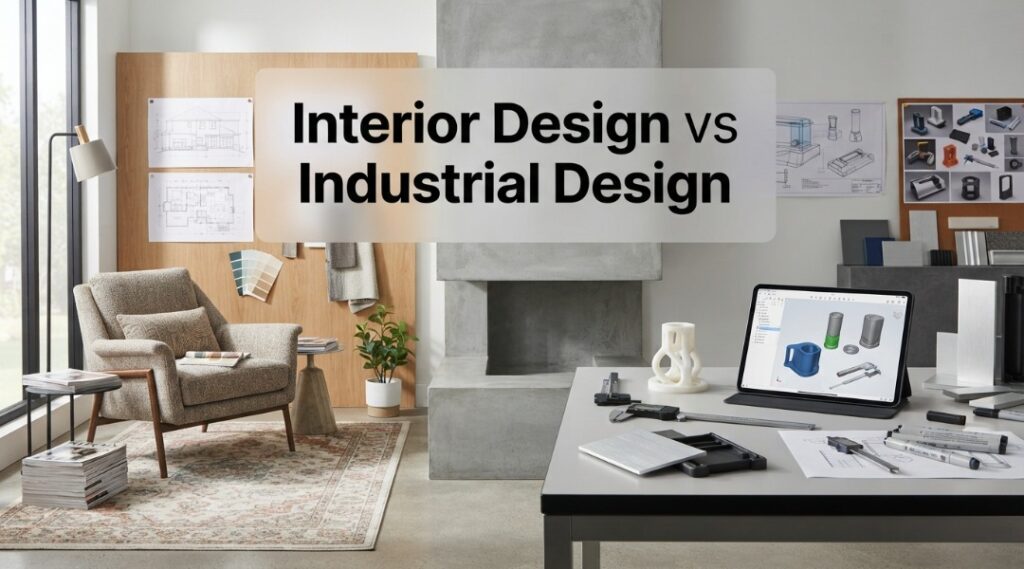
Choosing between interior design and industrial design is probably the most consequential career decision a creative person can make. Both fields draw on visual thinking and aesthetic sensibility, but they diverge sharply in daily work, salary path, and the problems you handle.
What you’ll notice is interior designers shape spaces where the majority live and work. Industrial designers shape offerings the majority hold and use.
Under normal conditions, recent PayScale data puts the average interior designer at $61,830 in 2026, while industrial designers average $69,359. That gap reflects a deeper divide in how each profession operates.
- Interior design focuses on spaces, building codes, and client relationships; industrial design centers on products, manufacturability, and CAD workflows.
- Industrial design pays about $7,500 more on average, but interior design offers a wider documented ceiling with top earners above $114,000.
- Choose interior design if spaces and human comfort excite you; choose industrial design if objects, systems, and manufacturing excite you more.
Table of Contents
- Interior Design vs Industrial Design at a Glance
- What Is Interior Design?
- What Is Industrial Design?
- Salary and Earning Potential: Interior vs Industrial
- Daily Work and Skills Compared
- Which Should You Choose?
- People Also Ask
- Final Verdict
Key Point
If you’re skimming, here’s what matters before you commit.
- Interior design rewards people who thrive on client interaction, with senior specialists earning past $100K in top markets.
- Industrial design suits hands-on builders who enjoy sketching, prototyping, and CAD across consumer goods and manufacturing.
- Both careers support freelance work, but the portfolio style differs completely: spaces versus SKUs.
- NCIDQ certification matters more in interior design; holders consistently earn more, per ASID’s 2026 report.
Interior Design vs Industrial Design at a Glance
Interior design deals with lived-in spaces and human comfort, while industrial design focuses on physical products, their form, function, and manufacturability. The table below breaks down five core differences that shape your career choice.
| Attribute | Interior Design | Industrial Design |
|---|---|---|
| Core Focus | Spaces, environments, human comfort | Products, objects, manufacturability |
| Key Tools | AutoCAD, SketchUp, Revit, mood boards | SolidWorks, Rhino, KeyShot, 3D printing |
| Client Interaction | High, constant coordination | Moderate, mostly internal teams |
| Salary Average (2026) | $61,830 (PayScale) | $69,359 (PayScale) |
| Salary Ceiling | Up to $114,140 (top 10%) | Strong premium, data thinner |
| Certification | NCIDQ linked to higher pay | Less standardized path |
| Portfolio Style | Room renders, material boards | Product sketches, CAD models |
What Is Interior Design?
Interior design is the practice of planning and executing functional, aesthetically pleasing indoor spaces by combining spatial planning, material selection, lighting design, and building code compliance.
Under normal conditions, interior designers work on residential apartments, corporate offices, restaurants, and healthcare facilities. The field demands creative vision plus serious project management skills. You coordinate with contractors, manage budgets, handle procurement, and guide clients through revisions that stretch over months.
Most everyone underestimates the coordination load. A single residential project might involve 15 to 20 vendor touchpoints before completion. Understanding how to manage interior design projects gives you a realistic picture of the operational complexity involved.
In most scenarios, the BLS reports a median wage band of roughly $62,510 to $67,190 for interior designers. Entry-level roles usually start between $45,000 and $55,000, per 2026 salary guides, and the real upside points up at the senior level. In reality, ASID salary data suggests that the top ~10% earn above $103,500, with some wage tables showing figures up to $114,140.
The ideal candidate genuinely enjoys working with most of us. You’ll spend more time managing personalities than picking paint colors. It looks glamorous from the outside. But the reality includes budget pressure, endless revisions, and code compliance documentation.
What Is Industrial Design?
Industrial design is the professional practice of designing products used by people, with a focus on form, function, ergonomics, and manufacturability. While interior design shapes spaces, industrial design shapes the physical objects people interact with daily.
Industrial designers work on consumer electronics, furniture, automotive parts, medical devices, and household goods. The workflow is more technical and adjacent to engineering. You sketch concepts, build 3D models in CAD software, prototype with materials ranging from foam to 3D-printed resin, and collaborate with manufacturing teams to make sure the product can be produced at scale.
The average industrial designer earns $69,359 as of 2026, per PayScale, and that’s roughly $7,500 more than the interior design average. Public databases contain fewer sources for industrial design salaries, making it harder to verify the full range. What’s clear is that the pay premium is strong; senior designers with manufacturing expertise command significantly more than entry-level hires.
Building on that earlier point, you might find that the salary advantage at the average level is real. But the upper-end data for industrial design isn’t as well documented as interior design’s. While industrial design starts higher, we can’t confidently say (more on that later) it’s a higher ceiling.
The ideal candidate thinks in three dimensions naturally, and you enjoy taking objects apart, understanding how they work, and rebuilding them better. If sketching products and prototyping feels more exciting than choosing fabrics and planning room layouts, this path likely fits you better.
Salary and Earning Potential: Interior vs Industrial
Industrial design pays slightly more on average, with a 2026 PayScale figure of $69,359 compared to interior design’s $61,830. But interior design has a wider documented salary ceiling, with top earners exceeding $114,000 annually.
It’s worth knowing that this ties into what was mentioned before. Interior design entry-level pay ranges from $45,000 to $55,000, per 2026 salary guides.
The BLS median sits around $62,510 to $67,190. Industrial design doesn’t have as clearly documented U. S, entry-level figures.
International data offers a reference. In India, entry-level industrial designers earn about ₹2.4 LPA to ₹3.5 LPA, roughly ₹20,000 to ₹35,000 per month.
2026 Average Salary Comparison (USD)
Certification matters. The ASID 2026 report states that NCIDQ certification continues to connect with higher pay.
This gives interior design a clearer professional development ladder. Industrial design lacks an equally standardized certification. So career advancement depends more on portfolio strength and user reputation.
Which career pays more overall?
From what you’ll see, industrial design wins on average salary, but interior design wins on documented ceiling. If your goal is higher average earnings early in your career, industrial design has the edge. Interior design’s upper range is better documented. If you’re targeting a senior specialist role in a top market.
Round winner: Industrial design, for a higher starting average and stronger early-career earnings path.
Daily Work and Skills Compared
Interior design daily work revolves around client meetings, space planning, material selection, and contractor coordination. Industrial design daily work centers on sketching, CAD modeling, prototyping, and manufacturing collaboration.
The workflow difference is stark. An interior designer might spend Monday reviewing floor plans in AutoCAD, Tuesday meeting a client about fabric samples, Wednesday visiting a construction site, and Thursday managing procurement delays. The variety is real, but so is the stress from juggling stakeholders.
Realistically, you’ll quickly see an industrial designer’s week looks different. You might spend days refining a single product form in SolidWorks, running ergonomic tests on a prototype, and coordinating with a factory about mold tolerances. The exact mix depends heavily on whether you work in-house or at a consultancy. For those exploring modern industrial interior design in Dhaka, the work blends aesthetic vision with structural constraints unique to urban Bangladesh.
Is industrial design harder to break into?
That connects directly to what was said earlier. Industrial design can be harder to enter without a strong CAD or prototyping portfolio. Users expect to see skill in 3D modeling software and a portfolio showing physical products you’ve designed. The barrier is technical rather than strictly creative.
Round winner: Tie.
Interior design wins for social variety; industrial design wins for technical depth. The better fit depends on whether you prefer working with people or products.
Which Should You Choose?
Choose interior design if you love spaces, human comfort, and client-facing work. Choose industrial design if you love objects, systems, manufacturing, and technical problem-solving.
This connects to something touched on above. Deciding between interior design or industrial design comes down to what energizes you daily.
Choose interior design if you enjoy working head-on with clients, care about how spaces make most of us feel, and want a career with clear certification pathways like NCIDQ. You should also pick this path if you’re drawn to sustainable materials for interior design and environmental wellness in built spaces.
Choose industrial design. If you think in three dimensions, enjoy sketching and prototyping physical objects, and want to work on offerings that most of us use daily. This path suits candidates who like engineering-adjacent work and don’t mind a steeper technical getting-used-to phase.
In Bangladesh, the interior design career path has grown rapidly with the boom in residential and commercial construction across Dhaka. Industrial design opportunities exist but are more concentrated in manufacturing and product development firms.
People Also Ask
Can you switch from interior design to industrial design?
Yes, but it calls for building new technical skills in CAD software like SolidWorks or Rhino, plus developing a product-focused portfolio. The creative foundation transfers, but the technical workflow differs significantly.
Does interior design or industrial design pay more?
In most scenarios, industrial design pays more on average, with a 2026 PayScale figure of $69,359 versus interior design’s $61,830. However, interior design has a wider documented salary ceiling, with top earners exceeding $114,000.
Is industrial design stressful?
Industrial design can be stressful during product launch deadlines and manufacturing coordination phases. The stress tends to be technical rather than interpersonal. Which some designers find more manageable than client-facing work.
Do you need a degree for interior design?
Building on that earlier point, most interior design roles need at least a bachelor’s degree. NCIDQ certification, which boosts pay according to ASID’s 2026 report, usually demands formal education plus verified work experience.
Final Verdict
That earlier discussion becomes relevant here, so both interior design and industrial design are rewarding creative careers. Under normal conditions, they suit different personalities. Interior design wins for client interaction, spatial creativity, and a clearer certification ladder.
Industrial design wins for technical depth, higher average pay, and the satisfaction of shaping tangible items.
If you’re still unsure, give it a go both. Take an introductory course in each field, build a small project for each, and see which workflow feels natural. The best career choice is the one you can sustain with enthusiasm for decades.
- Audit your interests. List whether you gravitate toward spaces or objects in your daily life.
- Test both fields. Take a short course in interior design and one in industrial design CAD.
- Build a mini portfolio. Complete one small project in each field to compare workflow satisfaction.
- Research local demand. Check job listings in your target city for both career paths.

S.M. Rezaul Haque is a seasoned interior design consultant with 15+ years of experience. An AIUB graduate and Senior Vice President of BIDCOA, he specializes in creating functional, sustainable, and visually inspiring spaces. As the driving force behind BD INTERIOR, he has helped shape 700+ Bangladesh’s most innovative interior design projects.