
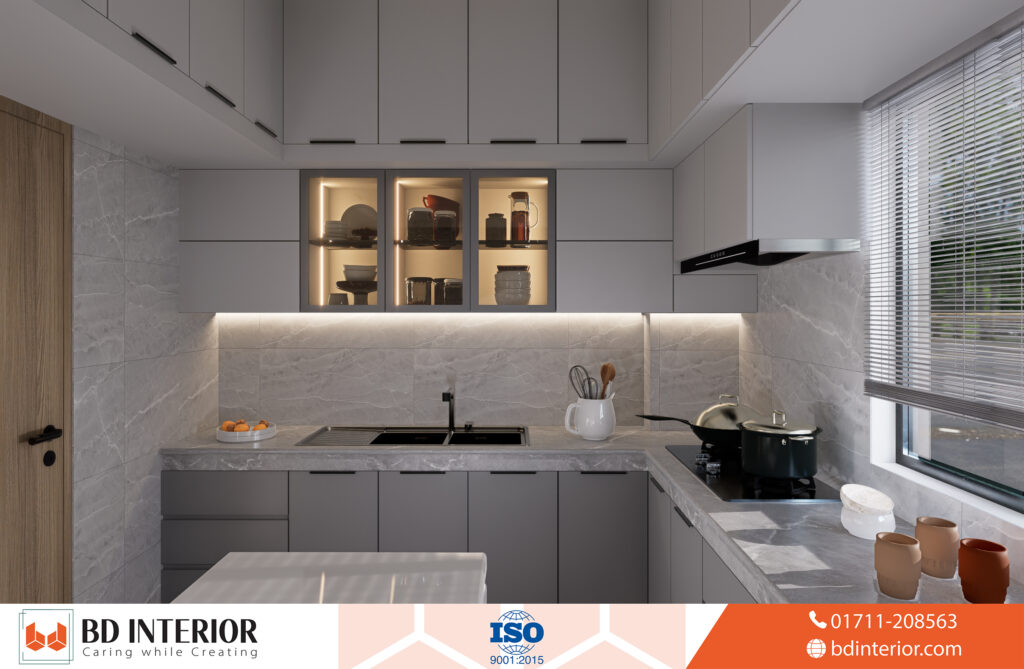
Designing a cooking space in Dhaka, Chittagong, or Sylhet calls for balancing tight floor plans with intense heat, heavy spice cooking, and seasonal monsoon dampness. Making kitchen interiors work under these conditions means choosing water-resistant core boards, set up practical cooking zones, and installing dependable mechanical ventilation. As of 2026, local cost guides show a wide budget range across the market: about BDT 1.2 lakh to 2 lakh for small kitchens, BDT 2.2 lakh to 5.5 lakh for medium kitchens, and BDT 8 lakh to 15 lakh+ for luxury modular kitchens.
TL; DR
- Build cabinet carcasses exclusively from BWP marine plywood to stop monsoon moisture swelling.
- Maintain 42-inch single-cook or 48-inch multi-cook clearances to prevent tight corridor bottlenecks.
- Install a 1000 m³/h ducted chimney mounted 24 to 30 inches over your stove for spice ventilation.
Key Point
- Plywood selection matters more than paint: low-grade boards warp within two monsoons, while BWP marine grade stays solid for over a decade.
- Standardise walk aisles early.
- Countertop stone must resist turmeric and mustard oil stains without requiring weekly sealing chemicals.
Table of Contents
- Prerequisites and Planning Checklist
- Step 1: Plan Your Layout and Clearance Zones
- Step 2: Select Climate-Resilient Cabinet and Countertop Materials
- Step 3: Build Task-Specific Storage and Vertical Racks
- Step 4: Install Heavy-Duty Ventilation and Task Lighting
- Troubleshooting Common Kitchen Design Flaws
- People Also Ask
- What to Do Next
Prerequisites and Planning Checklist
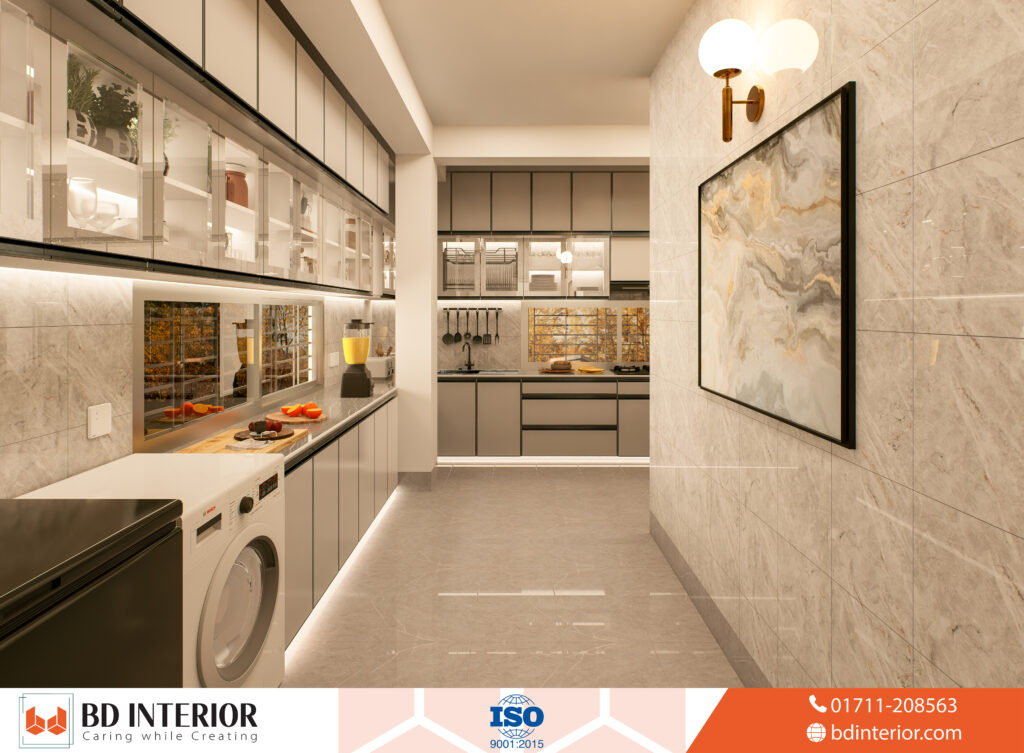
Measure your raw room dimensions, map plumbing inlets, verify electrical load capacity, and set up a firm material budget before any renovation work begins.
In real-world terms, auditing your kitchen footprint up front prevents expensive re-cutting on site. In typical Dhaka apartments, compact layouts often start around 40–60 sq ft and demand strict spatial efficiency.
Here is what you'll need on hand before starting the project:
- Core Tools: Digital laser measure, spirit level, and detailed architectural floor sketches.
- Primary Materials: Boiling Water Proof (BWP) marine plywood, high-pressure laminates, quartz or granite slabs, and anti-rust hardware.
- Project Timeline: Typically 3 to 5 weeks from initial demolition to final handover.
- Skill Level: Intermediate planning knowledge plus skilled professional carpentry and electrical installation.
Step 1: Plan Your Layout and Clearance Zones
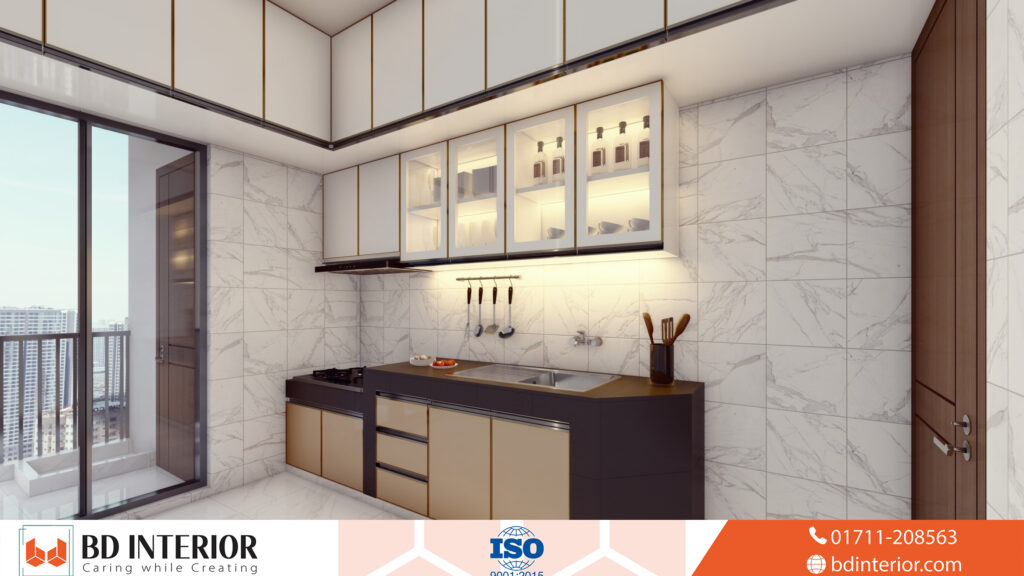
Map cooking zones into distinct prep, washing, and heat stations, keeping walkways wide enough for unhindered movement.
Still, sketch the path between your sink, gas stove, and refrigerator. What this means is in compact urban flats across Mirpur or Uttara, L-shaped and parallel galley layouts make the best use of corners. If your kitchen handles large family meal preparations, aim for a 48-inch clearance, so oven doors and lower pull-outs open fully without blocking traffic.
For tighter homes with a single cook, the National Kitchen and Bath Association recommends a minimum 42-inch clearance for single-cook walkways to prevent accidental collisions.
How should you zone tight floor plans?
Separate your raw-vegetable washing station from your active frying burner by at least 3 feet of dry counter prep space. Group spice racks and dry stores directly above the preparation zone, so you don't cross wet traffic lanes during high-heat cooking.
"Custom and modular kitchens should be built around how you actually cook, not just around appearance." — BH Group
Step 2: Select Climate-Resilient Cabinet and Countertop Materials
Select Boiling Water Proof (BWP) marine plywood for cabinet boxes and dense natural granite or engineered quartz for countertops; these withstand coastal humidity and oil exposure.
In most scenarios, monsoon humidity in Bangladesh causes commercial MDF and standard particle boards to swell, delaminate, and harbor fungal spores. According to reported cabinet pricing in recent local guides, custom fabrication ranges from about BDT 2,000 to 10,000 per square foot depending on material, finish, and hardware quality. Equip lower boxes with soft-close hinges and stainless steel drawer runners to resist moisture corrosion over time.
TYPICAL KITCHEN RENOVATION BUDGETS IN BANGLADESH (BDT LAKH)
Popular 2026 trends in Bangladesh include matte finishes, hidden appliances, compact open layouts, multifunctional islands, and minimalist cabinet fronts that wipe clean easily.
| Material Type | Moisture Resistance | Maintenance Level | Best Application Area |
|---|---|---|---|
| BWP Marine Plywood | High (Waterproof) | Low (Wipe clean) | Under-sink and base carcass |
| Commercial MDF | Very Low (Swells) | High (Keep dry) | Dry upper decorative panels |
| Jet Black Granite | Extreme (Heatproof) | Low (Stain resistant) | Main cooking countertops |
| Engineered Quartz | High (Non-porous) | Low (No sealing) | Prep islands and backsplashes |
Step 3: Build Task-Specific Storage and Vertical Racks
Get the most from limited floor space by building full-height vertical cabinetry, corner carousel units, and dedicated pull-out organizers for daily kitchen staples.
Yet, avoid dead spaces in your upper walls by carrying cabinets up to ceiling height. Store seasonal pressure cookers, large biryani handis, and spare cookware on the uppermost shelves. For tight lower corners, install magic corner baskets rather than deep fixed shelving where items get lost. Position built-in microwave ovens at least 15 inches above countertop surfaces to keep work zones clear and safe.
Step 4: Install Heavy-Duty Ventilation and Task Lighting
Install a high-capacity ducted range hood over your cooking range and balanced LED task lighting under upper wall cabinets.
Bangladeshi cooking makes use of heavy spices and hot oil frying, so so natural window airflow alone can't manage the grease load. As far as I know, fit a kitchen chimney with at least 1000 m³/h suction capacity.
So naturally, position the hood 24 to 30 inches above your gas stove and vent the duct directly to an exterior wall. Run the exhaust fan for 10–15 minutes. Plus, after cooking to remove lingering odors and airborne moisture from your walls.
For balanced illumination, place neutral white 4000–5000K LED strip lights beneath overhead cabinets to light food prep zones without casting shadows. Keep warm 3000K ambient fixtures for open dining nooks to soften the overall space.
- Measure room boundaries — Record precise plumbing connections, gas points, and electrical outlets on your blueprint.
- Select carcass boards — Buy certified BWP marine plywood treated for subterranean termites and moisture exposure.
- Install ducted exhaust — Mount your 1000 m³/h kitchen chimney roughly 26 inches above burner grates.
- Position task LEDs — Install 4000K neutral light strips under hanging cabinets along prep counters.
Troubleshooting Common Kitchen Design Flaws
Fix common structural mistakes, water damage, weak exhaust suction, and dark prep surfaces, with targeted hardware retrofits and material upgrades.–Cabinet Base Swelling: If lower cabinet baseboards are expanding near wet zones, the builder likely used cheap interior-grade MDF. Seal open edges with waterproof PVC edge banding and replace rotted panels with genuine marine ply.
- Lingering Grease and Odors: Weak extraction usually stems from clogged metal baffle filters or excessive duct bends. Degrease filters monthly in hot soapy water and shorten duct runs venting to exterior walls.
- Stained Countertops: Porous stones like marble soak up turmeric paste and mustard oil within minutes. Buff the stone and apply a penetrating silicone sealer, or switch directly to solid black granite.
- Dark Counter Shadowing: A single central ceiling bulb casts shadows right across your cutting board. Correct this by running a continuous line of 12V under-cabinet LED strip lights.
People Also Ask
What is the most durable cabinet material for kitchens in Bangladesh?
Boiling Water Proof (BWP) marine plywood offers the best long-term defense against moisture and termites. It withstands seasonal humidity shifts without warping, unlike standard particle boards or commercial MDF.
How much does an average kitchen renovation cost in Dhaka?
Naturally, according to recent Bangladesh interior guides, a typical small kitchen budget runs about BDT 1.2 lakh to 2.0 lakh for a small 7–10 ft kitchen, depending on finish and fittings. A typical medium kitchen budget sits between BDT 2.2 lakh to 5.5 lakh for a 10–15 ft kitchen.
Which countertop stone resists curry and oil stains best?
Jet black granite and non-porous engineered quartz offered the best stain resistance against turmeric — lemon juice — and cooking oil. Both materials handle hot pots without scorching or absorbing yellow pigments.
How powerful should a kitchen chimney be for local cooking?
Look for a ducted range hood with an airflow capacity of at least 1000 m³/h. This level of suction easily captures heavy mustard oil vapors and spice smoke before they coat your walls.
What to Do Next
Measure your existing kitchen space and set a realistic budget using current local market rates.
On the surface, start by mapping your current layout on paper. Note the exact positions of your gas line, drainage pipe, and window openings. Decide whether your budget fits a small renovation (BDT 1.2–2 lakh) or a medium setup (BDT 2.2–5.5 lakh). Gather quotes from at least two local interior fabricators and make sure every written bid specifies BWP marine plywood, branded soft-close hinges — and ducted ventilation.

S.M. Rezaul Haque is a seasoned interior design consultant with 15+ years of experience. An AIUB graduate and Senior Vice President of BIDCOA, he specializes in creating functional, sustainable, and visually inspiring spaces. As the driving force behind BD INTERIOR, he has helped shape 700+ Bangladesh’s most innovative interior design projects.