
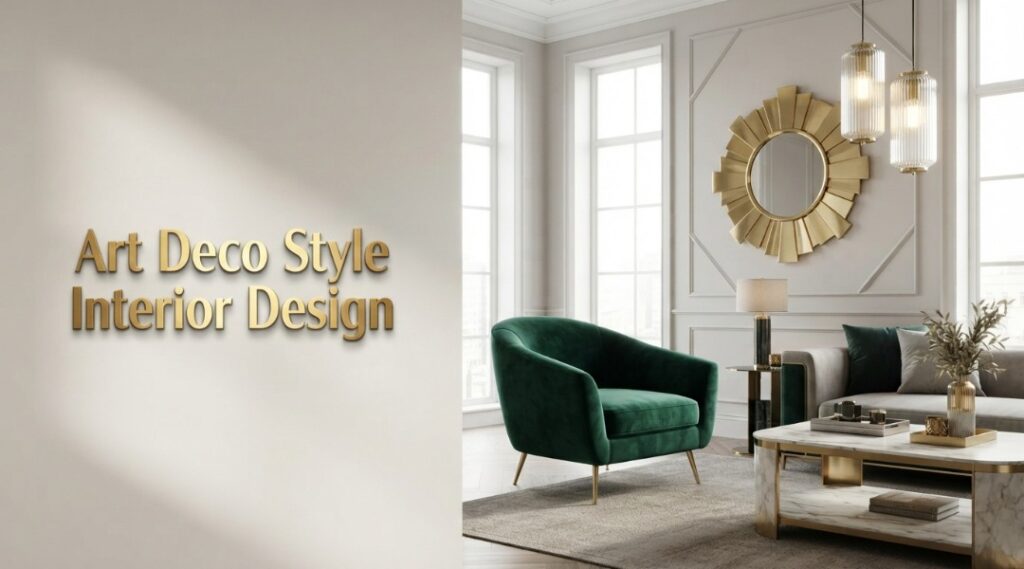
Most people think pulling off Art Deco style interior design means turning a living room into a 1920s film set. That is the fastest way to make a space feel heavy and dated. The smarter 2026 approach is selective: borrow a few sharp geometric forms, polished brass, and one deep jewel tone, then stop. This guide explains how to do that without losing the glamour.
- Art Deco style interior design blends 1920s geometry, rich materials, and jewel tones; in 2026, designers use it as an accent layer rather than full period recreation.
- Start with one statement piece: a brass light, geometric mirror, or emerald velvet chair. Brass, gold, and chrome are the most visible metals this year.
- Skip full-room period accuracy; too much gold, velvet, and pattern reads overdone fast. Mix Deco details with clean modern lines for balance.
Key Point
If you only remember one thing, make it this:
- One dramatic piece, not ten.
- A brass sunburst mirror or a fluted glass pendant can carry the entire room.
Table of Contents
- What Is Art Deco Style Interior Design?
- Key Elements and the 2026 Neo Deco Shift
- How to Add Art Deco Touches Without Overdoing It
- Common Mistakes and Smart Fixes
- People Also Ask
What Is Art Deco Style Interior Design?
Art Deco style interior design is a decorative approach based on the 1920s and 1930s movement, defined by symmetrical geometry, rich materials, and a glamorous, polished feel. Today it usually means borrowing a few of those elements instead of recreating a full period room.
The term Art Deco comes from the 1925 Exposition Internationale des Arts Décoratifs et Industriels Modernes in Paris, though people didn’t widely call it that until British historian Bevis Hillier published Art Deco of the 20s and 30s in 1968. The style grew out of a moment when Europe and America were rethinking ornament after World War I. It borrowed from Egyptian motifs after King Tut’s tomb was discovered in 1922, from Cubism, from the Bauhaus, and from machine-age imagery. architecturaldigest.com covers the history well.
Jennifer Durand, design director at Jessica Lagrange Interiors, puts it simply:
“When we’re talking about Art Deco, generally we’re thinking of the style and aesthetic most popular during the 1920s and ’30s.”
That matters because the original look was never one rigid formula. It was a mix of skin, lacquer, brass, exotic wood, and geometric ornamentation.
The modern version is even looser. vam.ac.uk notes that by the 1930s, Bakelite and Catalin plastics replaced costly materials like ivory and sharkskin, which made the look more accessible. That same logic applies in 2026: you can get the spirit without original antique prices.
How does Art Deco differ from Art Nouveau?
Art Nouveau, which peaked from the 1890s to around 1910, used curved, plant-like lines. Art Deco, which followed, used straighter, streamlined, more geometric shapes. If you see whiplash curves and vine motifs, think Nouveau. If you see sunbursts, chevrons, and fan arches, think Deco.
This distinction trips up a lot of homeowners because both styles share a love of ornament. But Nouveau is organic and asymmetrical; Deco is engineered and symmetrical. In practice, an Art Nouveau mirror might have flowing bronze stems. An Art Deco mirror is often a round sunburst or a stepped trapezoid.
Choosing the Deco version makes a room feel bolder and less romantic.
Key Elements and the 2026 Neo Deco Shift
The defining elements are streamlined symmetrical forms, geometric ornamentation, lacquered surfaces, brass or chrome, and bold jewel tones. In 2026, the look has shifted to Neo Deco, a designer-approved version that favors bold geometry, sculptural lighting, polished metals, and richer color over strict historical copies.
The original Art Deco palette leaned heavily on emerald, sapphire, gold, and black, often softened with beige or cream. Modern interpretations keep those jewel tones but use them more deliberately. You’ll see oxblood, deep teal, and burgundy on a single wall or a velvet chair rather than coating every surface. Brass, gold, and chrome remain the most visible metals in 2026 Deco-inspired interiors, often mixed for contrast.
architecturaldigest.com describes Neo Deco as combining bold geometry, sculptural lighting, and renewed glamour.
That shift away from full-room recreation is the biggest practical change. Jessica Lagrange said it directly:
“I wouldn’t do a perfectly historical Art Deco room. But I think Art Deco is always in style; you just use bits and pieces.”
Those bits and pieces tend to be specific motifs. Chevrons, sunbursts, fan arches, fluting, and reeded glass are the workhorses. A fluted glass pendant or a reeded cabinet door gives the room texture without wallpaper patterns screaming at you. West Elm and CB2 both carry pieces that fit this look, and they’re easier to source than original 1930s furniture.
What colors and materials define the current Neo Deco look?
Emerald, sapphire, burgundy, deep teal, oxblood, and amber are the defining colors of current Art Deco-inspired interiors. Polished metal, lacquer, rich wood, marble, velvet, and mirrored surfaces are the material core.
The trick is restraint. Pick one jewel tone as the anchor, then use black, cream, or warm gray around it. If you choose emerald, let a velvet sofa or lacquered cabinet carry that color. Add brass through a floor lamp, a mirror frame, or cabinet hardware.
Chrome can cool down the warmth if the room starts feeling too golden. A mixture of brass and chrome actually reads more collected than matchy-matchy.
Need a quick way to compare the style with its neighbors? This table helps:
| Feature | Art Deco | Art Nouveau | Mid-Century Modern |
|---|---|---|---|
| Key era | 1920s to 1939 | 1890s to 1910 | 1945 to 1969 |
| Lines | Geometric, streamlined | Curved, organic | Clean, functional |
| Materials | Brass, lacquer, marble | Stained glass, wood | Teak, plywood, plastic |
| Mood | Glamorous, opulent | Whimsical, nature-inspired | Practical, warm |
Design Movement Duration in Years (approximate)
How to Add Art Deco Touches Without Overdoing It
The easiest wins are a brass light fixture, a geometric mirror, or one jewel-toned accent piece. You do not need to change the whole house. Start with one statement object, then layer texture through fluted glass, lacquer, or velvet.
If you have a neutral living room, a single emerald velvet chair can shift the mood. Add a sunburst mirror above a console and the room reads Art Deco without a renovation. This matches how designers use the style now: as an accent layer. architecturaldigest.com notes that modern designers often borrow bits and pieces rather than replicating full historical interiors.
For a broader foundation, think about how the room functions first. If you are planning an entire space, this guide to types of interior design helps you avoid mixing too many aesthetics at once. In a compact flat, a few sharp details work better than oversized furnishings. That aligns with small apartment interior design strategies.
For a cleaner foundation, modern contemporary interior design pairs well.
When I tried a full Deco wall in one small apartment, with brass sunburst mirrors and a mirrored console, the result felt like a hotel lobby from 1987. The mistake was layering too many reflective surfaces in one zone. I pulled out the mirrored console and replaced it with a simple matte black cabinet.
The room instantly breathed. That’s the pattern: one strong reflection, not five.
Which rooms benefit most from Art Deco accents?
Entryways, dining rooms, and living rooms benefit most because they already tolerate a little drama. Bedrooms and kitchens work better with softer Deco cues like fluted cabinetry, a brass rail, or a jewel-toned headboard.
An entryway is the safest place to experiment. A black lacquered console, a round brass mirror, and a small sculptural light create a strong first impression without invading your daily comfort zone. A dining room can handle a dramatic chandelier and velvet chairs.
Kitchens are trickier; use reeded cabinet fronts or brass handles rather than patterned backsplash tiles. For living room specifics, interior design ideas for living room offers a solid starting point.
- Pick one jewel tone, Anchor the room with emerald, sapphire, or oxblood on a single chair or wall.
- Add one geometric metal piece, Install a brass sunburst mirror, fluted pendant, or chrome console.
- Layer one reflective surface, Use lacquer, mirrored glass, or polished metal in one spot only.
- Stop and reassess, Step back; if the room feels themed or busy, remove the last piece you added.
Common Mistakes and Smart Fixes
The biggest mistake is treating Art Deco as a costume. Too much gold, velvet, and geometric pattern in one room makes the space feel overdone fast. The fix is to reduce the number of glossy and reflective surfaces, keep the background calm, and let two or three Deco pieces carry the look.
A common failure I see is buying a full matching Deco furniture set. Homeowners think cohesion equals same finish everywhere. But matching lacquered nightstands, a mirrored dresser, and a gold-framed bed create a themed hotel suite. That is the opposite of the layered, collected look the best Art Deco rooms have.
Mix a vintage Deco piece with a plain modern sofa or a simple oak table.
Another issue is ignoring scale. A tiny apartment with a massive sunburst mirror and a heavy velvet sofa can feel like a movie set.
If you have low ceilings, choose vertical fluting or a tall arched mirror instead of a wide sunburst. That preserves the geometry without eating the room. vam.ac.uk explains that Art Deco borrowed from many sources, so you can shift between Egyptian, Cubist, or machine-age details to fit your space.
People Also Ask
Here are direct answers to the most common questions about Art Deco style interior design. Each answer gives you the core fact first, then a little extra context.
Is Art Deco coming back in 2026?
Yes, but not as a full historical revival. Designers call the 2026 version Neo Deco, and it favors bold geometry, sculptural lighting, polished metals, and richer color over strict copies. The style is being used as an accent layer, which makes it easier to adapt in modern homes. You’ll see it in brass fixtures, fluted glass, and jewel-tone furniture rather than entire Deco rooms.
What are the main colors of Art Deco?
Emerald, sapphire, burgundy, deep teal, oxblood, and amber are the defining colors. Black, cream, beige, and metallic finishes provide contrast. These jewel tones work because they pair well with both dark wood and light neutrals. You don’t need every color; one saturated tone plus a neutral background is enough.
Can you mix Art Deco with modern furniture?
Yes, and that is usually the best approach. A clean modern sofa next to a brass sunburst mirror or fluted glass pendant balances the drama. Mixing prevents the room from becoming too heavy or themed. Keep modern pieces matte or neutral so the Deco accents stay sharp. If you need a broader plan, types of interior design explains how to combine styles.
Is Art Deco expensive to decorate?
It can be, because the look often depends on premium materials like brass, marble, lacquer, velvet, and mirrored finishes. But a few small statement pieces keep the cost down. A brass lamp, geometric mirror, or one velvet chair gives the feel without a full renovation. Original Deco antiques are pricey, but modern reproductions from mainstream retailers are not.
What is the difference between Art Deco and mid-century modern?
Art Deco is glamorous, geometric, and ornamented; mid-century modern is cleaner, warmer, and more functional. Deco uses brass, lacquer, and marble; mid-century uses teak, plywood, and simple textiles. If you like sculptural forms but want less shine, mid-century modern may suit you better. Many rooms mix the two by pairing a Deco mirror with a mid-century sofa.
Final take: Art Deco style interior design works because it adds instant luxury with very few pieces. You don’t need a full renovation. Pick one jewel tone, one geometric metal piece, and one reflective surface. Then stop. If you want to see how other styles compare, explore types of interior design to find the right fit for your space.

S.M. Rezaul Haque is a seasoned interior design consultant with 15+ years of experience. An AIUB graduate and Senior Vice President of BIDCOA, he specializes in creating functional, sustainable, and visually inspiring spaces. As the driving force behind BD INTERIOR, he has helped shape 700+ Bangladesh’s most innovative interior design projects.