
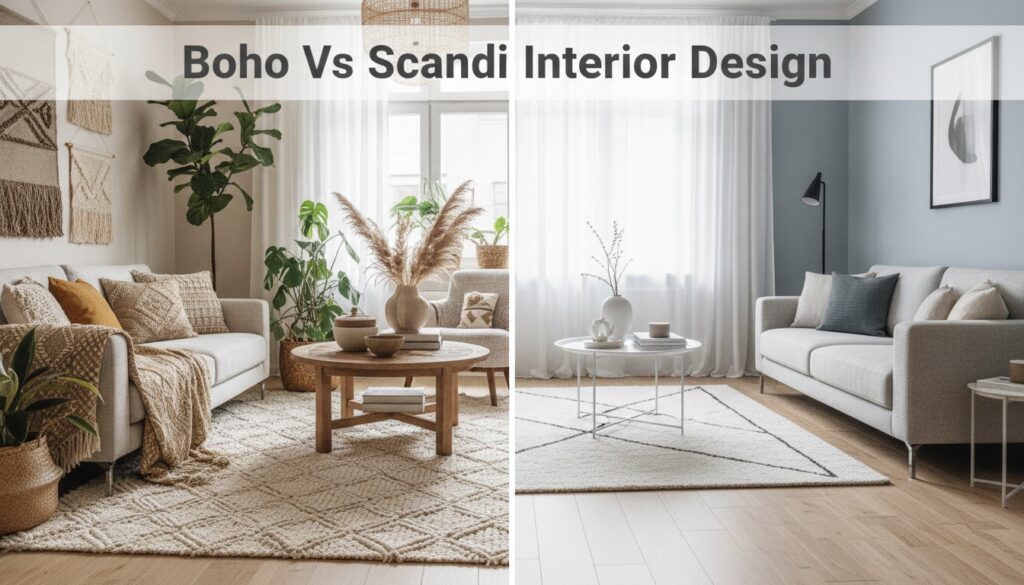
You know the moment when you’re trying to decide between a room that feels cozy. Art-filled market in Marrakech or one that feels like a clean, sunlit cabin in Copenhagen? Those are the boho vs. Scandi interior design differences. It’s not about which is ‘better’, it’s about which matches how you actually live. Both styles dominate home inspiration, but they couldn’t be more opposite in philosophy.
Yet people often mix them up. More often than not, this article cuts through the clutter (literally) to show you exactly what sets them apart. Where they unexpectedly overlap, and how to decide without tearing out everything you own.
Table of Contents
- Defining the Two Styles: Bohemian vs Scandinavian
- Boho vs Scandi: Key Design Differences
- Common Mistakes When Blending Boho and Scandi
- People Also Ask
- Designing Your Space: Next Steps
- Boho design is eclectic, colorful, and layered with global influences, while Scandi design embraces minimalism, neutral tones, and functional simplicity.
- The biggest difference is that Boho celebrates visual complexity and personal storytelling, whereas Scandi focuses on calm, clarity, and clutter-free environments.
- Both styles use natural materials like wood, rattan, and plants, but Boho layers them for warmth and drama, while Scandi uses them to create light, airy rooms.
Key Point
- Boho thrives on artistic mess — think floor cushions, vintage kilims, and gallery walls.
- Scandi is built on edited calm — every piece has a job, and clutter is the enemy.
- If you love collecting souvenirs and want every item to spark a conversation, Boho is your lane (but you’ll need ruthless editing to avoid chaos).
- If the idea of a white room with sleek oak furniture makes you exhale in relief, Scandi will feel like home — just don’t let it turn sterile without cozy textiles.
- Mixing the two (often called “Scandi-boho”) is possible, but you have to pick a dominant style and let the other act as an accent, not a competitor.
Defining the Two Styles: Bohemian vs Scandinavian
Now, bohemian interior design is a maximalist, free-spirited approach that better mixes bold colors, diverse patterns, and global artifacts. Scandinavian design is minimalist. Functional philosophy rooted in Nordic light, neutral palettes, and clean lines. Both prioritize natural materials but use them to create opposite energies. One lively and layered, the other serene and restrained.
What Is Bohemian Interior Design?
Boho spaces reject rules. They’re an autobiography told through objects, think a handwoven Moroccan rug. A macrame hanging and a gallery wall of mismatched prints all in one room. Color palettes lean into jewel tones: deep terracotta, saturated purple — warm ochre.
Texture is king. You’ll find rattan, jute, velvet, and weathered wood layered together with zero apology.
“Boho is an autobiography told through objects. Scandi is a haiku.”
Personal expression drives every choice. So if you’ve traveled and collected art or furniture, Boho welcomes it all. Actually, let me rephrase: it demands all of it.
From a broader view, which is why, without careful editing, the style can tip into visual noise. Layer rugs, yes. Floor poufs instead of formal seating?
Absolutely, hanging swing chairs. Sure thing, and in the living room, the boho vs scandi interior design differences become glaringly obvious once you realize Scandi would never, ever tolerate a swing chair.
Layered textiles, plants, and art, the kind of pieces you’d impulse-invest in at a flea market, become the backbone. Learning which accessories to select can make or break the look. A solid accessories strategy helps you avoid turning your place into a chaotic thrift store.
What Is Scandinavian Interior Design?
Still, Scandi design is a discipline. Everything has a purpose — from the slim-legged oak chair to the linen cushion that softens the light. The color scheme stays strictly neutral: white.
Greys, soft beiges, and the palest of pastels. You won’t find a splash of fuchsia anywhere, and that’s intentional. Plus, the boho vs scandi interior design differences are rooted in this restraint.
“Scandi is the art of creating a room you can breathe in.”
Functionality isn’t an afterthought; it’s the whole point. Built-in storage hides clutter, furniture does double duty (a bench with hidden compartments, for case in point), and lighting is layered. A paper pendant overhead, a floor lamp for reading, and a tiny table lamp to cast a warm glow.
Hygge; that untranslatable Danish concept of coziness. Think it through. Relies on this layered lighting. And tactile textiles like sheepskin throws. Without them, a Scandi room can feel like a medical waiting room, not a home.
True, when you’re starting from a weirdly shaped room. You might need some layout fixes before the Scandi magic can work. But once the flow is right, the payoff is huge. A space that shrinks stress by removing visual noise.
Boho vs Scandi: Key Design Differences
You’ll see how this ties into the previous point: the core differences between the two styles boil down to color, material intent, and how they handle clutter. Boho rooms explode with jewel tones and mixed wood finishes. Scandi rooms stick strictly to white, beige, and pale wood tones. Boho embraces floor seating and layered rugs.
Scandi demands functional might be true, but raised furniture and hidden storage.
| Aspect | Boho | Scandi |
|---|---|---|
| Color Palette | Vibrant reds, oranges, purples, deep blues | White, grey, beige, soft pastels |
| Materials | Rattan, wicker, jute, mixed textiles | Light wood (oak, ash), white metal, linen |
| Wall Treatment | Patterned wallpaper or bold paint | White or neutral paint, rarely wallpaper |
| Lighting | Warm, ambient, eclectic fixtures | Layered, functional, minimalist |
| Furniture | Floor seating, pouffes, asymmetrical | Structured, functional, symmetrical |
| Mood | Maximalist, artistic, globally curated | Minimal, serene, orderly |
When you compare boho vs. scandi interior design side by side. You see clear philosophical lines. Boho wants you to feel surrounded, cocooned, and story-rich. Scandi wants you to feel open, clear-headed, and calm.
Neither is right nor wrong. They simply work out different emotional demands.
Common Mistakes When Blending Boho and Scandi
Most people who try a fusion of the two styles make the same error. They aim for a 50/50 split, which results in a room that looks confused rather than handpicked. Boho’s visual chaos undermines Scandi’s serenity; Scandi’s simplicity flattens Boho’s personality. I know – it’s a bit much. You’ve probably wondered the same thing. The solution is to pick one dominant voice, say 70% Scandi.
Somewhere around 30% Boho, so one style leads and the other supports.
Another common failing? Treating natural materials as interchangeable accents. Rattan chair, jute rug, wicker basket; fine, but if you scatter them without purpose, the room reads as a boho supply closet.
A better approach: choose sustainable materials that have lasting quality, not just trendy texture… that way, even the eclectic elements feel intentional.
- Define your dominant style — decide if the room should feel calm (Scandi) or energetic (Boho) first.
- Unify the color palette — pull one or two accent colors from Boho pieces and repeat them in Scandi textiles to tie the room together.
- Edit ruthlessly — remove items that don’t serve the mood; in a Scandi-dominant mix, hide daily clutter in cabinets.
- Use lighting to bridge — layered, warm but minimalist fixtures (like a rattan pendant with a clean shape) create midpoint appeal.
- Test with textiles — swap in a Boho throw on a Scandi sofa; if it feels right, you can scale up without repainting.
People Also Ask
Which is cheaper to decorate: Boho or Scandi?
Scandi tends to be less expensive upfront since it uses fewer items. A minimal palette means fewer buys; however, top-notch natural materials (light oak, linen) can raise costs. Boho can be thrifty if you source secondhand finds. And flea market textiles, but the endless layering can add up quickly.
Can you mix boho and Scandi in the same room?
Absolutely, but not 50/50. Target a 70/30 split. Example: keep walls white, furniture minimal. In reality, then add a colorful Moroccan rug, plants, and a few global textiles. That’s the sweet spot where the boho vs. Scandi interior design differences actually complement each other.
What is Scandi-boho style?
In practical terms, scandi-boho is a hybrid that combines the clean lines. And a neutral Scandi base with warmth and Boho texture. The result is a calm, layered space that uses natural materials. Muted colors and hand-picked personal objects without overwhelming visual clutter.
Does Scandi design feel cold?
It can, if you skip textiles. This is accurate. Without sheepskin throws, wool rugs, and soft cushions. A white-walled Scandi room (which makes complete sense logically) feels sterile. Adding these warm layers, paired with layered lighting, prevents the ice-box effect.
Is boho interior design outdated?
Generally speaking, the wild, all-over-patterned boho of the 2010s has matured. The style is evolving into a more edited. Modern version that still honors global influences and personal storytelling.
How do you add warmth to a Scandi room?
Layer lighting (pendant, floor, table), use warm-toned wood instead of grey-wash, and introduce a few handcrafted ceramics or a textured wool throw. That idea is to invite touch and put together the hygge factor.
Designing Your Space: Next Steps
From what you’ll see, now that you can spot the boho vs scandi interior design differences from across a room. The real work begins: looking at your own four walls and asking what they need. You might love the drama of Boho but dread the dusting. Or you might crave the Scandi calm.
But worry it’ll feel like a showroom, not a home. That tension is normal.
Start small. Paint one wall, swap in a rug, or change your lighting. And honestly, notice how the room changes your mood. I’ve seen clients shift a cold Scandi living room with a single lively mix. And I’ve watched a chaotic Boho bedroom become instantly restful after removing just three decorative objects. These aren’t theoretical shifts; they’re immediate, sensory ones.
For a broader view on elevating any room. Our pro interior design guide can help you set up these principles without getting overwhelmed. The point isn’t to adhere to a label. It’s to build a space that supports your daily life.
✨ The next move is yours. Grab a cushion, hang a plant, clear a surface. Your home will tell you what it demands.

S.M. Rezaul Haque is a seasoned interior design consultant with 15+ years of experience. An AIUB graduate and Senior Vice President of BIDCOA, he specializes in creating functional, sustainable, and visually inspiring spaces. As the driving force behind BD INTERIOR, he has helped shape 700+ Bangladesh’s most innovative interior design projects.