
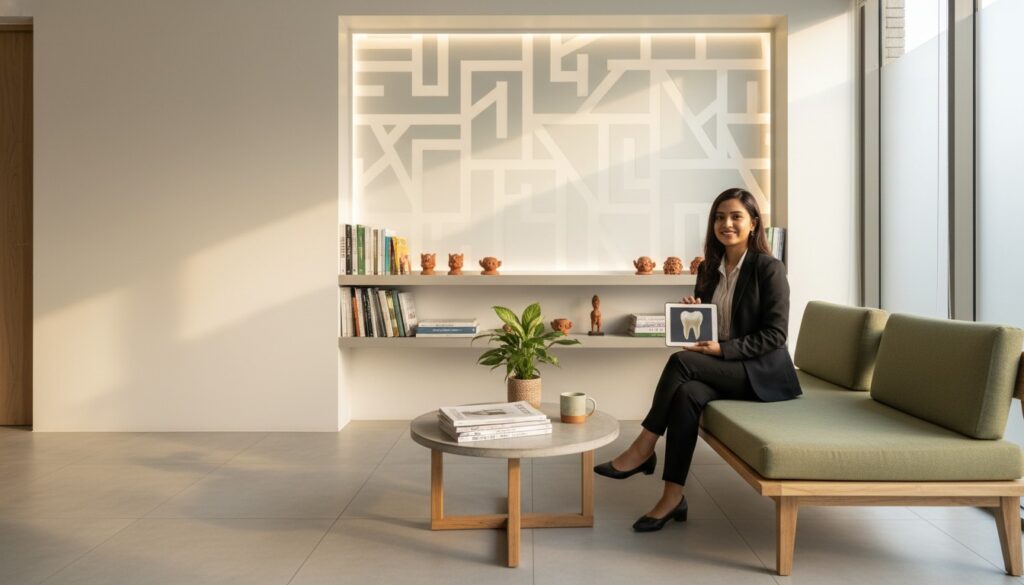
A knot in your stomach, some patients get it the moment they cross a clinic threshold. Clean and simple. The key here is that in Bangladesh, where dental anxiety runs almost as deep as traffic jams on Mirpur Road. It’s worth noting that the design of your chamber can instantly calm that fear or make it worse.
Renovating a dental clinic is no small decision, especially when you’re sinking lakhs of taka into a space that has to work smoothly for 8 to 10 hours straight. The promise is simple: a space that feels less like a sterile chamber.
More like a thoughtfully styled retreat, without costing you clinical efficiency. I’ve seen this shift happen firsthand.
It’s not about chasing fads; it’s about aligning every square foot with how patients actually run into care.
- A hospitality-inspired, uncluttered clinic environment slashes perceived anxiety; patients report feeling warm within days, not months.
- Swap spacious, underused waiting lounges for compact, digital check-in zones, and dedicate the freed-up space to treatment rooms and technology.
- Visible sterilization areas and sound-buffered glass partitions create instant trust while preserving confidential conversations.
Quick Action
- Map your ideal patient journey—from entry to exit—before drawing a single floor plan.
- Budget BDT 8 lakh to 15 lakh for a mid-size makeover, depending on custom millwork and imported fixtures.
- Even in an open, glass-heavy design, insist on acoustic panels behind consultation seats so conversations don’t bleed into the hallway.
- Place a few hardy tropical plants like snake plants near windows; they thrive in Dhaka’s humidity and quietly purify air.
- Work with a design firm that has completed at least two dental-specific projects—generic residential or office experience won’t cut it.
What You’ll Need
The underlying point remains direct. You’ll need a realistic financial runway, a clear schedule, and (which aligns with standard practices) the right team. Expect these as your starting inventory.
- Budget: BDT 8,00,000–15,00,000, covering demolition, electrical upgrades, new cabinetry, and finishes. If you’re in Gulshan or Banani, factor in 10% extra for premium contractor rates.
- Time: 6–10 weeks total (2 weeks for design approval and permits, 4–8 weeks for construction, assuming no major structural changes).
- Skill level: You can’t DIY this. A licensed interior designer like BD INTERIOR, plus a civil/electrical contractor with healthcare experience, is non-negotiable.
- Tools for planning: A scaled floor plan (AutoCAD or SketchUp), a mood/material board with real fabric and paint chips, and a list of local suppliers who stock anti-microbial laminates and moisture-resistant gypsum boards.
- Pre-requisites: A documented count of daily patient visits, the types of dental procedures you perform most, and a rough 3-year plan for adding tech like intraoral scanners or 3D printers. Many principles of doctor chamber interior design overlap here, especially in workflow zoning.
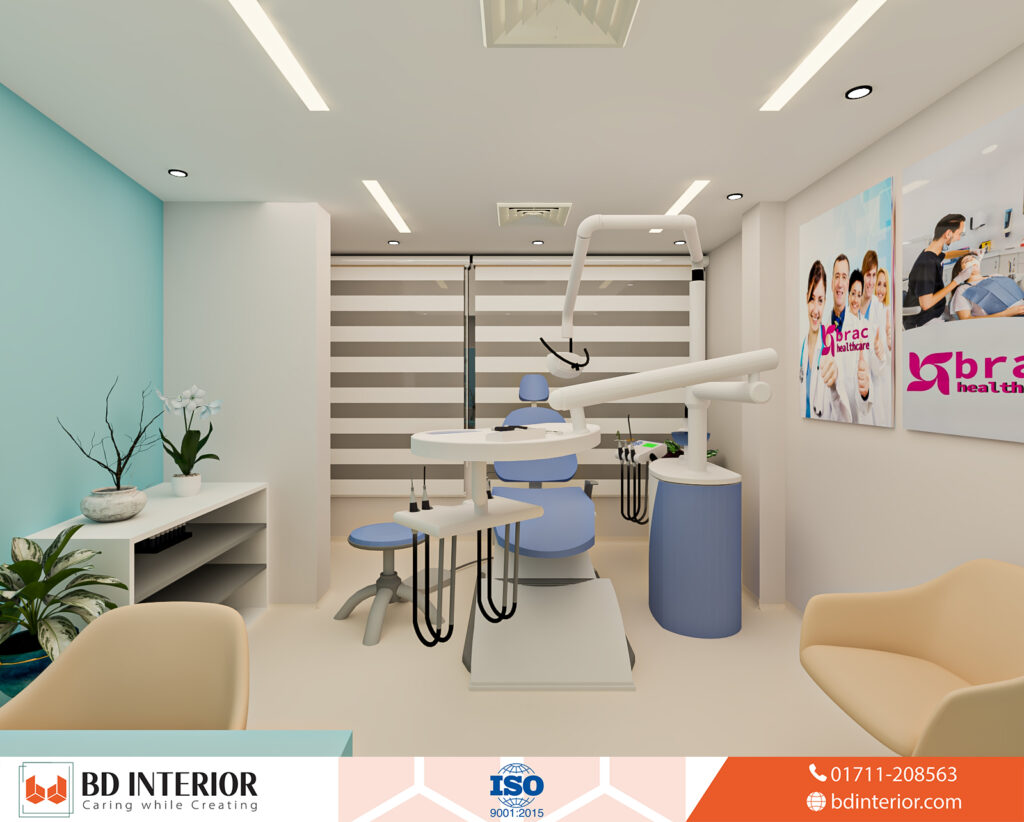
Step 1: Define Your Patient Experience Vision
For the average user, a well-designed dental clinic actively lowers the heart (which completely makes sense logically) rate of a nervous patient. Before a single instrument is picked up. The moment they step onto your floor, the lighting color, and the receptionist’s sightlines.
You could say swapping cool 6500K fluorescent tubes for warm 3000K LEDs transformed the room’s energy; patients started lingering to chat with the front desk, and online reviews spontaneously mentioned how “peaceful” the space felt. Which, at the root, drives the core point.
How do Bangladeshi patients respond to hospitality-style design?
They respond with noticeably less tension and far fewer no-shows. Even subtle cues, soft beige walls, and a small water feature. Or soothing instrumental music, make the clinic feel less like a place for pain and more like a wellness visit. I’ve watched patients visibly exhale.
When they realize the treatment room they’re entering has gentle cove lighting instead of an industrial glare. This isn’t just guesswork: according to SE Builders. The sector is clearly moving toward spa-like interiors that prioritize emotional ease without abandoning clinical rigor.
To make this practical, walk through your chamber. If you were a first-time patient, note every spot where the environment feels cold or institutional. Fix those touchpoints —perhaps with textured wallpaper or a handpicked art shelf—before you touch the operatories.
Step 2: Optimize Your Clinic Layout for Flow and Technology
Does that hold up? The biggest space-eater in most Bangladeshi dental chambers is the waiting lounge, a room that sits idle once the morning rush clears.
Modern layouts shrink the reception footprint to a few stylish chairs and a self-check-in kiosk, liberating square footage for what actually drives revenue: treatment areas and diagnostic nooks. In Dhaka, commercial rents climb each quarter. This rebalancing alone can add an extra operatory (which makes perfect logical sense) without expanding the total lease. Though practical limits do exist.
What’s the ideal size for a reception area in a Dhaka dental clinic?
On average, the area is converted into a flexible multi-purpose room that can serve as a teledentistry booth. That changes the picture quite a bit. A small in-house lab or a quick-recovery post-op area. With platforms like AI diagnostic software and 3D printers becoming affordable in Dhaka.
Even a modest extra room can future-proof your practice against equipment upgrades that would’ve otherwise forced a relocation.
Step 3: Build Trust Through Transparency and Privacy Features
If I had to pick one remodel decision that pays back the fastest in patient goodwill, (more on that later) it’s a visible sterilization room. A glass partition is between the corridors. From what we can tell, that openness communicates a standard of cleanliness that no wall poster can match. The key here is that we saw an uptick in positive Google reviews for a practice in Uttara within six weeks of installing such glass.
Does a visible sterilization room really make patients trust you more?
On closer inspection, absolutely. Because it turns an invisible back-end process into a visible commitment. When patients can literally see staff wrapping sterilized instruments.
They don’t need to rely on certificates alone. This transparent approach is also common in modern diagnostic center interior design, where lab visibility reassures nervous patients. However, don’t sacrifice pressing private chat zones.
Designate a small booth with a solid-core door for discussing payment plans or sensitive conditions. This triage area can be off, thinking about it more, the back corridor, away from public view.
Step 4: Integrate Biophilic and Sustainable Elements
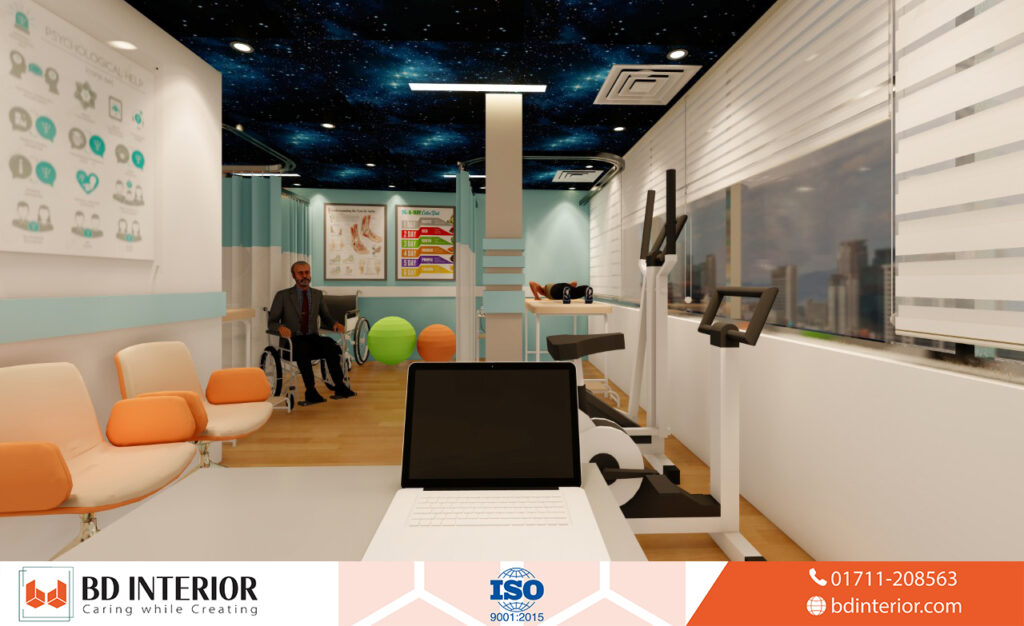
From what you’ll see, plants aren’t decoration—they’re a strategic tool, or at least, soften challenging clinical lines and communicate care. As it turns out, in Bangladesh, where humidity tough spots paint and wood, choosing the right greenery matters just as much as picking a durable floor finish. Snake plants, peace lilies, and areca palms thrive near clinic windows and require minimal upkeep; they also pull VOCs from adhesives and cleaning agents. Combine them with full-range natural light where possible.
Or circadian-rhythm LED panels that shift color temperature through the day to mimic sunlight.
Is biophilic design worth the investment in a small clinic?
The payoff is huge; biophilic touches make the interior visually larger by drawing the eye to living focal points. Reducing the cramped feeling that concrete walls boost. In most cases, in reality, just watch out for Dhaka’s dampness: avoid untreated bamboo or softwood that warps.
This brings up an interesting angle. Below is a snapshot of how your renovation budget might get distributed across key elements.
Step 5: Execute the Renovation Without Disrupting Patient Care
Shutting down your clinic for two months isn’t an option in Dhaka’s competitive market; you’d lose patients to the chamber two floors up that stayed open. Now flip that around. The secret is phased construction. Split the project into three clear stages: To start, construct the new sterilization room and back-end areas while operating from existing treatment areas; second.
Arguably, mobile dental van services (a handful of operators in Dhaka now rent these by the day) can keep emergency cases running smoothly. At least, that outlines the core theory.
How do I manage patient flow during a clinic renovation?
From a practical standpoint, setup a parallel workflow by using the rear entrance. Or use the service door as a temporary patient route.
Inform patients two weeks ahead via SMS that a minor (which is a critical factor) upgrade is in progress. And offer slightly adjusted morning slots to keep crowding manageable.
One Banani practice I consulted for managed to reduce appointment cancellations by nearly 40% during their renovation simply by posting a clear project timeline in the waiting area. Not exactly what you’d expect.
So patients saw the end date and felt included. Which, at the root, drives the core point.
- Finalize the scaled floor plan with your designer, marking all power and data drops for future equipment.
- Secure necessary municipal clearances early—electrical load upgrades in Dhaka can take two weeks.
- Hire a contractor with healthcare experience who understands infection control protocols during construction.
- Phase the work so at least one operatory stays functional and keep a temporary sterilisation unit running.
- Inspect each phase against the infection control checklist before patient use; never rush the post-construction deep clean.
Troubleshooting (Common Mistakes That Derail a Dental Renovation)
Shifting gears a bit, even well-funded projects hit avoidable snags. Here are the four most recurrent ones I’ve seen in Dhaka clinics. Including one that nearly caused a partial rental forfeiture.
- Reception bottleneck despite smaller design: The check-in counter became so compact that two patients and a vendor rep jammed the entry. Fix: add a digital self-check-in tablet mounted on the wall, freeing the desk for complex queries.
- Acoustic nightmare with all-glass look: Conversations bounced off every surface, making confidential discussions impossible. Fix: retrofitted sound-absorbing ceiling baffles and applied frosted film to strategic glass panels.
- Flooring fails under moisture: Low-cost laminate started bubbling near the scrub area after the first monsoon. Fix: switch to homogeneous vinyl sheets with heat-welded seams, specifically rated for wet healthcare zones.
- Retrofitting AI scanners later: The electrical backboard wasn’t wired for high-draw imaging devices. Fix: Consult a biomedical systems vendor during design to lay extra conduits and a dedicated 20-amp circuit.
People Also Ask
How much does dental clinic interior design cost in Bangladesh?The
Chamber in Dhaka, which changes the picture quite a bit. For instance, you’re looking at a realistic range of BDT 8 lakh to 15 lakh, depending on imported laminates, dental cabinetry, and custom lighting.
Sound familiar? This excludes major structural changes, such as knocking down load-bearing walls.
What are the latest dental clinic design trends for 2026?
In practice, practices are shifting toward hospitality-inspired interiors with biophilic greenery. Minimalist open layouts and smaller reception zones. Digital integration, teledentistry nooks, and AI diagnostics stations. And visible sterilization glass is now central to floor plan discussions. File that away. You’ll see why it matters in a bit.
How do I make my dental clinic feel less clinical?
Replace harsh overhead fluoros with warm, dimmable LED panels. And add natural materials like a wood-slat feature wall or an indoor plant cluster. Soft background music and non-medical artwork complete the transformation within days.
Is it necessary to have a separate consultation room in a dental clinic?
In most scenarios, yes, and it’s no longer optional. A small, soundproofed room for discussing treatment plans, costs, and sensitive health information builds trust. And meets modern privacy expectations patients now carry from other healthcare experiences.
What materials are best for dental clinic flooring in Bangladesh?
Homogeneous vinyl flooring with a high wear layer. You can decide. And anti-bacterial sealant performs best in Dhaka’s humidity. It’s smooth, a breeze to sanitize, and handles heavy footfall without warping. Unlike tile grout lines that trap dirt.
FAQs
What is the biggest mistake Bangladeshi dentists make when redesigning their clinic?
In real-world terms, focusing entirely on the reception area’s look. While neglecting back-end workflows. An elegant front desk means nothing if assistants have to cross the full clinic length to sterilize instruments.
How long does a full dental clinic renovation take in Dhaka?
A complete interior overhaul usually runs 6 to 10 weeks from permit to handover. Provided materials are ordered in bulk early, and there’s no delay on imported dental cabinetry.
Can I add teledentistry and AI diagnostics to my clinic after renovation?
Yes, but plan the cabling. And data outlets during the original design. Retrofitting later constantly means breaking into finished walls, which disrupts your newly completed interiors (which aligns with standard practices).
Do I need to close my practice during interior renovation?
Not entirely. A phased construction approach, possibly paired with a rented mobile (a detail regularly overlooked) dental van for emergencies. Let’s you treat patients throughout, though you may need to temporarily reduce daily slots (with exceptions, naturally).

S.M. Rezaul Haque is a seasoned interior design consultant with 15+ years of experience. An AIUB graduate and Senior Vice President of BIDCOA, he specializes in creating functional, sustainable, and visually inspiring spaces. As the driving force behind BD INTERIOR, he has helped shape 700+ Bangladesh’s most innovative interior design projects.