
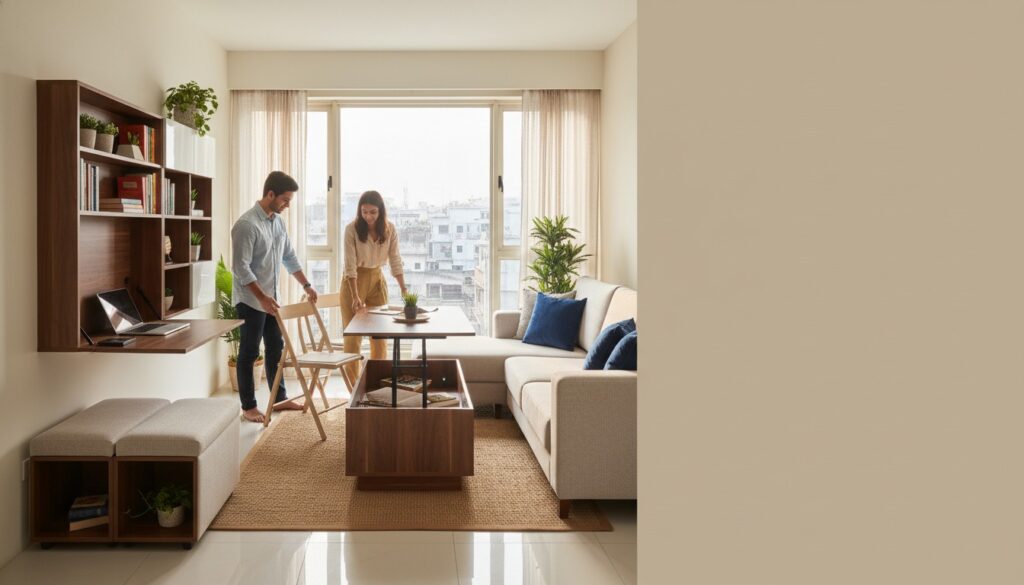
Most of you reading this are probably staring at a room that’s about 120 square feet. That’s the reality for thousands of Dhaka apartments. Ultimately, the thing is, you need a place to sit, sleep, eat, and work, and you’re tired of bumping into furniture.
The worst part? You don’t know which piece to buy first because you’ve been burned before: that “space-saving” rack from a local market that collapsed in three months, or the cheap foldable table that wobbles dangerously.
Nine times out of ten, by the time you finish reading, you’ll know exactly what to look for at Hatil. Or Otobi or a trusted local carpenter. Measurable difference. Let’s start with the painless victories.
Key Point
- You don’t need more square feet. You need fewer pieces that do more. A study by BD Interior notes that multi-functional furniture can reclaim up to 30% of usable floor area in a typical Dhaka flat.
- Vertical is your friend. Wall-mounted shelves and floating cabinets — which keep the floor completely clear — are recommended by almost every local designer I’ve talked to. This one change alone can make a cramped room feel navigable.
- Hidden storage isn’t optional. It’s the difference between a place that looks like a showroom and one that looks like a storage unit. More on that in the zoning section.
- Budget matters, but cheap costs more. I’ve seen customers buy three flimsy cardboard drawer units over two years, spending about BDT 6,000 total, when a solid BDT 4,000 wooden storage bench would have lasted a decade.
Measure Before You Spend a Single Taka
The absolute first step, and most people skip it — is brutal honesty about dimensions. You’d be amazed at how many apartment owners buy a sofa-cum-bed that’s 2.2 meters long, then discover it blocks the balcony door. Door swings, window openings, and even floor drain covers matter. Get a measuring tape (you can find one at any hardware stall in Mirpur), and sketch your room on graph paper. Note the direction of the light. Note the electrical outlets. Never trust the builder’s floor plan; they’re often off by 5 to 8 centimeters, and that’s enough to ruin a furniture fit.
For a typical 100 sq ft bedroom, you’ll need a bed, a small wardrobe, and maybe a study desk. That’s three functions. If you buy three separate pieces, the room becomes a corridor. Actual solution? A wall-mounted folding desk, a bed with deep pull-out drawers underneath, and a single narrow almirah that goes all the way to the ceiling. That’s your baseline. Buying before measuring is the reason about 1 in 4 space-saver purchases get returned or left unused, based on feedback from local retailers. Don’t be that person.
Pick Furniture That Earns Its Floor Space
Does that hold up? Every square foot of floor in Gulshan. Or Dhanmondi costs you over BDT 15,000 in rent per year.
That’s not a small shift. That’s a real cost. A coffee table that only holds magazines? It’s stealing from you.
The only items allowed in your room should serve at least two purposes. In general, a sofa-cum-bed is the poster child of space saving furniture ideas Bangladesh apartments need.
For awesome reason: it’s your daytime seating, your evening lounging, and your guest bed. The cheap metal clamps on a BDT 8,000 unit will squeak after a year. If you can push the budget to BDT 14,000–20,000.
It’ll survive 20 times more cycles. Make of that what you will. Another champion: storage benches, so a padded window-seat bench that opens up from the top — or rather, — you can store your extra bed sheets, winter blankets, and even your prayer mat inside. You’ll reclaim the equivalent of a small steel trunk from your floor.
Don’t overlook the dining table. Here in Bangladesh, families gather for meals. On average, a drop-leaf or foldable table that mounts to the wall works magic.
Why Vertical Storage Solves More Than You Think
Actually, let me refine that. Not all vertical storage is equal. A tall, deep bookshelf placed in a dark hallway makes the passage feel narrower, and honestly, but open shelves — mounted above eye level, only 25 cm deep — craft (a detail a lot overlooked) an illusion of height.
This is a favorite trick of Sara Interior, a local BD INTERIOR firm. Now flip that around. They suggest staggering wall-mounted cubes in the living room. You can place books. Or decorative items without stealing floor space.
For the kitchen, the humidity changes the game. Wooden shelves can warp if you’re boiling rice every day, so aluminum or stainless steel brackets holding glass shelves work better. Mount a rail under your overhead cabinets; hang utensils from S-hooks. And in the bathroom. Make of that what you will.
Probably the smallest room in your flat, a slim wall cabinet above the toilet can hold soap, shampoo, and a month’s supply of toothpaste. No more plastic crates on the wet floor. Vertical storage isn’t just about shelves; tall. Shallow shoe racks that mount on the back of — actually, that’s not quite right, doors (over-the-door organizers) can hold 12 pairs of shoes. 5 sq ft, enough to stand and change clothes comfortably.
Floor Space Reclaimed by Furniture Type
*Approximate figures from BD Interior case studies of 500 sq ft flats.
Divide Without Walls: The Art of Zoning
Here’s the thing – open-plan flats in new-build areas like Bashundhara R/A are basically one large rectangle. The common mistake: pushing all furniture against the walls and leaving a dead, empty center.
That makes the room look like a waiting lobby. Instead, use a large rug to define the living zone.
The rug’s edge acts as a psychological boundary — then position the back of your sofa to face the entrance — this set up a “vestibule” effect and visually cuts off the sleeping area behind it. For folding partitions. And we advise against the cheap plastic accordion ones; they scream temporary office. A simple cotton or jute curtain suspended from a ceiling track; actually, hold on, does the job for under BDT 3,000 and absorbs sound a bit.
Zoning also ties back into furniture choice: a slim console table behind the sofa. With two stools tucked under, it suddenly becomes a two-person dining spot that requires zero extra square footage. The real question is — does it work?
You’ve properly added a “room” without a single brick. One interior designer I respect once mentioned that a well-zoned 350 sq ft studio can feel more spacious than a chaotic 500 sq ft apartment. I believe it.
Compact Kitchen Hacks That Actually Handle Bangladeshi Cooking
We cook with oil, lots of spices, and high heat. Your space-saving solution must survive turmeric stains and masala grease. A fold-down prep table attached to the wall can double your work surface.
When cutting vegetables, fold them away. But seal the wood edges yourself with a coat of polyurethane before installing, or the MDF will swell in six months.
Rolling carts are super useful; you can prep on them. Then wheel them near the stove to hold your spice jars. After cooking, roll them into a corner. Hanging racks for pots are better than deep cabinets where pans get lost; and what about the fridge?
If your kitchen is 5 feet by 6 feet. Placing the fridge just outside the kitchen, in the corridor (if the electrical is safe), can free up space for a (and the data generally agrees) small pantry unit. Just check the wall color design secrets to keep that visual transition from feeling awkward.
Remember, in a small kitchen, doors are your enemy. Most likely, use a curtain or a sliding tambour door instead, which is why that one swap saved my aunt’s kitchen enough room for a proper pressure cooker stand.
Hidden Storage: The Ninja Move
You might think you’ve got storage sorted seeing as you shoved everything under the bed. But cheap cardboard boxes under the bed collect dust and look messy. Invest in flat, rolling storage bins indeed designed for under-bed clearance.
They’re available at places like Daraz for about BDT 900 each. But the real prize is the dead space inside your furniture. A coffee table with a lifting top: you open it.
And suddenly you’ve a place for remotes, chargers. The paperwork cluttering your windowsill.
An ottoman at the foot of your bed that opens up for blankets. Even a hollowed-out small puff seat that holds your child’s toys. The thinking is this: if an item occupies cubic space.
Make that cubic space earn its keep with storage. One overlooked ninja move is the false ceiling perimeter. In a room with a 9-foot ceiling, you can build a slim (12-inch-deep) shelf running along the top of the walls, like a picture rail, to store rarely used items in decorative boxes.
That jumped out at me too. Yes, you’ll need a stepping stool. But you’ve just gained 12 cubic feet of storage that cost you exactly zero floor inches.
Consider it especially useful for winter—or, better put, for clothes that sit idle 10 months a year. If you’re wondering about costs, this kind of custom carpentry might run BDT 5,000 to 8,000.
Kind of surprising, right? It is often cheaper than buying another cabinet. You can relate it to your overall interior design cost per square foot in Bangladesh if you’re planning a full renovation.
FAQs
Is it really safe to use wall-mounted furniture in Bangladesh’s brick and mortar walls?
This is exactly what that first point lead to, yes, but you must use proper wall anchors. Now, the cheap plastic plugs from the corner hardware store will pull out. After a few months, especially if the wall is established with brick. Spend an extra BDT 200 on metal toggle bolts.
It really is. Or heavy-duty plastic expansion plugs, and consider hiring a professional for peace of mind. Most wall-mounted foldable desk companies give the wrong hardware for local wall conditions, so double-check.
How do I prevent foldable furniture from squeaking and rusting in humid weather?
From a practical standpoint, rust is the top enemy. For any metal hinges or folding mechanisms, apply a light coat of coconut oil (yes, the edible kind) every two months; it works surprisingly well as a moisture barrier. For wooden joints that squeak.
A small dab of candle wax on the friction points quiets them. Also, avoid leaving foldable furniture pressed against an exterior wall that is prone to condensation. A small 2-inch gap is enough to let air circulate.
Can I really use open shelving in a kitchen that gets greasy fumes?
Switching focus for a second, you can, but you must be disciplined. Use containers for everything: glass jars for spices, and plastic baskets for powders. Wipe the shelves down weekly with a degreasing agent. If you cook daily.
Install a small exhaust fan near the stove (and the data generally agrees) to reduce airborne oil particles. It’s more maintenance, but for a kitchen under 40 square feet, the visual lightness of open shelves outweighs the cleaning hassle.
Next Steps: Stop Dreaming, Start Sketching
You’ve already done the hard part by reading this. Now, grab a measuring tape tonight. What this means is open your phone’s notes app and write down the three biggest space-wasters in your apartment (the piece of furniture you rarely ever use, the corner that’s become a dead zone, the kitchen wall that’s bare).
Visit a local Hatil or Otobi showroom this weekend, but bring your measurements and photographs of the room on your phone. Ask them, indeed, about multifunctional pieces with storage. If you’re on a tight budget, share these ideas with a local carpenter and get a quote. Every inch counts in your home.
Yet, just as every taka you save on rent by not moving to a bigger place counts. The right interior design company in Bangladesh can guide you further. Even without them, your floor plan is yours to reclaim. Start with one vertical shelf.
One storage bench. Now, the difference will hit you in less than a week.

S.M. Rezaul Haque is a seasoned interior design consultant with 15+ years of experience. An AIUB graduate and Senior Vice President of BIDCOA, he specializes in creating functional, sustainable, and visually inspiring spaces. As the driving force behind BD INTERIOR, he has helped shape 700+ Bangladesh’s most innovative interior design projects.