
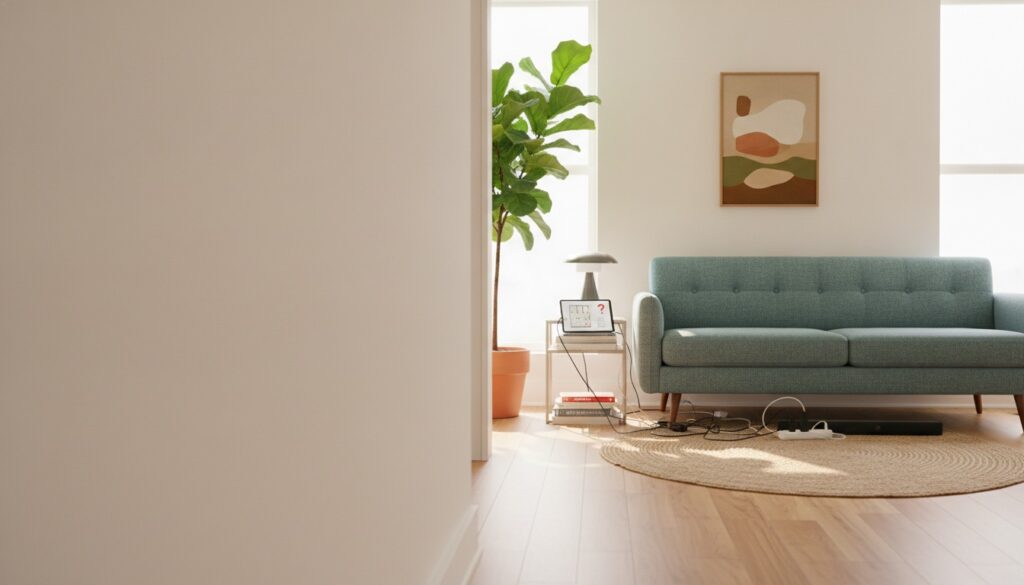
You’ve lugged home a new rug from Baitul Mukarram market, swapped out the curtains, and still, the room feels unsettled. Here’s the other side of it. The truth about interior design problems isn’t just that they exist, it’s that most of them hide in plain sight, in the layout you’ve gotten used to or the lighting you’ve stopped noticing.
In Bangladeshi homes, where floor plans are compact. Humidity eats at everything, these oversights compound fast. Yet, you throw money at another showpiece; let’s untangle why your space isn’t working.
- Interior design problems usually stem from layout, lighting, furniture scale, color drift, and storage gaps, not from lacking expensive pieces.
- Fixing them in a Dhaka flat often means zoning with rugs, sticking to a 3–5 color palette, layering light sources, and choosing scaled-down furniture that breathes.
- Quick, low-cost wins — like swapping bulbs, adding closed storage, and testing paint under monsoon light — can rescue a room without a full remodel.
Key Point
- Most design frustration isn’t about taste; it’s about the room fighting how your family actually lives. That sofa that looked grand in the showroom? It’s now blocking the natural walking path to the verandah.
- Honestly, many homeowners I’ve spoken to in Banani and Uttara say the biggest relief came after they removed a third of their decor, not after they bought more. Negative space is a design tool, not an accident.
- If you tackle only two things, make them lighting and scale. You’ll gain more breathing room than any new furniture can give you.
What Are Interior Design Problems, Really?
It’s hassle-free to think of interior design problems as failed style choices. They run deeper. These are recurring issues in the bones of a room: how light hits surfaces, whether a seating arrangement guides or blocks movement, and whether storage actually clears visual noise. Does it actually matter?
Ultimately, in a standard Dhaka apartment, where the living area is often under 150 square feet. Even a single overstuffed sofa can choke the entire flow.
The most common culprits, according to multiple design practitioners and user feedback from forums, are mismatched furniture scale, monotone lighting, color palettes that clash rather than complement, and the kind of clutter that stores emotions more than items. The solution almost never starts with buying. It starts with editing. Which, as you can guess, is the part most people resist.
How Lighting and Layout Choices Sabotage Even the Best Decor
Setting that to the side, and sure enough, a single ceiling light, the default in so tons of Bangladesh rental flats, is a recipe for a flat, unwelcoming atmosphere even with the best color on the walls. But layered lighting combines ambient, task, and accent sources.
Changes how a room feels minute by minute. One of the clearest warnings from field reports: That grey paint you loved under the shop’s tube light may turn cold and lifeless once the monsoon clouds roll in, because you tested it under only one condition. Actually, I’ve made exactly that mistake myself.
Why does a room with expensive furniture still feel cramped?
Because furniture scale overrides furniture cost every time, so in a Gulshan drawing room, hold on, barely 10 feet wide, a deep European-style sectional leaves less than 18 inches for passage. Those numbers tell a story.
That’s not comfortable walking; it’s a daily squeeze. The fix: choose pieces with visible floor clearance and arms no higher than 30 inches.
They let your eye travel. Creating the illusion of more square footage without you having to knock down a wall.
Can poor lighting actually make paint colors look wrong?
Building on that earlier point, yes, and it’s more common than you think; a light bulb’s color temperature, around 3000K warm or 6000K cool, pushes pigment one direction or another. Under cool daylight LEDs are common in many Bangladeshi new buildings.
A soft beige can turn anemic. That’s why testing your shortlisted colors with actual samples on at least two different walls is non-negotiable. Why does that matter? A single tube light overhead will never tell the whole story.
Storage Nightmares and Clutter: The Endless Battle in Bangladeshi Flats
Clutter doesn’t mean you’re messy. It means your home lacks places to put things that disappear visually. In entryways, shoes pile up because there’s no closed cabinet. In bedrooms, the floor holds bags and extra pillows due to the fact that the wardrobe is bursting.
Open shelving, trendy as it is, often becomes a gallery of dust. And scattered odds and ends that no one curates after the first week.
Closed storage, especially in high-traffic zones. Gives your eyes a rest. That alone makes a room feel bigger.
Why do I still have clutter after buying more storage?
Because storing a lot lets clutter, it doesn’t cure it. You add shelves. Arguably, the real move is to treat negative space as part of the design.
Leave a third of every surface bare. Group small decor in clusters of three, not seven, and avoid lining up picture frames like soldiers.
You probably know someone who has a display cabinet (and that implies quite a bit) full of unused wedding gifts. That’s not storage — that’s a museum.
For those really tight bedrooms. Where every inch counts, you don’t need a full remodel. Simple fixes like picking the right scale bed frame can make pathways feel less like obstacle courses. And if your bedroom feels truly tiny.
The right space-saving furniture can recover square footage you didn’t think you had.
People Also Ask
What’s the first thing I should fix if my room feels off?
Start with the layout. Drag your largest furniture piece away from the wall. And let it float, anchored by a rug. This simple shift alone redefines the entire zone without a single taka spent on new items. It forces the room into conversation areas instead of a furniture showroom line.
How do I choose a color palette that won’t feel mismatched?
Limit yourself to a base color and a secondary tone. And one accent, repeating them across textiles, art. Accessories. Restraint is the glue that ties a room together. And for local context, a lot of Bangladeshi interiors benefit from warmer woods and earthy neutrals that counteract harsh white tube light.
Is an interior designer necessary for small flat problems?
Not pretty much always, but a consultation can save you from expensive trial and error. An experienced eye spots flow bottlenecks instantly. Still, plenty of homeowners handle layout and storage issues themselves with careful measurement and honest editing.
The key is being ruthless about what you roughly 100% use. Which at the root drives the core point. Keep this in mind; it shows up again soon.
Why does my room look smaller at night?
Still, overhead lights cast shadows downward, closing in walls. True enough. Adding a floor lamp behind a sofa. Or a wall sconce at eye level pushes light sideways, making the perimeter recede visually. In Dhaka’s humid evenings.
This trick alone can make a cramped drawing room feel like a retreat.
How often should I repaint interior walls in Bangladesh?
The underlying point remains direct. Still, particularly if they face north or see quite a bit of rain-splash from the balcony, because of humidity and dust, well-maintained walls may need a refresh every 3 to 4 years. But often, just cleaning. Swapping your light bulbs delivers a newer feel without opening a paint tin.
How to Finally Make Your Dhaka Flat Feel Right
There’s no single magic piece, but a sequence of moves that usually works. When I guide a friend through their apartment in Dhanmondi. We always begin by removing every accessory, then adding back only those that earn a place. Suddenly, the room takes a breath.
You’ll notice the furniture itself looks better. And if your wall color feels off, it’s constantly. Because it’s fighting the light, not seeing as you picked wrong. Testing a swatch live for three days, under morning sun.
Tube light costs almost nothing and saves a lot of regret.
- Assess your layout — pull furniture 6 inches away from walls and walk every path; mark where you have to sidestep.
- Define exactly three colors — one for walls, one for large furniture, one for accents — and commit.
- Layer your light — add a floor lamp and a table lamp to any room that relies on a single ceiling fixture.
- Test paint patches — apply 2×2 ft swatches on at least two walls; observe them three times a day before buying full cans.
- Audit your clutter — remove every decorative object and restore only half, keeping surfaces 30% bare.
Most persistent interior design problems boil down to a handful of principles you can control today. Rethink scale, manage light. Treat storage like a curation exercise, not a packing contest. You may not need a professional designer or a bigger flat, so sometimes, just moving the sofa and changing a bulb is enough to make you love walking through your (more on that later) own front door again.

S.M. Rezaul Haque is a seasoned interior design consultant with 15+ years of experience. An AIUB graduate and Senior Vice President of BIDCOA, he specializes in creating functional, sustainable, and visually inspiring spaces. As the driving force behind BD INTERIOR, he has helped shape 700+ Bangladesh’s most innovative interior design projects.