
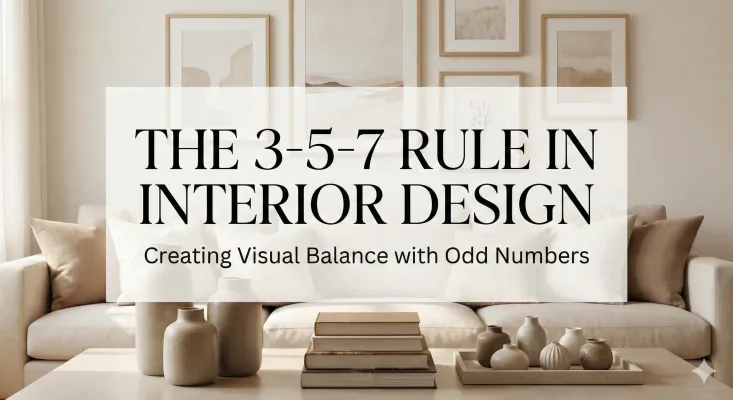
Walk into any well-styled room and something about it just feels right. The shelves look handpicked. The coffee table arrangement draws your eye without feeling cluttered. That invisible logic behind the appeal a lot comes down to a hassle-free styling principle.
It’s a guideline that relies on odd-number groupings to put together visual balance on surfaces.
You don’t need a design degree or an expensive budget to use it. You just need to grasp why odd numbers work and how to arrange items so they feel intentional rather than random.
- The 3-5-7 rule groups items in odd numbers (3, 5, or 7) to create natural-looking visual balance on surfaces like shelves and mantels.
- It works because odd-number arrangements feel more dynamic and less rigid than even-numbered pairs or symmetrical grids.
- Success depends on varying height, texture, and scale within each grouping, not just counting objects.
Table of Contents
- What is the 3-5-7 Rule in Interior Design?
- How the Rule Actually Works
- Where to Apply It and Where to Stop
- Common Mistakes That Defeat the Purpose
- People Also Ask
- Final Thoughts on the 3-5-7 Approach
Key Point
- Odd numbers create rhythm; even numbers create symmetry, and rhythm feels more alive.
- Three large anchors, five medium pieces, and seven small accents form a practical layering system for any flat surface.
- The rule fails fast if all items share the same height or material, because odd count alone can’t fix visual monotony.
- Use it as a starting framework, not a law you can’t break.
What is the 3-5-7 Rule in Interior Design?
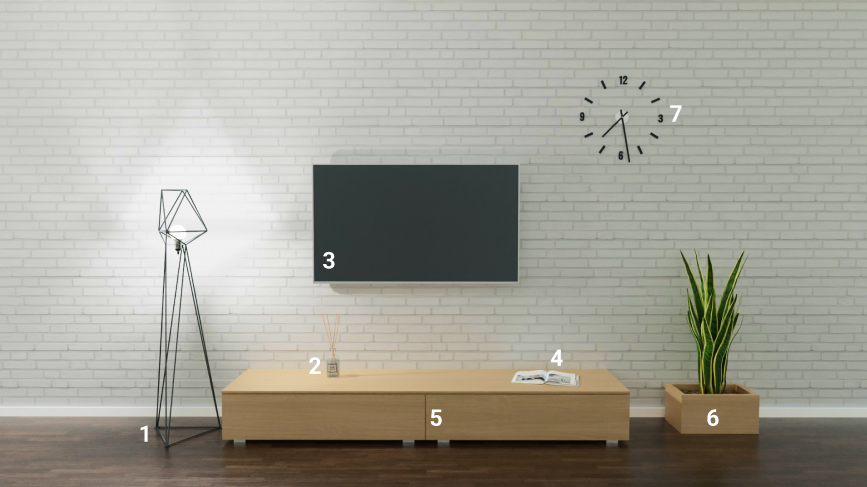
The 3-5-7 rule is a styling guideline that arranges decorative objects in odd-numbered groups of three, five, or seven to make surfaces look balanced and natural.
It builds on the older rule of three. Plus, it says that odd-numbered groupings feel more visually engaging than pairs or even-numbered sets.
Interior designer Jamie Gernert explains the core idea plainly: “The 3-5-7 rule is based, to put it differently, on the idea that odd numbers of objects are more visually engaging and appealing than even-numbered groupings.”
The principle hints that it works a lot on shelves, mantels, coffee tables (which is a make-or-break factor), consoles, and gallery walls. These are surfaces where small clusters of objects can easily look flat or overly stiff. If everything is matched and mirrored. The rule gives you a painless way to pick a direction structure for how to place loads of items together.
Sam Sutherland, a stylist at Flitch, puts it this way: “The idea is that grouping items in odd numbers, three, five or seven, feels more natural to the eye than even numbers.”
Still, zooming out a bit, you’ve probably found that what makes this more than just a counting exercise is the layering concept, so a practical interpretation breaks the numbers into tiers. You use 3 large anchor pieces, 5 medium supporting objects, and 7 small decorative details. This makes depth rather than a flat row of identical items.
Actually, the 3-5-7 numbers aren’t a fixed formula. You must use all three tiers at once.
You might use just three items on a small side table, or five on a longer console. The tiers are a planning tool, not a need.
How the Rule Actually Works
The mechanism behind odd-number styling comes down to how human eyes process visual information.
Building on that earlier point, on the surface, even-number arrangements naturally build symmetry. Which the brain reads that as static and complete, and odd numbers prevent that closure, forcing the eye to keep moving across the arrangement. That movement is what designers call visual rhythm.
Mollie Ranize from Dmar Interiors describes every effect: “The 3-5-7 styling rule is a hassle-free yet great principle that brings visual balance and interest to any arrangement.”
Why do odd numbers feel more natural than even ones?
At a high level, odd-number groupings feel more natural, since they prevent the brain from splitting the arrangement into mirrored halves. When you see two candles, your mind pairs them and stops looking.
When you see three, your eye keeps scanning to find the relationship between all three objects. That sustained attention reads as interesting rather than settled.
How does scale variation actually work in practice?
Within the same grouping, scale variation means mixing tall, medium, and short objects. A stack of books at 4 inches, a vase at 12 inches, and a small sculpture at 6 inches creates a height range that moves the eye up and down.
Not exactly what you’d expect. The odd count does nothing, and if all three items sit at the same height. This detail matters more than it might seem right now.
Sure enough, that’s where an awesome amount of DIY decorators land tripped up. They group five items of similar size and wonder why the arrangement still looks flat. As it turns out, the number matters, but the variation in height, texture, and shape matters more.
According to a 2025 study by Y Ren on intelligent interior design, design effectiveness depends on how elements interact spatially within a room, not just on their precise placement. You could say, and this right away supports why scale variation beats simple counting when applying the 3-5-7 rule.
Where to Apply It and Where to Stop
The 3-5-7 rule shines on specific surfaces where small groupings either sing or fall flat based on arrangement alone.
At a high level, coffee tables, bookshelves, mantels, console tables, sideboards, and gallery walls are the prime candidates.
You’ll want to pay attention here. By most accounts, the majority say the rule makes shelves and tabletops look more selected with seriously little effort. That feedback captures the appeal perfectly.
You don’t need expensive objects. From a practical standpoint, you need better arrangement of what you already own.
Sure enough, look at a coffee table scenario. Start with three items: a tray, a stack of books, and a small plant. Plus, that’s a clean three-piece grouping.
This reflects what I mentioned a while ago: add a candle and a decorative bowl, and you’ve got five. The progression feels natural mainly because each addition fills a visual gap rather than crowding the surface.
Is the 3-5-7 rule worth it for beginners?
For beginners, this rule is without a doubt worth using, but mainly because it eliminates the most common decorating paralysis: not knowing how to put a bunch of items on a surface. Instead of staring at a console table wondering. If two lamps look better than three, you have a structure that answers the question for you.
The rule has limits, which means seriously large spaces need broader composition decisions that go beyond small object groupings.
A 400-square-foot living room with a sectional, a media wall, and floor-to-ceiling windows needs furniture layout planning first, but does that actually hold up? Object styling comes second.
According to a 2019 study by SH Zolfani and P Chatterjee published in Symmetry, selecting appropriate decoration materials remains a big challenge for decorators, and structured evaluation processes improve outcomes. The study used SWARA and BWM comparison techniques to rank lasting design criteria. This supports the idea that simple structures like 3-5-7 give structure to otherwise overwhelming choices.
This reflects what I mentioned a while ago: for more detailed surface-specific guidance, you can explore styling and decor ideas that complement the odd-number approach, and if you’re working with accessories as a beginner, the rule pairs especially well with foundational styling techniques. This detail matters more than it might seem right now.
| Surface | Ideal Count | Key Variation Factor |
|---|---|---|
| Coffee table | 3 or 5 | Height and texture |
| Bookshelf (per shelf) | 3 or 5 | Scale and color |
| Mantel | 3, 5, or 7 | Height and spacing |
| Console table | 3 or 5 | Height and shape |
| Gallery wall | 5 or 7 | Frame size and spacing |
Visual Impact by Grouping Size (Perceived Dynamism Score)
Common Mistakes That Defeat the Purpose
The biggest mistake is treating the rule as a law instead of a guideline. When every surface in a room uses the same 3-5-7 pattern, the space starts to feel formulaic and predictable. Variety in approach matters as much as variety in objects.
Here’s something to consider: a second common error is grouping items that are too similar in size, shape, or material. Five identical ceramic pots in a row still look static, regardless of the odd count. The variation in scale, height, texture, and spacing is what makes the odd-number principle actually work.
Third mistake: forcing odd numbers where symmetry works better, which means some spaces genuinely call for pairs. Two nightstands with matching lamps flanking a bed is a classic proof. Where symmetry build a calming, intentional feel. But breaking that to force a third item would look forced.
According to a 2026 study by Z Wang and L Wang on low-carbon interior design, the heterogeneity built into interior design problems means that different game plans influence performance in ways that call for Consider this, approaches.
Kind of surprising, right? The research applied multi-goal particle swarm optimization to show that design choices interact in complex, non-linear ways. For the 3-5-7 rule, what that means is context, room size, and existing decor all affect whether a specific grouping succeeds or falls flat.
At a high level, building on that earlier point. When working on living room layouts that incorporate the 3-5-7 approach, remember that furniture placement should come before object styling. The rule works on surfaces, not on floor plans.
People Also Ask
Can I use the 3-5-7 rule on a small budget?
Yes, the rule works across all budgets. Because it focuses on arrangement, not on the cost of individual pieces. From a practical standpoint, five well-placed thrift-store finds can look just as polished as five expensive objects, mainly. Because visual balance comes from how items relate to each other. The rule actually shines brightest with inexpensive objects. Because thoughtful grouping makes cheap pieces look intentional.
Does the 3-5-7 rule work for gallery walls?
Under normal conditions, gallery walls are one of the best applications for this rule. Probably vary the frame sizes, spacing, and orientations to pick up the most from the effect. Keep the largest pieces toward the center-bottom for visual anchoring.
Should every surface in a room follow the 3-5-7 rule?
No, and this is a trap quite a bit of DIY decorators fall into. If every shelf, table, and windowsill draws on the same odd-number pattern, the room feels repetitive and staged. Mix approaches. Plus, some surfaces can use pairs for calm symmetry. While others use odd numbers for energy.
What is the difference between the rule of three and the 3-5-7 rule in interior design?
The rule of three is the original principle, stating that groupings of three feel more natural than pairs. The 3-5-7 rule expands that concept to include larger groupings of five and seven, giving you more flexibility for longer surfaces and bigger arrangements. The core principle stays the same: asymmetry with balance.
According to a 2023 study by CM Putri, JM Argilés-Bosch, and D Ravenda, ambiguous and conflicting regulations create confusion when applied without contextual adaptation. While this research focuses on governance, the parallel holds: rules only work. It could go either way when practitioners grasp their intent rather than applying them mechanically.
The 3-5-7 rule succeeds when you grasp the behind-the-scenes principle of asymmetrical balance.
- Gather your objects, Collect all decorative items from the target surface and sort them by size, height, and texture before deciding on groupings.
- Choose your count, Select 3, 5, or 7 items based on the surface size, keeping the largest pieces as visual anchors.
- Build height variation, Arrange items so the tallest object sits off-center, with medium and short pieces filling the visual gaps around it.
- Step back and edit, View the arrangement from across the room, then remove any piece that doesn’t add visual value to the grouping.
Final Thoughts on the 3-5-7 Approach
At a high level, the 3-5-7 rule gives homeowners and DIY decorators a practical shortcut for making surfaces look styled without hiring a professional. It works mostly because odd numbers create visual movement, and movement reads as intentional design. But the rule only delivers. When you pair it with variation in height, texture, and scale.
According to a 2023 study by X Dong, X Rui, and C Li on interior ballistic two-phase flow models, classical design and improvement approaches often factor in only narrow performance indexes while missing broader systemic factors. The lesson transfers hands-on to interior styling: fixating on a single variable like object count. While ignoring texture, height, and context produces suboptimal results.
Yet, when someone asks what the 3-5-7 rule in interior design is, the real answer is that it’s a thinking tool, not a formula. Use it as a starting structure. Break it when symmetry serves the space better. And if you’re choosing accent pieces like a living room rug, remember that the rug anchors the room before any object styling begins.
The best decorators treat the 3-5-7 rule the way solid cooks treat recipes. Basically, they learn it, get why it works, then adjust freely based on what’s in front of them. That flexibility is what separates a styled room from a staged one.

S.M. Rezaul Haque is a seasoned interior design consultant with 15+ years of experience. An AIUB graduate and Senior Vice President of BIDCOA, he specializes in creating functional, sustainable, and visually inspiring spaces. As the driving force behind BD INTERIOR, he has helped shape 700+ Bangladesh’s most innovative interior design projects.