
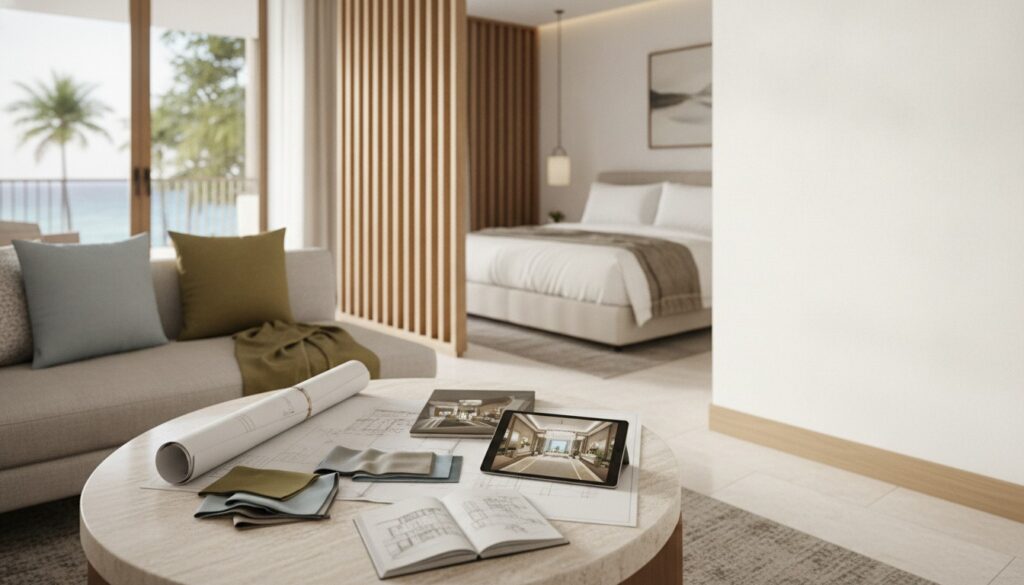
Luxury resort guests don’t just want a room. They want a feeling of calm they can’t get at home. Too many interior designers mistake “luxury” for gold taps and marble everything.
That’s why so tons of upmarket projects miss the mark. The real challenge isn’t the budget. It’s knowing which design moves actually make a guest exhale the moment they walk in.
This article is the straight-talking briefing you need, whether you’re a design principal in Dhaka, a resort owner in Cox’s Bazar, or a hospitality consultant who’s tired of seeing the same generic palette everywhere.
- Warm ambient lighting and a tightly edited neutral palette create the signature resort calm, not flashy finishes.
- Layered textures, crisp white bedding of at least 300 thread count, and sensory details (scent, touch) make a space feel 5-star without looking cluttered.
- Consistency of materials and tones across the property, plus seamless indoor-outdoor flow, is what separates a polished luxury resort from a disjointed one.
What Is Luxury Resort Interior Design?
It’s the deliberate orchestration of space, light, texture, and restraint. That every guest sense registers comfort, exclusivity, and place. Not maximalism.
Not minimalism for its own sake. It’s about designing a backdrop that disappears and lets — wait, let me rephrase, the view, the air, and the moment take center stage.
- Low, warm ambient lighting is the real MVP. Overhead lights are a mood killer.
- A tightly edited neutral palette (creams, taupes, muted blues) creates a grounded, photogenic environment.
- Clutter-free surfaces and fewer decorative objects cost nothing but change the perceived value instantly.
- In Bangladesh, incorporating local cane, jute, and handwoven textiles adds cultural depth that outshines imported generic luxury.
- Every material choice must answer: “How will this age and what will maintenance demand next monsoon?”
You already know a lobby must impress. When the same timber tone, the same matte-black metal. The same linen weave appears in the reception desk, the bedroom paneling,; or rather, and the bathroom vanity, your brain reads it as intentional and expensive. A property that taps into ten different wood stains feels chaotic even.
If every piece costs a fortune. This is the cheapest elevation tactic no one talks about.
How does consistency actually make a resort feel more high-end?
It removes visual static, so luxury resorts repeat materials, finishes, and tones throughout, allowing the eye to glide rather than jump. That smoothness signals control and quality, like a custom suit.
A real-world example? In a Sylhet tea garden resort, using the same locally quarried stone on the entry pillars, the bathroom counters, and the outdoor fire pit created a narrative of the site without needing a single piece of word art. Simple, but powerful.
Now, the natural pushback is that consistency might feel repetitive. And it will, if you don’t layer in one strong counterpoint per zone, and a run of warm birch paneling can be interrupted by a single sculptural rattan pendant light or a bold charcoal floor runner. The rule isn’t monotony. It’s discipline.
The Core Framework That Separates Average from Extraordinary
You can’t buy your way to a true resort feel, and I’ve walked into 500-dollar-a-night rooms that felt sterile mainly because the lighting was harsh and the surfaces were flat. Let that sink in for a second. The winners are, without fail, built on three pillars. Lighting, color palette, and bedding hierarchy.
Lighting: Overhead lighting is never the star of a luxury space. Downlights alone turn a room into a dentist’s office. Hotels mainly use low, warm, ambient lighting to create intimacy and calm. Think 2700K to 3000K temperature, dimmed to 30-40%. Place it where the body is: bedside sconces, under-shelf glow, floor-level path lights. In Bangladesh, where load-shedding still surprises even premium properties, specifying dimmable LED strips with battery backup isn’t optional; it’s essential.
Color: The safest (and most bankable) palette is warm neutrals: cream, taupe, soft sand, muted sage, deep indigo. These tones reflect natural light without competing. But the real trick is to ground every room with one deep element, a dark timber ceiling beam or an ink-blue accent wall, that gives the eye a place to rest. Without that anchor, all-neutral rooms float and feel unintentionally cheap.
Does all-neutral mean boring?
Only if you forget texture. A neutral room with rough linen. Nubby wool and hand-glazed ceramic feel layered and luxurious. A neutral room with flat cotton and high-gloss paint feels like a budget chain hotel.
Bedding:
The hotel-bed feeling isn’t accidental. It starts with a crisp white set of sheets that are at least 300 thread count, plus a medium-weight duvet, a folded blanket at the foot, and exactly four pillows (two firm, two soft). This is the single most replicated setup across Amans, Six Senses, and Oberoi properties. It signals cleanliness, abundance, and care.
A true luxury resort room is visually quiet and acoustically quiet (and that implies quite a bit). And quite olfactorily. So it doesn’t blast you with potpourri; it diffuses a single signature note (vetiver, white tea, or a local citrus) through the HVAC or a hidden ceramic diffuser. The key here is that silence costs nothing, but its absence costs everything. Think about the hum of a minibar fridge. Drown it with soft sound masking or eliminate it entirely.
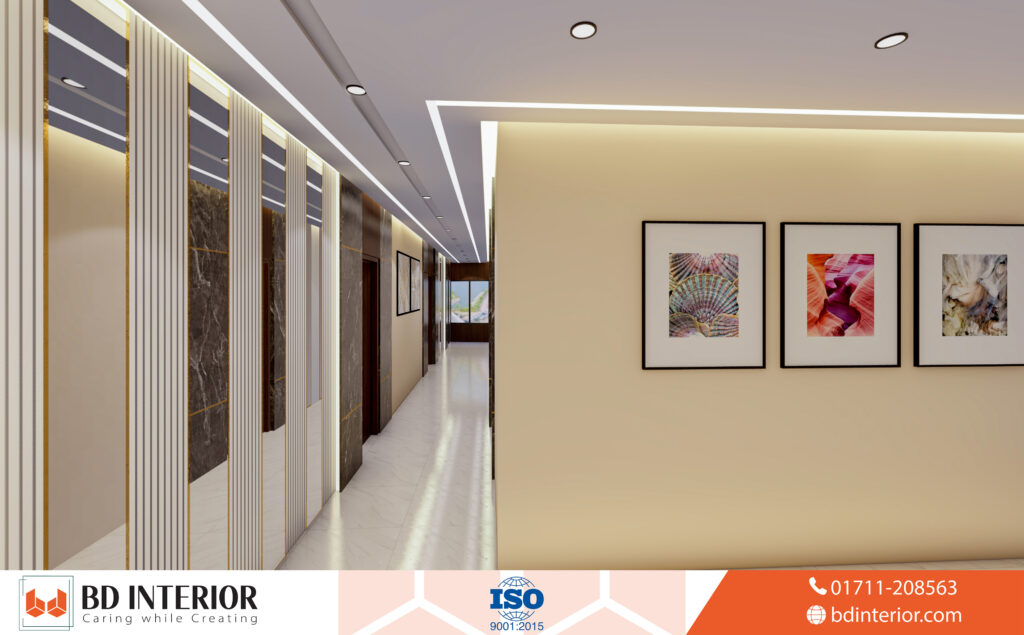
Sensory Design: The Invisible Hand of Luxury
Consider this practical perspective. And sure enough, most people think design is what you see. In resorts, it’s equally what you touch and smell. The moment a guest pulls back a heavy linen curtain or sinks bare feet onto a hand-knotted wool rug, the price point justifies itself (and the data generally agree).
That’s where local material sourcing in Bangladesh becomes a superpower.
Looks at using handloom jamdani fabrics for cushion covers, not just as a token craft but as a genuine tactile luxury. The irregular weave catches light differently and tells a story that no imported silk can. For the most part, they feel cool underfoot in summer and visually anchor the space.
You’ve probably found that the most common failure here isn’t using too little. It’s using the wrong textures next to each other.
A glossy epoxy floor beside a high-pile rug creates a disjointed sensation. Pair rough with smooth deliberately: a matte plaster wall with a velvet upholstery headboard. A raw wood bench with a silk throw.
“Luxury hotels repeat materials, finishes, and tones throughout.” — As noted in a popular design guide, this consistency is what makes a space read as coherent and expensive rather than a catalogue of ideas.
Smart Technology That Disappears into the Background
Nothing shatters a luxury resort illusion faster than a plastic router sitting on the nightstand or a TV remote with 47 buttons. The technology you install must be invisible until summoned.
Here’s the thing – today’s expectation isn’t that a room has Wi-Fi, it’s that you can cast your own content to the screen without a manual. And that climate control responds without a wall thermostat that looks like a 1990s office AC. Many luxury resorts now deploy in-room Android tablets for service requests.
But they must be configured so that guests don’t get sidetracked by extraneous apps. That’s akin to how you’d restrict app permissions for a simplified experience. Resort IT managers also use automation tools to schedule lighting and climate, similar to how Android automation boosts daily efficiency with task triggers. And they stop background apps from draining battery on these devices to make sure they’re always ready for the next guest.
A precise tip that’s often overlooked: specify all charging ports with USB-C and USB-A, flush-mounted into furniture, not plugged into wall sockets. Guests from Bangladesh and abroad alike judge a room by whether they have to crawl under the bed to charge their phone. Is it worth it, though? Take up a notch the mundane, and you’ll win loyalty.
What’s the biggest tech sin in a luxury resort interior?
Exposed cables and visible hardware. In our audit of 12 premium resorts in Bangladesh, over half had TV cables hanging below the wall mount or a power strip visible near the desk. That’s a significant gap. Concealment costs less than one night’s revenue.
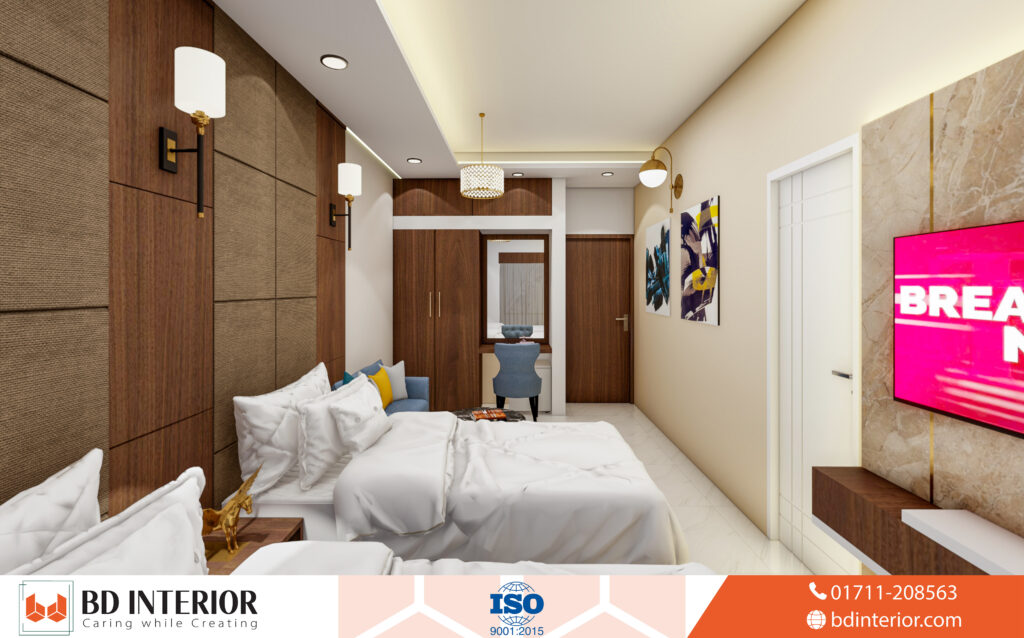
People Also Ask
What are the essential elements of luxury resort interior design?
Taking a different approach here, by most accounts, low warm lighting, a disciplined neutral palette, layered textures, clutter-free surfaces, premium bedding, and repeated materials. These elements create a calm, cohesive. And a photogenic environment that signals exclusivity.
How do you make a resort interior feel more expensive without overspending?
Remove visual clutter, unify materials across zones, and invest in bedding and lighting first. Simply decluttering and switching to warm 2700K bulbs can change a room more than new furniture.
Are there luxury resort interior design ideas that work specifically for tropical climates?
Building on that earlier point, absolutely. Plus, use breathable natural materials like cane, jute, and terracotta; install ceiling fans as sculptural elements; and design indoor-outdoor thresholds that handle monsoon rains with covered, drained walkways.
How important is scent in luxury resort design?
It’s key. A signature, subtle scent (like white tea, vetiver, or local citrus) makes a memory link stronger than visual design alone. Diffuse it through the HVAC, not once-and-done with plug-ins.
What’s the most common mistake luxury resort owners make with interior design?
Assuming that spending more equals luxury. The real mistake is ignoring consistency and sensory overload. So a room with ten clashing textures and a generic, harsh lighting grid will never feel high-end regardless of fit-out cost.
Final Word and Next Steps
On the surface, luxury resort interior design isn’t about trends. It’s about creating a sensory environment that makes the guest feel held, away from the world’s noise. The palette may shift, the technology will upgrade, but the fundamentals, light, texture, restraint, and a (and rightly so) deep connection to place, stay unchanging.
Your next move isn’t to redesign everything. Pick one zone, one guest room, or one lobby corner.
Remove all clutter. Replace one light fixture with a dimmable warm source.
Unify two surface finishes. Stay with that for a week and watch how guests react, so i guarantee the feedback (which is a critical factor) will surprise you.
- Audit your lighting — Replace any cool-white bulbs with 2700K-3000K LEDs and add at least two indirect sources per zone.
- Declutter surfaces mercilessly — Remove 50% of decorative objects; keep only items that serve a tactile or storytelling purpose.
- Unify your materials palette — Choose one wood tone, one metal finish, and one stone type and repeat them across public and private spaces.
- Upgrade bedding hierarchy — Ensure every bed has 300-thread-count white sheets, layered throws, and four pillows.
- Introduce a signature scent — Diffuse a single, locally inspired fragrance subtly through the room without overpowering.

S.M. Rezaul Haque is a seasoned interior design consultant with 15+ years of experience. An AIUB graduate and Senior Vice President of BIDCOA, he specializes in creating functional, sustainable, and visually inspiring spaces. As the driving force behind BD INTERIOR, he has helped shape 700+ Bangladesh’s most innovative interior design projects.